Ripple Scales Fiat and Stablecoin Rails Across 60+ Markets — Will Its Payments Expansion Impact $XRP Price?
Share
Key Takeaways
Ripple has expanded its payments infrastructure to over 60 markets, integrating fiat currencies and stablecoins into a unified system for cross-border settlements.
The upgraded Ripple Payments platform offers institutions end-to-end services, including custody, FX conversion, and global payouts through blockchain-based rails.
Stablecoin integration introduces new settlement options, which could complement or in some cases compete with XRP’s traditional role as a bridge asset.
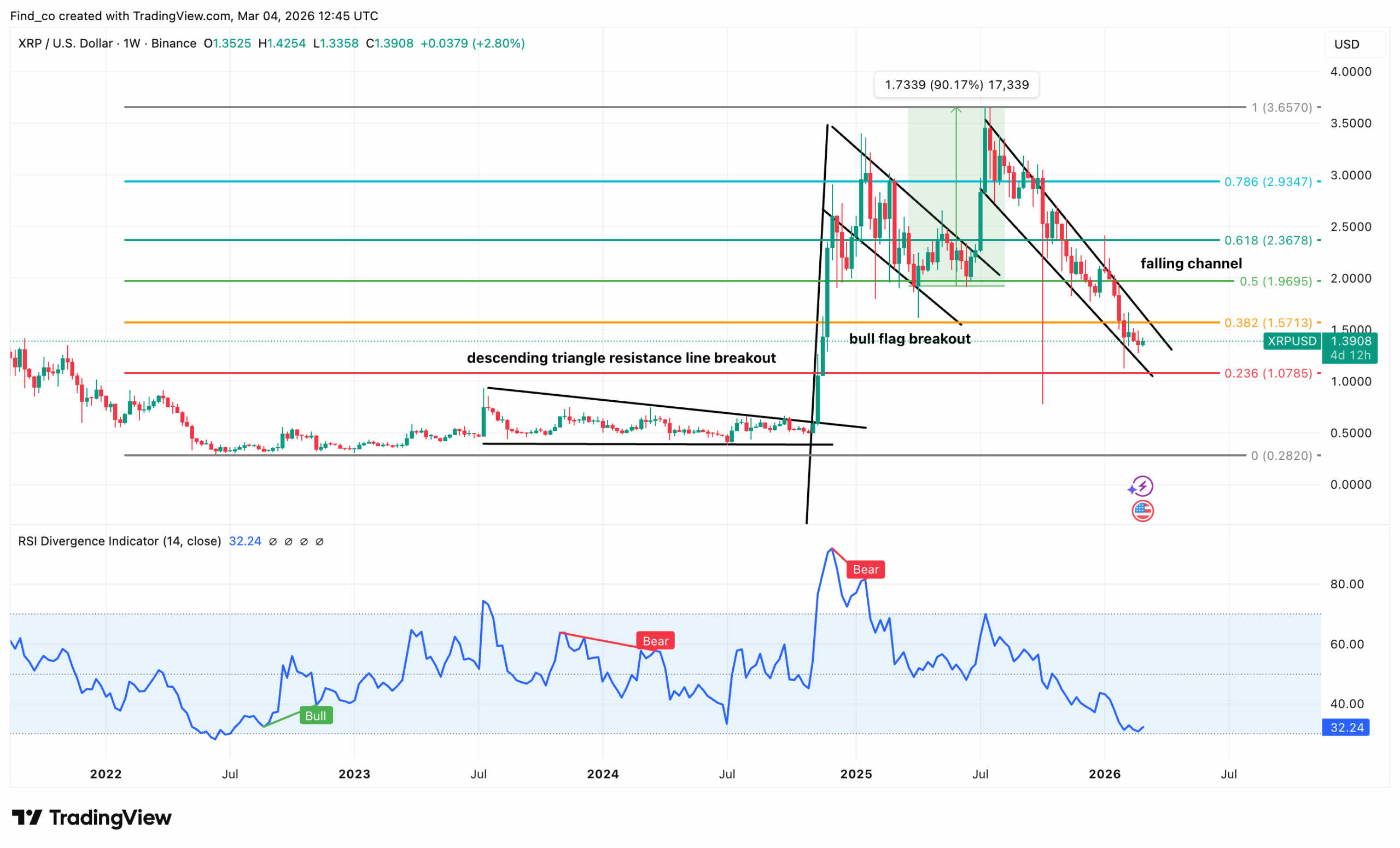
Despite recent price volatility, XRP’s long-term technical structure suggests the current decline may represent a mid-cycle correction rather than a full bear trend.
Ripple is entering a new phase in its strategy to reshape global payments. The blockchain firm recently expanded its Ripple Payments platform into a full-stack infrastructure that combines fiat currencies and stablecoins for cross-border transactions across more than 60 global markets.
The development marks one of the most significant upgrades to Ripple’s enterprise offerings since the launch of its original cross-border payment network.
Ripple Payments now gives businesses everything they need to move money globally across fiat and digital rails in one place: collect, hold, exchange, and pay out in both fiat and stablecoins: https://t.co/pbDNA3Nq9Y
While the expansion highlights growing institutional adoption of blockchain-based financial infrastructure, it has also sparked debate among analysts and traders: will Ripple’s payments growth translate into higher demand for XRP, the network’s native token?
This article examines Ripple’s new payments architecture, expert perspectives, and the potential implications for XRP’s price using both fundamental and technical analysis.
Ripple’s Strategic Expansion into Stablecoin Infrastructure
Ripple’s latest upgrade transforms its payments platform from a cross-border settlement solution into a comprehensive financial infrastructure layer that integrates fiat currencies and stablecoins in a single system.
The platform now enables businesses and financial institutions to:
Collect payments in both fiat currencies and stablecoins
Custody and manage digital assets
Convert currencies through automated FX services
Execute global payouts through integrated payment rails
According to the company, the expanded platform is live in more than 60 markets and has processed over $100 billion in transaction volume since launch.
The upgrade was enabled partly by Ripple’s acquisitions of infrastructure providers Palisade and Rail, which added custody capabilities, treasury automation, and virtual account technology to the ecosystem.
This move positions Ripple as a potential competitor not only to blockchain payment networks but also to traditional systems such as correspondent banking and SWIFT-based settlement.
Institutional Adoption and Global Financial Infrastructure
Ripple’s payments infrastructure is increasingly targeting institutional finance. Banks and fintech firms can now manage multiple parts of the payment lifecycle, from collection to settlement, through a single integration rather than relying on fragmented providers.
Several institutions have already adopted the platform, including:
AMINA Bank (Switzerland)
Banco Genial (Brazil)
Zand Bank (UAE)
AltPayNet (Philippines)
Ripple also claims to hold more than 75 global licenses, including regulatory oversight from the New York Department of Financial Services, enabling it to operate within regulated financial frameworks.
Ripple President Monica Long said financial institutions require infrastructure that treats digital assets with the same rigor as traditional finance.
At the same time, the stablecoin market itself is expected to grow rapidly. Citigroup estimates that global stablecoin supply could reach $3.7 trillion by 2030, suggesting enormous potential demand for on-chain payment infrastructure.
Where XRP Fits Into Ripple’s Payments Ecosystem
Despite the expansion of fiat and stablecoin rails, XRP still plays a role in Ripple’s broader liquidity strategy.
The token was originally designed as a bridge asset to facilitate cross-border transfers between currencies, reducing the need for pre-funded accounts in foreign markets.
This process can settle transactions within seconds, potentially reducing capital costs for financial institutions.
However, the expansion into stablecoins introduces new dynamics. Stablecoins themselves can now act as settlement assets, potentially reducing reliance on XRP in some payment flows.
As observed, while the Ripple Payments network continues to expand and process billions in transactions, XRP’s market price remains volatile. For example, XRP recently traded around $1.36, experiencing a short-term decline amid broader crypto market weakness.
This reflects a broader phenomenon within crypto markets: the separation between network utility and token speculation.
Even when underlying infrastructure adoption grows, token prices may remain driven by macroeconomic conditions, liquidity cycles, and investor sentiment.
XRP Technical Structure Suggests Current Decline Is a Mid-Cycle Pullback
XRP’s long-term structure suggests the current decline may still be part of a broader bullish cycle rather than the start of a new bear market, according to Victor Olanrewaju (Crypto Citizen Network’s analyst).
Historically, XRP’s price spent nearly two years consolidating inside a descending triangle between 2022 and late 2024. That structure eventually resolved with a breakout above the resistance line, which triggered a powerful rally toward the $3.65 region.
The move represented roughly a 90% rally from the breakout zone and confirmed the end of the long accumulation phase.
After that, XRP’s price formed a bull flag in early 2025, which led to another continuation move higher.
However, the market failed to sustain those highs and began forming a falling channel that has guided the correction since the mid-2025 peak.
At the time of writing, the altcoin is trading around $1.39, between the 0.236 Fibonacci support at $1.07 and the 0.382 level at $1.57.
These retracement zones often serve as the final stages of a correction following a major impulse move.
In addition, the RSI on the weekly timeframe has also fallen toward the low-30s, approaching historically oversold territory for XRP.
In previous cycles, when the weekly RSI reached similar levels during corrections, the market eventually entered an accumulation phase before beginning a new surge.
Thus, if XRP’s price continues to hold above the $1.07 support region, the falling channel could eventually resolve with a breakout toward the $1.96 to $2.36 zone, which corresponds to the 0.5 and 0.618 Fibonacci levels.
A sustained move above those levels would signal that the correction has likely ended and that the market could attempt another push toward the previous highs near $3.60.
Bigger Picture: Ripple vs Traditional Payment Rails
Ripple’s broader ambition is to modernize global payments infrastructure.
Traditional cross-border payments rely heavily on correspondent banking networks, which can involve:
Multiple intermediaries
High fees
Settlement delays of several days
Ripple’s blockchain-based approach aims to deliver near-instant settlement and improved capital efficiency.
By integrating fiat currencies, stablecoins, and digital assets into a unified infrastructure, Ripple is positioning itself as a financial operating system for global money movement.
Will Ripple’s Expansion Ultimately Boost XRP Price?
The relationship between Ripple’s infrastructure growth and XRP’s price remains complex.
In the short term, XRP may continue to behave like a typical crypto asset – driven by speculation, market cycles, and macroeconomic conditions.
In the long term, however, several factors could strengthen the token’s value proposition:
Institutional adoption of Ripple’s liquidity solutions
Growth of the global stablecoin market
Regulatory clarity in major financial jurisdictions
Expansion of blockchain-based payment infrastructure
If Ripple succeeds in becoming a key provider of global payment rails, XRP could still benefit from the network’s liquidity ecosystem.
But as the company increasingly integrates stablecoins and fiat rails, the token’s future may depend on how central it remains to the settlement layer of Ripple’s expanding financial network.
What is Ripple’s new payments infrastructure expansion?
Ripple has expanded its Ripple Payments platform to combine fiat currencies and stablecoins into a unified system for cross-border transactions. The infrastructure is now live in more than 60 markets and enables financial institutions to collect payments, manage digital assets, convert currencies through automated FX, and execute global payouts through integrated payment rails.
How does XRP fit into Ripple’s payment ecosystem?
XRP functions as a bridge asset within Ripple’s On-Demand Liquidity (ODL) system. Financial institutions can convert local currency into XRP, transfer it across the blockchain within seconds, and then convert it into the destination currency. This process reduces the need for pre-funded accounts and can improve capital efficiency in cross-border payments.
XRP’s price does not always move in direct correlation with Ripple’s network expansion. While Ripple’s infrastructure adoption continues to grow, XRP’s market value is also influenced by broader crypto market trends, liquidity cycles, macroeconomic factors, and investor sentiment.
Could Ripple’s stablecoin integration reduce XRP’s role?
Ripple’s integration of stablecoins introduces alternative settlement options within its payments network. In some transactions, stablecoins may be used instead of XRP. However, XRP may still play an important role in liquidity provisioning and cross-currency bridging, particularly in markets where stablecoin liquidity is limited.
Disclaimer:
The information provided in this article is for informational purposes only. It is not intended to be, nor should it be construed as, financial advice. We do not make any warranties regarding the completeness, reliability, or accuracy of this information. All investments involve risk, and past performance does not guarantee future results. We recommend consulting a financial advisor before making any investment decisions.
Onkar Singh has three years of experience as a digital finance content creator. Throughout his career, he has collaborated with various DeFi projects and crypto media outlets. In his leisure time, he enjoys fitness activities at the gym and watching movies across different genres. Balancing his professional and personal interests, Onkar continues to contribute to the digital finance landscape while pursuing his hobbies.
Victor Olanrewaju is a crypto analyst and reporter at CCN with deep roots in on-chain research and technical analysis. His crypto journey began in 2017, but it was the 2020 Uniswap airdrop that sparked a full-time pivot into the space.
With a foundation in copywriting, Victor honed his craft creating high-converting content for leading crypto brokers — most notably an XRP price prediction that ranked #1 on Google during the 2021 bull run.
He later joined AMBCrypto in 2022, where he combined storytelling with technical and on-chain analysis to cover key market narratives.
In 2024, he expanded his expertise at BeInCrypto, collaborating with analysts and using tools like Glassnode, Santiment, and IntoTheBlock to break down Bitcoin and altcoin trends.
At CCN, Victor covers the top cryptocurrencies, memecoins, macro shifts, blending real-time insights with deep-dive metrics.
He holds a Bachelor’s degree in Physics from the University of Ibadan, equipping him to simplify complex data for a wide audience. Follow his work or connect on LinkedIn or X.


 Easy
Easy