Regulatory pressure on privacy coins reflects a broader shift toward financial transparency across traditional finance and digital assets. | Credit: Derek Fenech
Share
Key Takeaways
Governments increasingly restrict privacy coins on regulated exchanges, focusing on platforms rather than criminalizing ownership of assets like Monero (XMR) or Zcash (ZEC).
Japan, South Korea, and India introduced direct exchange bans, while several other countries apply stricter anti-money laundering compliance that discourages listings.
European markets show growing caution ahead of the European Union’s Anti-Money Laundering Regulation (AMLR), expected to strengthen transaction traceability rules before 2027.
Privacy coins remain legal to hold in most jurisdictions, but access through licensed exchanges continues to narrow as regulators prioritize transparency in cryptocurrency markets.
Financial anonymity has become one of the most contested battlegrounds in global crypto policy.
Privacy coins such as Monero (XMR) and Zcash (ZEC) continue to test the limits of financial regulation.
These networks use advanced cryptography to conceal wallet addresses, transaction amounts, and transaction histories.
Supporters argue that financial privacy protects civil liberties, business confidentiality, and personal security.
Regulators argue that the same design can shield money laundering, sanctions evasion, ransomware payments, and terrorist financing.
Since 2018, governments across Asia, Europe, North America, and the Middle East have restricted or removed privacy coins from regulated exchanges.
So if I buy Monero and it gets delisted off of Kraken (in the US kraken is the only exchange it’s available on) how do I ever sell? Lol this is what concerns me about XMR and why I find ZEC a much safer alternative given the option to go fully private with Zcash
In most cases, authorities did not criminalize ownership. Instead, they cut access through licensed trading platforms, limiting liquidity and mainstream participation.
As of March 2026, at least 10 countries impose bans or strict exchange restrictions on Monero, Zcash, and similar cryptocurrencies.
This article outlines where restrictions apply, why regulators focus on privacy coins, how exchanges have responded, and how these rules shape access to assets such as Monero and Zcash.
Japan Bans Exchange Listings of Privacy Coins
Japan became one of the first major economies to take direct action against privacy coins after tightening oversight of crypto exchanges.
South Korea Blocks Privacy Coins on Domestic Exchanges
South Korea strengthened crypto oversight under amendments to its Financial Transactions Reporting Act, placing strong emphasis on transaction traceability.
These measures reflect broader regulatory reforms introduced through amendments to the Act on Reporting and Using Specified Financial Transaction Information, which strengthened AML oversight and required virtual asset service providers to register with the Korea Financial Intelligence Unit (KoFIU).
Within this framework, regulators emphasized transaction traceability, which contributed to the removal of privacy coins such as Monero and Zcash from domestic exchanges.
🚨BREAKING: Dubai’s financial regulator has banned privacy tokens across the Dubai International Financial Centre, citing AML and sanctions risks. The updated rules also bar mixers like Tornado Cash. pic.twitter.com/VOUJ5w4bmn
The restriction is zone-specific and does not represent a blanket federal prohibition across the UAE.
United Kingdom Tightens AML Oversight Affecting Privacy Coins
The United Kingdom has not introduced a direct legal ban on privacy coins, but regulatory oversight has made them increasingly difficult to list on licensed platforms.
Regulatory focus: Strict AML supervision for crypto asset service providers.
Exchange impact: Some platforms avoided listing Monero or removed privacy coins to comply with FCA registration requirements.
Legal position: No explicit nationwide ban on owning privacy coins.
The United Kingdom illustrates how strict licensing rules can discourage exchange listings without introducing formal legislation targeting specific cryptocurrencies.
The European Union is developing a unified regulatory framework that could significantly affect privacy coins across member states.
While most current restrictions result from exchange compliance decisions, upcoming legislation may introduce stricter requirements for cryptocurrency platforms operating across the bloc.
Regulatory framework: European Union Anti-Money Laundering Regulation (AMLR).
Policy objective: Increase traceability of cryptocurrency transactions handled by regulated exchanges.
Exchange response: Some platforms have already reviewed or adjusted privacy coin listings to align with anticipated compliance requirements.
Implementation timeline: AMLR enforcement is expected to roll out gradually before full application around 2027.
Several EU countries have already seen exchange-level adjustments as companies prepare for stricter regulatory oversight.
Poland sees exchange adjustments ahead of EU AML reforms
Poland has not introduced a national ban on privacy coins, but exchange activity has briefly affected access for local users as platforms adjust to evolving European compliance expectations.
Market development: Binance announced plans in June 2023 to delist privacy coins for users in Poland and several other European markets.
Regulatory context: The move reflected broader compliance adjustments tied to anti-money laundering expectations within the European Union.
Outcome: The exchange later revised parts of the decision after regulatory clarification.
Poland illustrates how exchange compliance decisions can affect market access even when no national legislation directly targets privacy coins.
Belgium Applies EU Compliance Standards to Privacy Coins
Belgium follows the broader European regulatory framework governing cryptocurrency service providers. Restrictions tied to privacy coins primarily reflect compliance obligations rather than direct legislation targeting these assets.
Regulatory authority: Financial Services and Markets Authority (FSMA).
Policy framework: Oversight aligned with European Union AML directives and registration rules for crypto providers.
Exchange response: Some platforms avoid offering privacy coins because monitoring and reporting requirements can be difficult to meet.
Belgium reflects how regulatory expectations at the European level can influence exchange listing decisions across national markets.
Ireland Takes Cautious Regulatory Approach to Privacy Coins
Ireland has not introduced laws specifically banning privacy coins, but regulatory oversight has influenced exchange behavior.
Regulator involved: Central Bank of Ireland.
Compliance focus: AML supervision for virtual asset service providers operating in the country.
Market effect: Some exchanges limit or avoid listing privacy coins to comply with regulatory requirements.
Ireland demonstrates how regulatory supervision can shape exchange listings even without explicit legislative restrictions on privacy-focused cryptocurrencies.
Privacy Coin Restrictions by Country and Region
Regulatory approaches vary across jurisdictions, but the outcome often looks similar: reduced access to privacy coins on licensed trading platforms.
The table below summarizes the regulatory actions and their practical impact on users.
Monero uses ring signatures, stealth addresses, and confidential transactions to conceal sender, receiver, and amount. Zcash supports shielded transactions via zero-knowledge proofs (ZKPs).
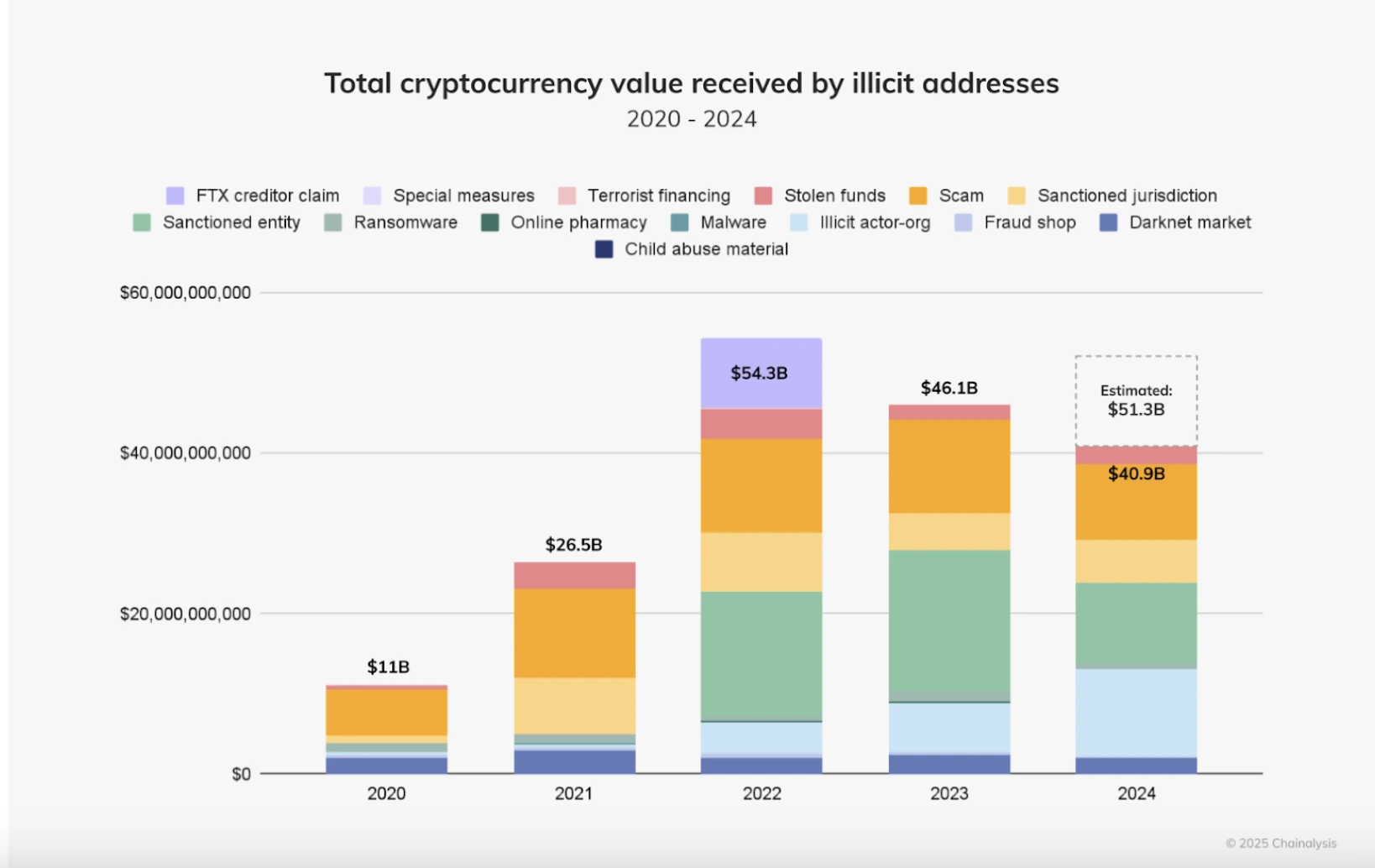
According to Chainalysis 2025 crypto crime data, Bitcoin and stablecoins account for a significantly larger share of total illicit transaction value in absolute terms.
Chainalysis reports that large on-chain services now help illicit actors move and launder cryptocurrency. | Source: Chainalysis.
Privacy coins represent a small percentage of overall market capitalization, yet regulators view their structural anonymity as a compliance obstacle.
The Financial Action Task Force continues to push global implementation of the Travel Rule, which requires exchanges to transmit sender and recipient data for qualifying transfers.
Privacy-focused assets complicate that reporting model.
Future of Privacy Coins Under Global Regulation
Regulatory pressure on privacy coins reflects a broader shift toward financial transparency across traditional finance and digital assets.
Governments increasingly require traceability, identity verification, sanctions screening, transaction reporting, and cross-border information sharing from licensed intermediaries.
At the same time, decentralized exchanges, peer-to-peer transfers, and non-custodial wallets continue operating in many jurisdictions.
Developers also integrate privacy features into broader blockchain ecosystems, including optional privacy layers and advanced cryptographic tools.
Future policy is likely to focus on harmonized global standards rather than widespread criminal bans.
Exchange-level restrictions, stricter licensing regimes, expanded blockchain analytics partnerships, and coordinated international enforcement may define the regulatory landscape through 2027 and beyond.
Privacy coins remain legal to hold in several countries, but regulated access continues to narrow.
The long-term balance between financial anonymity, regulatory oversight, innovation, market integrity, and civil liberties will shape the next phase of digital asset regulation worldwide.
Is it illegal to own Monero or Zcash in a private wallet?
In most countries, including the United States, the United Kingdom, and most of Europe, owning privacy coins is not illegal. Current regulations mainly target cryptocurrency exchanges and other regulated service providers rather than individual holders. However, users may find it more difficult to convert privacy coins into fiat currency or transfer them through regulated platforms.
Can privacy coins still be traded on decentralized exchanges?
Yes, privacy coins can still be traded through decentralized platforms in many cases. Most decentralized exchanges operate as permissionless protocols, meaning they do not directly block transactions. However, some website interfaces, aggregators, or compliance layers may restrict access to certain assets or wallet addresses to meet regulatory requirements.
How are privacy coin gains reported to tax authorities?
Tax authorities generally treat privacy coins the same as other cryptocurrencies. Individuals must track acquisition price, sale price, and transaction dates when reporting capital gains or losses. Because privacy-focused blockchains obscure transaction histories, users may need to maintain their own records, such as exchange statements or transaction logs, to demonstrate cost basis.
Why do regulators often treat Monero differently from Zcash?
Monero transactions are private by default and conceal sender, receiver, and transaction amounts. Zcash offers optional privacy features but also supports transparent addresses similar to Bitcoin. Because transparent transactions can be audited more easily, some regulators view Zcash as easier to monitor than fully private networks.
Disclaimer:
The information provided in this article is for informational purposes only. It is not intended to be, nor should it be construed as, financial advice. We do not make any warranties regarding the completeness, reliability, or accuracy of this information. All investments involve risk, and past performance does not guarantee future results. We recommend consulting a financial advisor before making any investment decisions.
Dr. Lorena Nessi is an award-winning journalist and media technology expert with 15 years of experience in digital culture and communication. Based in Oxfordshire, UK, she combines academic insight with hands-on media practice.
She holds a PhD in Communication, Sociology, and Digital Cultures, and an MA in Globalization, Identity, and Technology.
Lorena has taught at Fairleigh Dickinson University, Nottingham Trent University, and the University of Oxford. She is a former producer for the BBC in London, with additional experience creating television content in Mexico and Japan.
Her research focuses on digital cultures, social media, technology, capitalism, and the societal impact of blockchain innovation.
She has written extensively on digital media and emerging technologies, with her work featured in both academic and media platforms. Her Web3 expertise explores how blockchain technologies shape culture, economics, and decentralized systems.
Outside of work, Lorena enjoys reading science fiction, playing strategic board games, traveling, and chasing adventures that get her heart racing. A perfect day ends with a relaxing spa and a good family meal.


 Easy
Easy