JPMorgan launches MONY, a tokenized U.S. Treasury fund on Ethereum with daily yield, instant settlement and 24/7 trading, signaling on-chain finance at scale. | Credit: CCN.com
Share
Key Takeaways
The My OnChain Net Yield Fund (MONY) went live in December, marking a major milestone in JPMorgan’s on-chain strategy.
The fund invests in short-term U.S. Treasuries while offering on-chain benefits, including daily dividends, instant settlement, and 24/7 trading.
By deploying MONY on Ethereum via its Kinexys platform, JPMorgan signals growing confidence in public blockchains for regulated financial products.
With over $100 million in AUM at launch and tokenized funds on Ethereum exceeding $10 billion, on-chain asset management is entering a scaling phase.
JPMorgan has taken another major step in bringing traditional finance on-chain. On Dec. 15, 2025, the bank launched the My OnChain Net Yield Fund, or MONY, its first tokenized yield fund deployed on the Ethereum blockchain. Designed for institutional and qualified investors, MONY represents a significant milestone in the convergence of regulated financial products and public blockchain infrastructure.
At its core, MONY is a tokenized money market-style fund that invests in short-term U.S. Treasuries, one of the most conservative and widely used instruments in global finance.
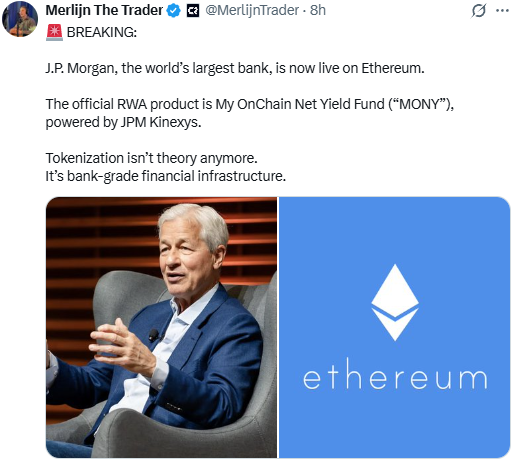
BREAKING: J.P. Morgan, the world's largest bank, is now live on Ethereum
But unlike traditional money market funds, MONY is issued, settled, and transacted directly on-chain, offering features that are difficult or impossible to replicate in legacy financial systems.
What Is MONY?
MONY is a tokenized fund that provides exposure to short-term U.S. government debt while delivering yield in a digital, blockchain-native format. Each token represents a proportional claim on the fund’s underlying assets and is priced at $1 per token, mirroring the stable net asset value structure familiar to money market investors.
JPMorgan is now live on Ethereum. | Credit: Merlijn The Trader X profile
As of launch, MONY holds $100.3 million in assets under management and charges a 0.16% management fee, which is competitive with traditional institutional yield products.
Only qualified investors can access it, with a $1 million minimum investment. This reflects both regulatory requirements and the product’s institutional focus.
How Kinexys and Ethereum Power JPMorgan’s Tokenized Yield Strategy
Although MONY lives on the Ethereum blockchain, it is issued and managed through J.P. Morgan’s Kinexys platform, the bank’s blockchain-based infrastructure for digital assets, payments, and tokenized financial instruments.
JPMorgan chose Ethereum not for experimentation, but for its maturity. As the most widely adopted smart contract blockchain, Ethereum offers:
By using a public blockchain rather than a closed or permissioned ledger, JPMorgan signals confidence that open networks can meet institutional requirements for reliability, transparency, and scalability when combined with appropriate compliance controls.
Why Tokenized Yield Matters
Traditional yield products, such as money market funds, are operationally complex. They rely on custodians, transfer agents, clearinghouses, and batch-based settlement systems that can introduce delays, costs, and counterparty risk.
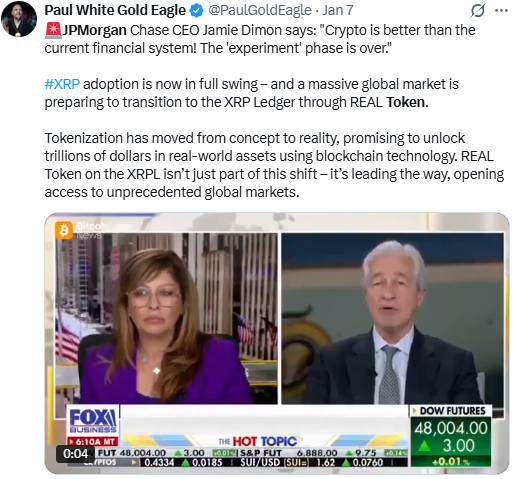
Jamie Dimon recently changed his narrative on crypto. | Credit: Paul White Gold Eagle X profile
Tokenized funds like MONY streamline this process by placing ownership, settlement, and recordkeeping directly on-chain. This creates several advantages:
Instant settlement: Transactions settle in real time, reducing liquidity risk and freeing up capital that would otherwise be locked during clearing periods.
Continuous availability: Investors can subscribe, redeem, or transfer holdings 24/7, regardless of market hours or geographic location.
Programmability: On-chain funds can be integrated into broader financial workflows, such as collateral management, automated treasury operations, or composable DeFi strategies, within regulatory limits.
Ethereum’s Tokenized Fund Market Grows as Institutions Scale Adoption
MONY’s launch comes amid rapid growth in the broader tokenized asset market. Tokenized funds on Ethereum now exceed $10 billion in total value, reflecting rising demand from asset managers, banks, and corporates seeking blockchain-based alternatives to legacy infrastructure.
Major financial institutions now focus on how quickly they can deploy tokenization at scale.
Products like MONY demonstrate that blockchain adoption is moving beyond pilots and proofs of concept into live, revenue-generating financial instruments.
John Donohue, JPMorgan’s Head of Global Liquidity, described MONY as “a key step in the future of asset trading,” underscoring the bank’s view that on-chain settlement and tokenized funds will become foundational components of modern financial markets.
Why MONY Is Not DeFi and Why That Matters for Institutions
It is important to distinguish MONY from decentralized finance (DeFi) yield products. While both operate on blockchain rails, MONY is:
Fully regulated.
Issued by a global systemically important bank.
Backed by real-world assets held under traditional custody frameworks.
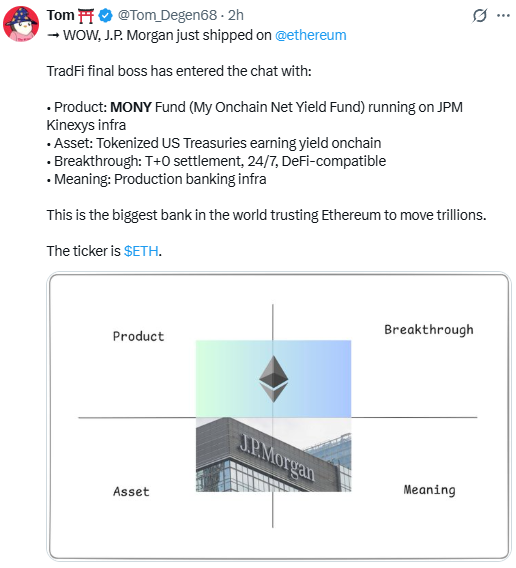
MONY explained. | Credit: Tom Degen X profile
Rather than competing with DeFi, MONY represents a parallel evolution, bringing the efficiencies of blockchain to regulated finance while maintaining institutional-grade risk controls and compliance.
This hybrid model is increasingly attractive to conservative capital allocators who want the benefits of blockchain without the volatility, governance uncertainty, or smart contract risk often associated with permissionless DeFi protocols.
Why MONY Could Be the Blueprint for Future On-Chain Capital Markets
MONY is unlikely to be JPMorgan’s last on-chain fund. Instead, it serves as a blueprint for how other asset classes, corporate bonds, repo markets, structured products, and even equities, could eventually be tokenized and traded natively on blockchain infrastructure.
As tokenized funds continue to scale, the implications are far-reaching:
Faster capital markets
Lower operational costs
Greater transparency
More flexible global access to yield
With MONY now live on Ethereum, the line between traditional finance and on-chain finance continues to blur.
What was once experimental is quickly becoming standard. And JPMorgan’s entry into on-chain yield signals that blockchain-based asset management is no longer a future concept but a present reality.
MONY, short for My OnChain Net Yield Fund, is JPMorgan’s first tokenized yield fund issued on the Ethereum blockchain. It provides on-chain exposure to short-term U.S. Treasuries while offering daily yield, instant settlement, and 24/7 trading.
What does MONY invest in?
MONY invests exclusively in short-term U.S. Treasury securities, making it a low-risk, cash-management–style investment similar in profile to institutional money market funds.
Who can invest in MONY?
The fund is available only to qualified investors, with a minimum investment of $1 million. This reflects regulatory requirements and the fund’s institutional focus.
Why did JPMorgan choose Ethereum?
Ethereum offers the most mature smart contract ecosystem, strong security guarantees, and deep institutional adoption. By deploying MONY on Ethereum, JPMorgan leverages a public, widely supported blockchain while maintaining compliance through its Kinexys platform.
Disclaimer:
The information provided in this article is for informational purposes only. It is not intended to be, nor should it be construed as, financial advice. We do not make any warranties regarding the completeness, reliability, or accuracy of this information. All investments involve risk, and past performance does not guarantee future results. We recommend consulting a financial advisor before making any investment decisions.
Giuseppe Ciccomascolo began his career as an investigative journalist in Italy, where he contributed to both local and national newspapers, focusing on various financial sectors.
Upon relocating to London, he worked as an analyst for Fitch's CapitalStructure and later as a Senior Reporter for Alliance News. In 2017, Giuseppe transitioned to covering cryptocurrency-related news, producing documentaries and articles on Bitcoin and other emerging digital currencies. He also played a pivotal role in establishing the academy for a cryptocurrency exchange website. Crypto remained his primary area of interest throughout his tenure as a writer for ThirdFloor.


 Easy
Easy