Why Grayscale Says Bitcoin’s 30% Volatility Is Normal and New Highs Are Coming.
Share
Key Takeaways
Grayscale says Bitcoin’s recent 30% decline mirrors its long-term average pullback, the ninth correction in this bull market.
While halvings still shape supply, Grayscale argues that institutional flows and macro liquidity now drive prices.
Metrics like high put-option skew, light speculative positioning, and long-dormant coins moving on-chain suggest the market may be stabilizing after capitulation.
potential Fed rate cuts, bipartisan crypto legislation, and expanding ETP adoption could provide the fuel for Bitcoin’s next phase of growth into 2026.
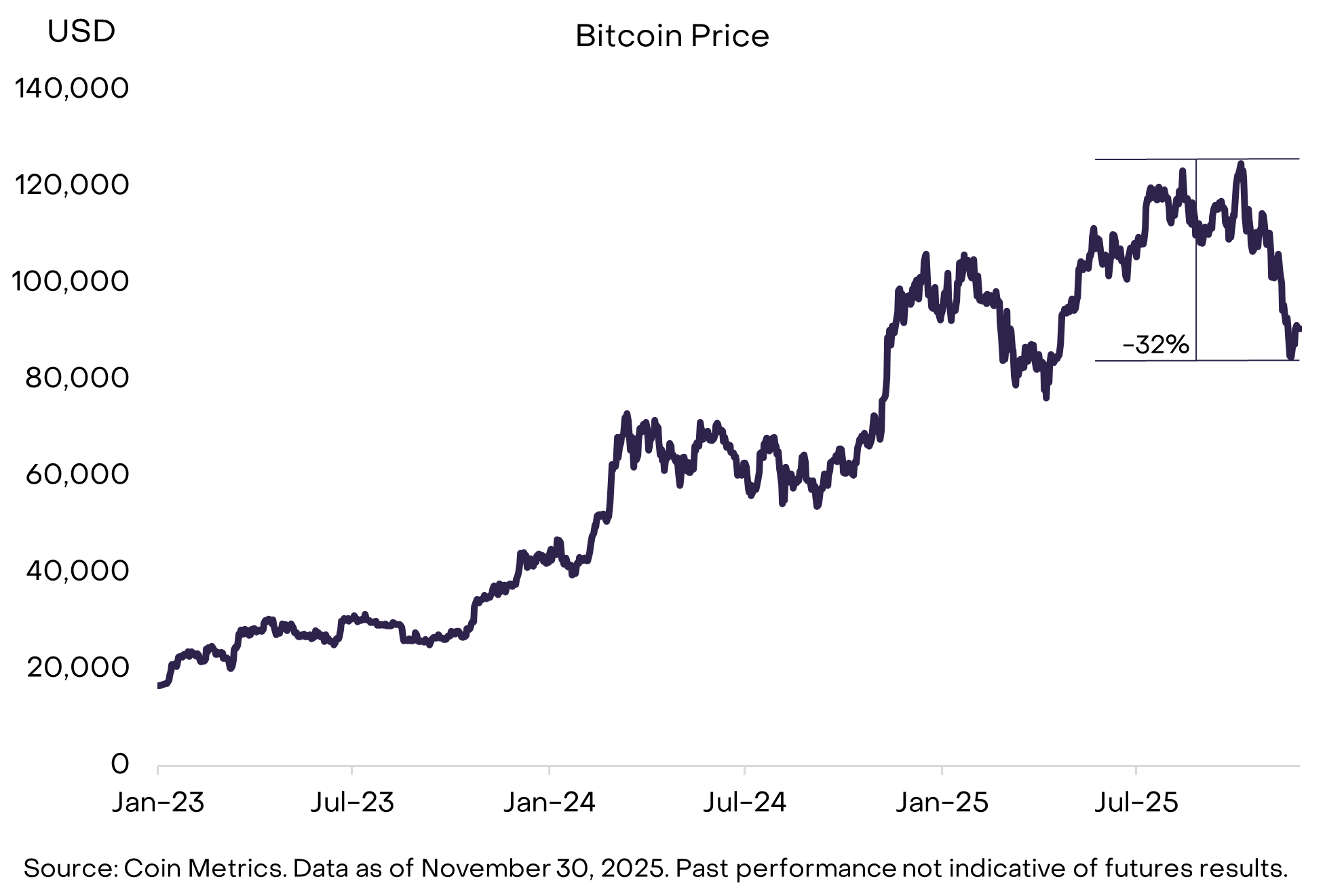
After a year marked by rallies, retracements, and regulatory breakthroughs, Bitcoin investors are ending 2025 with another test of conviction. Since early October, the world’s largest digital asset has shed about 30% of its value, slipping below the $90,000 mark and sparking talk of another downturn.
Bitcoin’s latest pullback consistent with historical average. | Source: Grayscale
But Grayscale’s latest report, “November 2025: What It Takes to HODL,” suggests that the recent pullback is far from a red flag. Instead, the research team frames it as a textbook example of Bitcoin’s normal market rhythm – one that rewards patience and punishes panic.
Here are five of the most surprising insights from Grayscale’s analysis.
1. A 30% Decline in Bitcoin Price Is Business as Usual
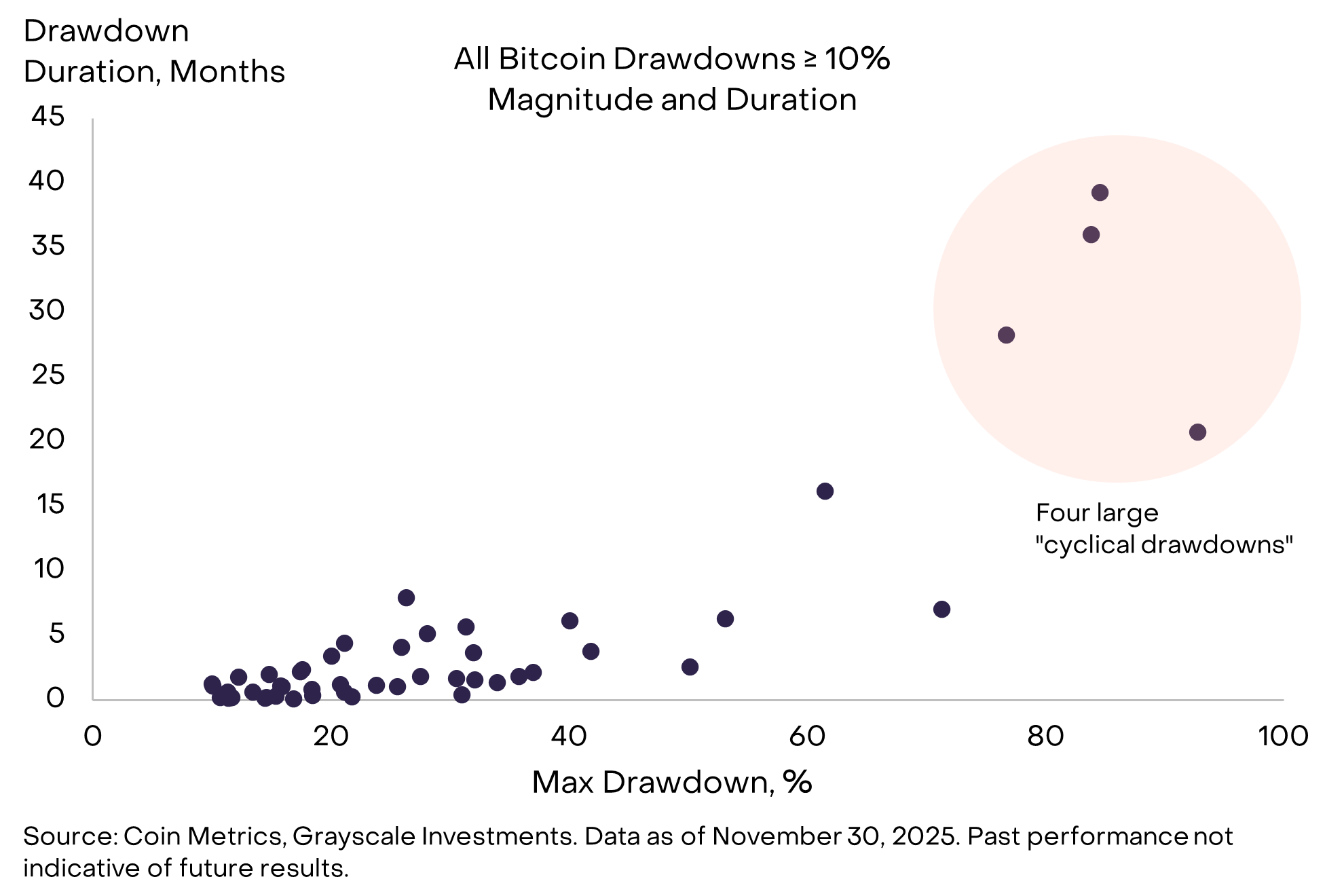
Grayscale’s first message is perhaps the most counterintuitive: the recent correction is entirely within historical norms. The firm’s research shows that since 2010, Bitcoin has experienced more than 50 drawdowns of at least 10%, with an average decline of about 30% from peak to trough.
In the current bull cycle alone, which began after the November 2022 bottom, there have already been nine such corrections. In other words, what many investors view as an alarming fall is statistically a feature of Bitcoin’s behavior during uptrends.
These periodic setbacks, Grayscale says, serve as “pressure valves” that release excess leverage and speculative froth, clearing the way for healthier, more sustainable rallies. For long-term holders, the key is endurance.
2. The “Four-Year Cycle” May Be Over
For more than a decade, Bitcoin’s halving events, scheduled every four years (approx.), have been treated as the heartbeat of the market. Each halving cut new supply, helped trigger parabolic price runs, and was followed by a long, grinding bear market.
Grayscale now challenges that narrative head-on. The firm argues that while Bitcoin’s supply still follows a four-year rhythm, its price no longer has to.
Bitcoin has experienced four large cyclical drawdowns. | Source: Grayscale
Combined with more stable liquidity and broader macro participation, these changes may be decoupling Bitcoin’s price dynamics from the predictable “boom every four years” model. Grayscale’s conclusion is bold – the four-year cycle may finally be fading.
3. Signs of a Market Bottom Are Emerging
Even as prices fell through November, Grayscale sees evidence that Bitcoin may already be carving out a short-term bottom.
The report points to several encouraging indicators: a spike in put-option skew, suggesting that traders have already heavily hedged against further declines, and discounts among major digital asset treasuries, often a sign of light speculative positioning.
At the same time, on-chain metrics show “old coins” moving after long dormancy, reflected in a jump in Coin Days Destroyed (CDD). Historically, similar patterns have marked capitulation phases rather than the start of prolonged declines.
Still, not all data is bullish. Futures open interest has dropped, and ETP flows remained negative until late November. Grayscale suggests that a sustained recovery will become more convincing once these fund flow signals turn positive again.
4. Privacy Coins Quietly Lead the Pack
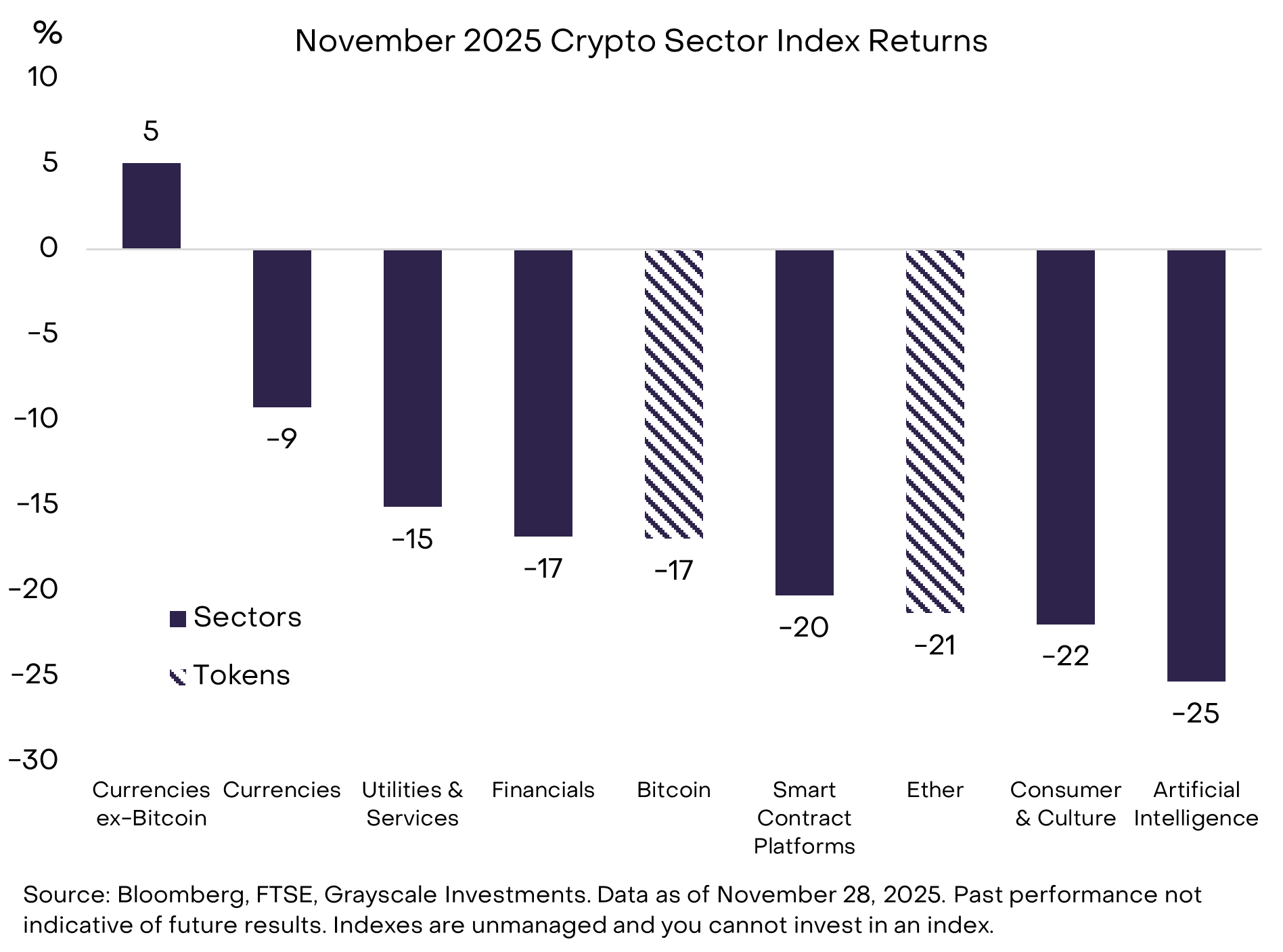
While Bitcoin has taken a breather, a different segment of the crypto market has quietly outperformed. Privacy-focused assets such as Monero (+30%), Decred (+40%), and Zcash (+8%) topped Grayscale’s Currencies Crypto Sector Index in November.
Non-Bitcoin currency assets outperformed in November. | Source: Grayscale
That rally coincided with renewed attention to privacy across the ecosystem. Ethereum co-founder Vitalik Buterin introduced a new privacy framework dubbed Kohaku, while layer-2 project Aztec launched its Ignition Chain, designed to bring zero-knowledge privacy features to Ethereum transactions.
Grayscale has long argued that blockchain adoption cannot reach its full potential without embedded privacy tools. November’s market data, it says, may hint at early signs of that thesis taking root.
5. Macro and Policy Winds Could Turn Favorable
Grayscale’s research also highlights a macro backdrop that could soon tilt in crypto’s favor. With inflation cooling and growth moderating, the Federal Reserve is widely expected to deliver another rate cut in December.
A lower policy rate, the report notes, generally weakens the U.S. dollar and boosts demand for alternative stores of value like gold and increasingly, Bitcoin.
Meanwhile, Washington appears to be finding rare bipartisan footing on crypto regulation. The Senate Agriculture Committee recently advanced a draft bill outlining a new market structure framework. If the issue remains above partisan politics heading into the 2026 midterms, it could unlock a new wave of institutional adoption.
Together, these trends, easier monetary policy and clearer rules of the road, could form the twin pillars of Bitcoin’s next leg higher.
Bottom Line? HODL Still Works
Grayscale’s message to investors is both reassuring and realistic: volatility isn’t going away, but it isn’t a sign of structural weakness either. Bitcoin’s drawdowns, however painful, are the price of admission for long-term gains that have historically averaged 35–75% annually over three to five years.
“Eventually, fundamentals and valuations will converge,” the report concludes. “The most meaningful gains come not from timing the next pullback, but from staying invested through them.”
If Grayscale is right, 2026 could bring a new phase of price discovery – one not dictated by a halving calendar, but by the maturity of a market learning to stand on its own.
What the Critics Still Say About Bitcoin
Despite Grayscale’s optimistic outlook, a number of influential economists and market commentators remain deeply skeptical of Bitcoin’s long-term value. Among them, gold advocate Peter Schiff continues to be one of the loudest critics.
Schiff argues that Bitcoin’s recurring volatility and lack of intrinsic worth make it more akin to a speculative bubble than a monetary revolution. He dismisses the “digital gold” narrative, insisting that true stores of value must have tangible utility and stability, qualities gold possesses but Bitcoin lacks.
In Schiff’s view, each major Bitcoin rally merely sets up the next crash, with the asset’s price driven not by fundamentals but by the hope that new investors will pay more than the last.
From academia, Nobel laureate Eugene Fama, often called the father of modern finance, has expressed similar doubts through the lens of efficient market theory. Fama maintains that Bitcoin fails every classic test of a sound financial asset: it generates no cash flow, pays no dividends, and lacks intrinsic value.
In interviews, he has described Bitcoin as “neither a currency nor an investment,” emphasizing that its extreme price swings make it unsuitable as either a medium of exchange or a store of value.
Without underlying earnings or productive output to anchor its price, Fama argues, Bitcoin’s valuation depends entirely on speculation, a trait that leaves it vulnerable to collapse once enthusiasm fades.
Beyond the Headlines: Valid Concerns or Outdated Frameworks?
Critics like Schiff and Fama raise legitimate questions about valuation, intrinsic worth, and stability – concerns that have shadowed Bitcoin since its creation. Yet proponents argue that these views rely on traditional financial models that may not capture decentralized network value or scarcity coded into the protocol.
Grayscale acknowledges such skepticism indirectly in its report. The firm concedes that Bitcoin remains a volatile asset with “meaningful drawdowns,” but contends that its risk–reward profile reflects its stage of adoption.
As the market structure matures, through regulated ETPs, institutional custody, and clearer legal frameworks, volatility may decline, addressing at least part of the critics’ case.
The Ongoing Debate
For now, the divide remains philosophical as much as financial. Traditional economists demand intrinsic yield or tangible backing; digital-asset advocates see value in decentralized scarcity and network consensus.
The Grayscale report implicitly positions Bitcoin somewhere between the two: an emerging macro asset still finding equilibrium between speculation and store-of-value legitimacy.
Why does Grayscale believe the four-year Bitcoin cycle may be ending?
According to the report, institutional investment, ETP inflows, and broader macro factors now influence Bitcoin more than its halving schedule. These structural shifts could make price cycles longer and less predictable.
How does Grayscale identify signs of a market bottom?
The firm points to elevated put-option hedging, discounted digital asset treasuries (DATs), and rising Coin Days Destroyed, all indicators that speculative excess has been flushed out and long-term holders are repositioning.
Which crypto assets outperformed during Bitcoin’s decline?
Privacy-focused coins like Monero, Decred, and Zcash led November’s gains, supported by renewed attention to privacy frameworks and layer-2 innovations on Ethereum.
What macro factors could benefit Bitcoin in 2026?
Lower interest rates, continued regulatory progress, and the growing market for crypto ETPs, now managing around $145 billion, could boost institutional demand and help propel Bitcoin’s next upward phase.
Disclaimer:
The information provided in this article is for informational purposes only. It is not intended to be, nor should it be construed as, financial advice. We do not make any warranties regarding the completeness, reliability, or accuracy of this information. All investments involve risk, and past performance does not guarantee future results. We recommend consulting a financial advisor before making any investment decisions.
Onkar Singh has three years of experience as a digital finance content creator. Throughout his career, he has collaborated with various DeFi projects and crypto media outlets. In his leisure time, he enjoys fitness activities at the gym and watching movies across different genres. Balancing his professional and personal interests, Onkar continues to contribute to the digital finance landscape while pursuing his hobbies.


 Easy
Easy