Why Eugene Fama Warned Bitcoin Could Become Worthless Within 10 Years — ‘Probability Close to 100%’
Share
Key Takeaways
Nobel laureate Eugene Fama warns that Bitcoin has “a close to 100%” chance of becoming worthless within a decade.
Fama argues Bitcoin fails fundamental monetary principles: its extreme volatility prevents it from functioning as a reliable medium of exchange or store of value.
Other top economists echo similar warnings, including Paul Krugman, Robert Shiller, Nouriel Roubini, Kenneth Rogoff, John Quiggin, Yanis Varoufakis, and Eswar Prasad.
Economists highlight Bitcoin’s limited use as a form of real-world money, noting its minimal adoption for payments compared to its speculative trading volume.
Bitcoin has captivated investors, technologists, and the public for more than a decade, but its extreme volatility continues to alarm many leading economists. Among the most striking warnings came in January 2025, when Nobel Prize–winning economist Eugene Fama declared that Bitcoin carries “a close to 100% probability” of becoming worthless within the next decade.
For a figure often described as the “father of modern finance” to assign near-certainty to Bitcoin’s long-term collapse marked a pivotal moment in the mainstream debate around cryptocurrency.
But Fama is far from alone. His warning aligns with a growing tradition of skepticism among globally recognized economists, including Paul Krugman, Robert Shiller, Kenneth Rogoff, Nouriel Roubini, John Quiggin, Yanis Varoufakis, and Eswar Prasad, who argue that Bitcoin’s structural weaknesses render it financially fragile and potentially destined for failure.
Their critiques, though varied, converge on a core theme: Bitcoin’s long-term value depends almost entirely on belief, not on economic fundamentals.
Below, we unpack Fama’s 2025 prediction, explore the theoretical foundations of his skepticism, and situate his views within the broader context of academic criticism.
Fama’s “Close to 100%” Probability That Bitcoin Price Goes to Zero
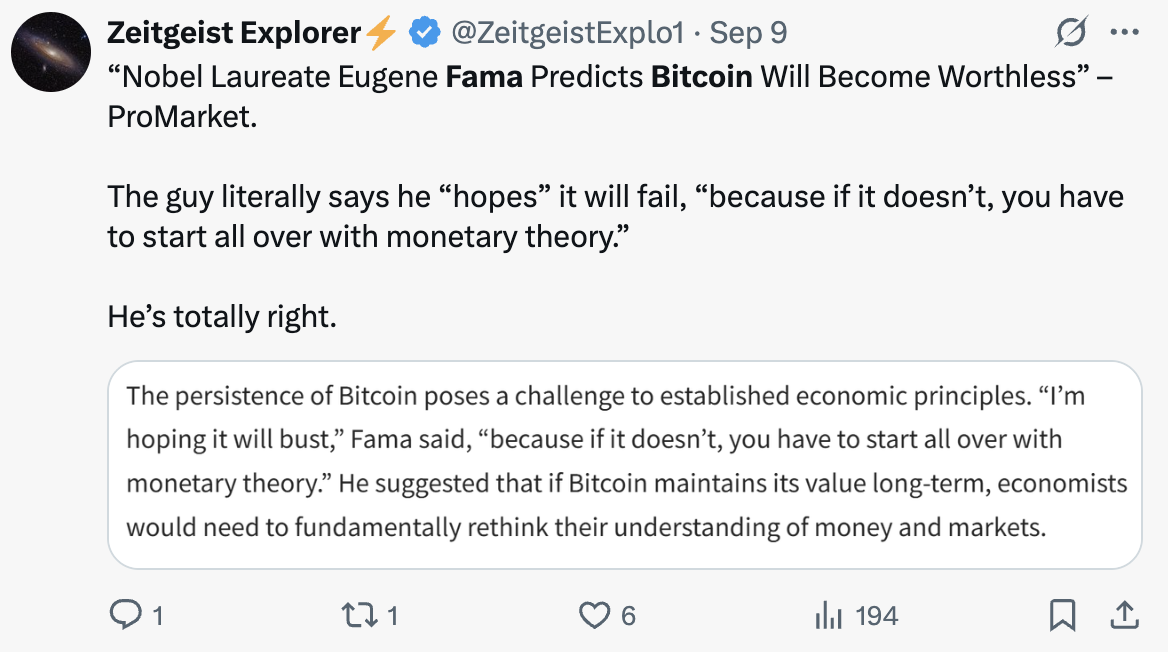
In early 2025, during an interview discussing the future of digital money, Eugene Fama made one of the starkest predictions ever issued by a Nobel laureate. When asked if Bitcoin could crash to zero within ten years, he answered: “I would say it’s close to one.” In probability terms, that means nearly 100%.
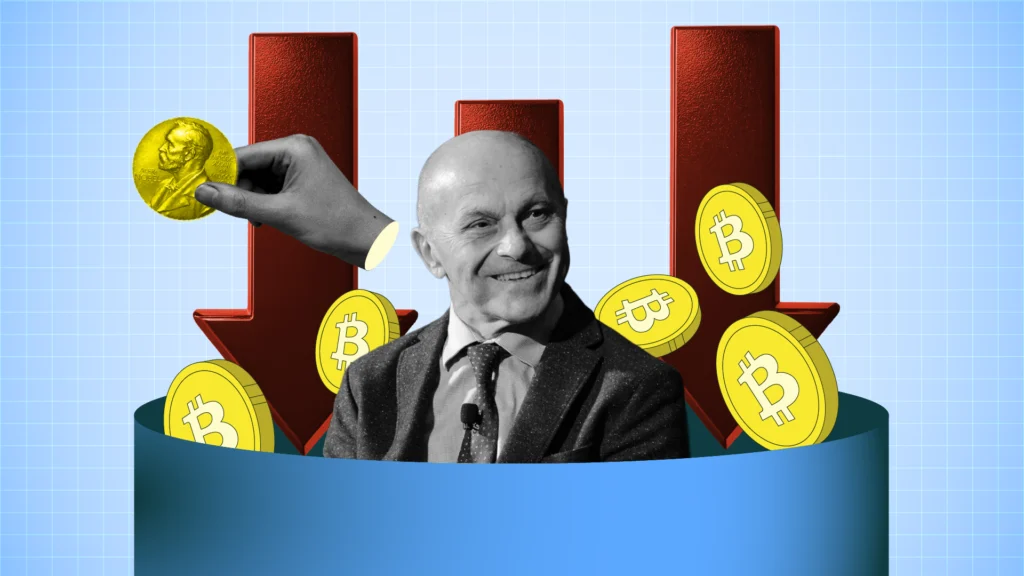
Eugene Fama has always criticized Bitcoin. | Credit: Financial Guru X profile
Fama’s skepticism rests on three key arguments:
1. Bitcoin Violates the Basic Rules of a Medium of Exchange
According to standard monetary theory, a currency must maintain a relatively stable real value to function as a reliable medium of exchange. Fama argues Bitcoin fails this fundamental requirement:
Its price regularly swings by double-digit percentages in days or even hours.
This volatility makes it impractical to price goods, pay wages, or plan production.
A currency that fluctuates more like a tech startup stock than a monetary unit “is not supposed to survive,” he warns.
Bitcoin’s supply is permanently capped at 21 million. Fama agrees with many economists that this design, while appealing to some ideologues, creates severe financial instability. Without flexible supply, price movements depend entirely on shifts in demand, meaning sentiment, hype, and speculation drive value more than economic use.
As economist Luigi Zingales put it to Fama in their conversation, once supply is fixed, price becomes “entirely demand-driven.” For Fama, this makes Bitcoin highly vulnerable to boom-and-bust cycles.
3. Bitcoin’s Technology Is Inefficient and Potentially Corruptible
Fama is skeptical not just of Bitcoin as money but of the blockchain itself:
Mining consumes enormous amounts of energy.
The system could be compromised if malicious actors coordinate the use of massive computing power.
These structural weaknesses undermine the ledger’s reliability.
Fama’s conclusion is blunt: Bitcoin’s long-term value is unsupported by fundamentals, and its current valuation, around $2 trillion at the time of his warning, is “implausible and unsustainable.”
Fama Isn’t Alone: Other Economists Who Say Bitcoin Could Collapse
Fama’s prediction might be the boldest in recent years, but it is far from isolated. Many leading economists have publicly questioned Bitcoin’s long-term viability, citing volatility, speculative dynamics, regulatory risks, energy consumption, and a perceived lack of intrinsic value.
Fama said Bitcoin will become “worthless”. | Credit: Zeitgest Explorer X profile
Here is how Fama’s warning fits into the bigger picture.
It is popular mainly for speculation, tax evasion, or illicit activity.
It generates no income, produces no goods, and has no intrinsic utility.
Krugman describes crypto as a “scandal-ridden, environment-destroying” industry propped up by hype rather than economics. His bottom line is similar to Fama’s: without real utility, Bitcoin’s valuation has no stable foundation.
Robert Shiller: Bitcoin Is a “Classic Bubble” With No Anchor
Another Nobel laureate, Robert Shiller, sees Bitcoin as the purest modern example of a speculative bubble:
Bitcoin’s price, he argues, is driven by contagious narratives rather than fundamentals.
It lacks intrinsic value; its worth depends entirely on collective belief.
Shiller has long warned that Bitcoin could “totally collapse and be forgotten.”
His view reinforces Fama’s central point: value built on belief can evaporate.
Nouriel Roubini: Bitcoin Is “Worthless” and Fails as Money
Economist Nouriel Roubini, famous for predicting the 2008 crisis, takes an even harsher stance. He argues Bitcoin fails on all three functions of money:
Too volatile as a store of value.
Not widely accepted enough to serve as a unit of account.
Too slow, costly, and limited in its ability to serve as a medium of exchange.
Roubini frequently calls Bitcoin “a bubble” and “a pseudo-asset,” echoing Fama’s claim that its design is fundamentally flawed.
Yanis Varoufakis: “The Perfect Tulip Bubble”
Former Greek finance minister Yanis Varoufakis argues Bitcoin’s price is wildly disproportionate to its real economic usage. He sees it as:
A “confidence game” sustained solely by collective belief.
A token representing nothing more than redundant mathematical work.
An asset with no stable floor above zero.
This aligns closely with Fama’s point that Bitcoin’s end state is likely to collapse.
Kenneth Rogoff: Governments Will Not Permit Bitcoin to Thrive
Harvard economist Kenneth Rogoff predicts Bitcoin will eventually be crushed by regulation if it ever becomes systemically important. His framing is simple:
If Bitcoin becomes successful, governments will shut it down.
If it remains niche, it will remain speculative and unstable.
In either scenario, long-term value is doubtful.
Eswar Prasad: A “Greater Fool” Asset With No Intrinsic Value
He, too, sees Bitcoin as an evolutionary dead end in monetary innovation—consistent with Fama’s view.
Adair Turner: Bitcoin Is “A Tulip in 1635”
Former UK financial regulator Adair Turner compares Bitcoin directly to the tulip bubble:
Bitcoin produces no income or utility.
Its price is driven solely by speculation.
It could collapse suddenly if sentiment shifts.
This mirrors Fama’s “eventual zero” prediction.
Peter Schiff: “Bitcoin Has No Future”
Although not an academic economist, Peter Schiff’s commentary reflects similar arguments: Bitcoin is unsuitable as a medium of exchange, inferior to gold, and poised for collapse.
In late 2025, BlackRock’s Bitcoin ETF experienced its largest-ever one-day outflow, forcing the sale of over $500 million in BTC.
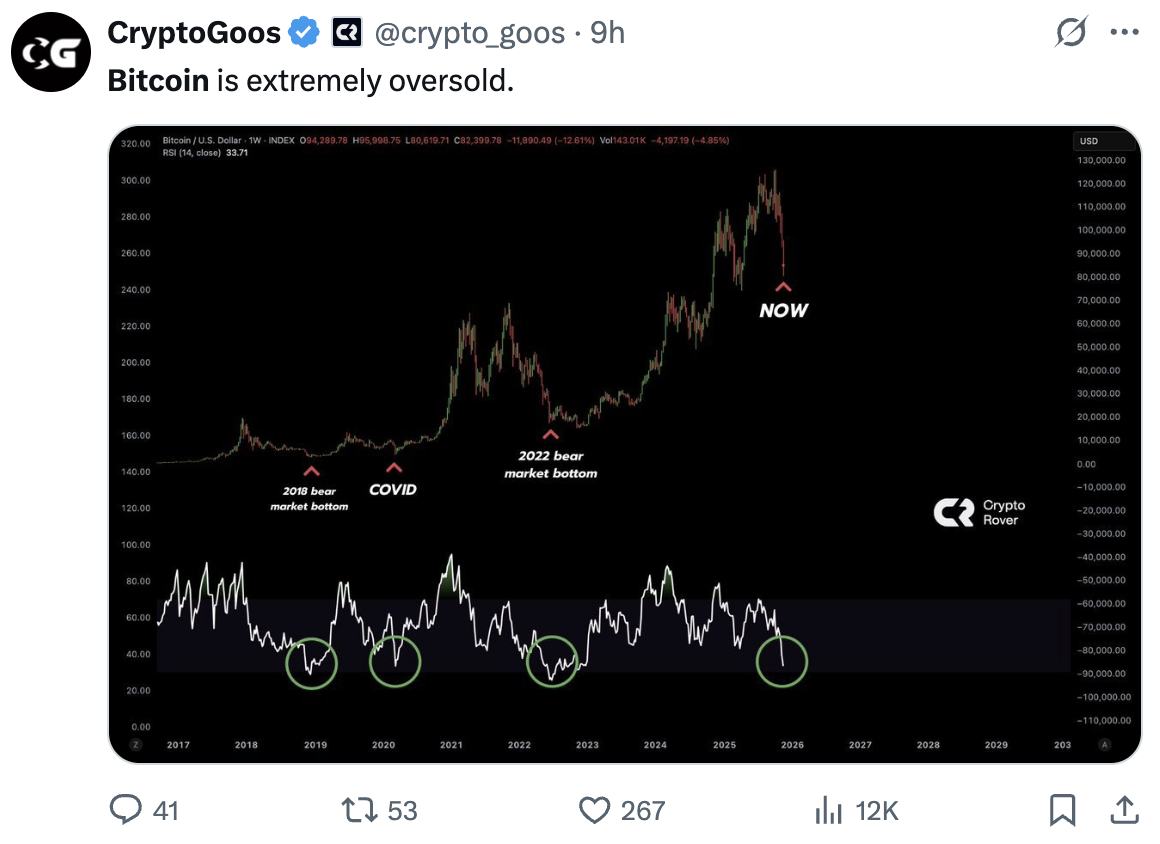
Investors pulled funds amid weakening sentiment and broader market stress. Bitcoin slipped below $83,000 after briefly surpassing $126,000 in October.
Bitcoin is extremely oversold. | Credit: CryptoGoos
These events don’t prove Eugene Fama right, but they do highlight how quickly confidence can crack, even among institutional players.
Fama’s “Worthless Bitcoin” Prediction Captures a Wider Economic Fear
Eugene Fama’s prediction that Bitcoin could become worthless within ten years is extreme, but it reflects genuine concerns among leading economists. Their critiques center on the same structural issues:
Extreme volatility.
Lack of intrinsic value.
Speculative dynamics.
A rigid fixed supply.
Minimal real-world monetary usage.
Environmental cost.
Regulatory fragility.
Reliance on belief rather than fundamentals.
Together, these concerns form a broad and consistent critique: Bitcoin may not be economically sustainable in the long run.
Still, Bitcoin’s supporters argue the opposite, that its decentralization, scarcity, and resistance to censorship make it revolutionary, and that critics have underestimated it for years.
The next decade will reveal which side is right. For now, the world’s most influential economists, including Fama, remain profoundly skeptical, with some assigning the probability of long-term collapse as high as “close to 100%.”
Whether Bitcoin can survive such formidable doubt is one of the defining financial questions of our time.
Eugene Fama stated that Bitcoin has “a close to 100% probability” of becoming worthless within the next decade. He argues that Bitcoin violates basic monetary principles, relies entirely on speculative demand, and lacks economic fundamentals that could sustain long-term value.
Are other economists as skeptical as Fama?
Yes. Nobel Prize winners like Paul Krugman and Robert Shiller, as well as economists like Nouriel Roubini, Kenneth Rogoff, and Eswar Prasad, have long warned that Bitcoin lacks intrinsic value and functions primarily as a speculative asset.
Does Fama dismiss blockchain technology entirely?
Yes. He argues that blockchain is inefficient, energy-intensive, and vulnerable to corruption if enough computing power is coordinated against the network. For him, the technology does not justify Bitcoin’s valuation.
Why do economists focus so much on Bitcoin’s intrinsic value?
In economics, intrinsic value is a foundation for long-term price stability. Assets with no intrinsic value rely heavily on collective belief. Critics argue that because Bitcoin doesn’t generate cash flow or serve essential utility, its price could collapse if sentiment shifts.
Disclaimer:
The information provided in this article is for informational purposes only. It is not intended to be, nor should it be construed as, financial advice. We do not make any warranties regarding the completeness, reliability, or accuracy of this information. All investments involve risk, and past performance does not guarantee future results. We recommend consulting a financial advisor before making any investment decisions.
Giuseppe Ciccomascolo began his career as an investigative journalist in Italy, where he contributed to both local and national newspapers, focusing on various financial sectors.
Upon relocating to London, he worked as an analyst for Fitch's CapitalStructure and later as a Senior Reporter for Alliance News. In 2017, Giuseppe transitioned to covering cryptocurrency-related news, producing documentaries and articles on Bitcoin and other emerging digital currencies. He also played a pivotal role in establishing the academy for a cryptocurrency exchange website. Crypto remained his primary area of interest throughout his tenure as a writer for ThirdFloor.


 Easy
Easy