Bitcoin has seen $1.4B in ETF inflows, yet price momentum remains muted. Here’s why derivatives, ETF mechanics, and macro risks are shaping BTC’s move. | Credit: CCN.com
Share
Key Takeaways
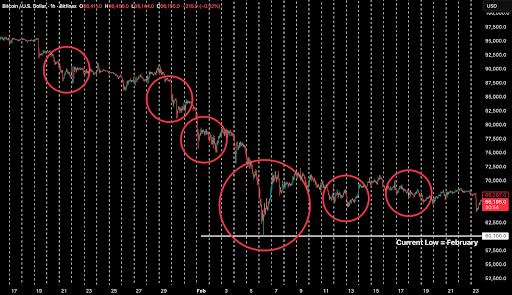
Despite more than $1.4 billion flowing into spot Bitcoin ETFs, BTC has remained largely range-bound around the mid-$60,000 levels.
Authorized Participants (APs) can temporarily short ETF shares and hedge with Bitcoin futures, delaying the actual purchase of BTC in the spot market.
With around $43 billion in Bitcoin futures open interest, leveraged trading, options positioning, and hedging strategies are heavily influencing short-term price movements.
Historically, periods of deleveraging and sideways price action often reset market conditions and set the stage for the next major Bitcoin rally.
Bitcoin has attracted massive institutional inflows in recent weeks, with more than $1.4 billion flowing into U.S. spot Bitcoin ETFs. Under normal circumstances, such demand would be expected to push prices significantly higher.
Yet Bitcoin has largely remained range-bound, hovering around the mid-$60,000 range rather than breaking out to new highs.
For many investors, this disconnect between strong ETF inflows and stagnant price action is confusing. However, several structural and macro factors help explain why the market is not reacting the way many expected.
Here are several key reasons why Bitcoin’s price has remained subdued, and why the bigger bull market may still be ahead.
1. ETF Inflows Don’t Always Translate Into Immediate Bitcoin Buying
One of the most overlooked dynamics in the current market is that ETF inflows do not always translate into immediate spot Bitcoin purchases.
Bitcoin ETFs rely on Authorized Participants (APs), large financial institutions such as market makers and broker-dealers, to create or redeem ETF shares. These participants help ensure that ETF prices closely track Bitcoin’s underlying value.
However, APs can temporarily short ETF shares before acquiring the actual Bitcoin needed to back them.
Under Regulation SHO, APs can short ETF shares without first borrowing them. They often hedge this position by going long Bitcoin futures instead of buying Bitcoin in the spot market immediately.
Bitcoin/USD monthly chart. | Credit: TradingView
In practice, the process works like this:
Investors buy ETF shares
APs supply those shares quickly by shorting them
They hedge exposure using Bitcoin futures
Actual spot Bitcoin purchases may occur later
This creates a timing gap between ETF demand and spot buying, which can make Bitcoin’s price appear to react more slowly, even during periods of strong inflows.
2. Derivatives Markets Are Dominating Price Discovery
Bitcoin’s price is increasingly shaped by derivatives markets rather than spot trading alone.
Today, Bitcoin futures and options markets are extremely large, allowing traders to speculate with leverage or hedge their exposure.
As of early March 2026, Bitcoin futures open interest stands at roughly $43.7 billion, spread across exchanges such as Binance, CME, Bybit, and OKX.
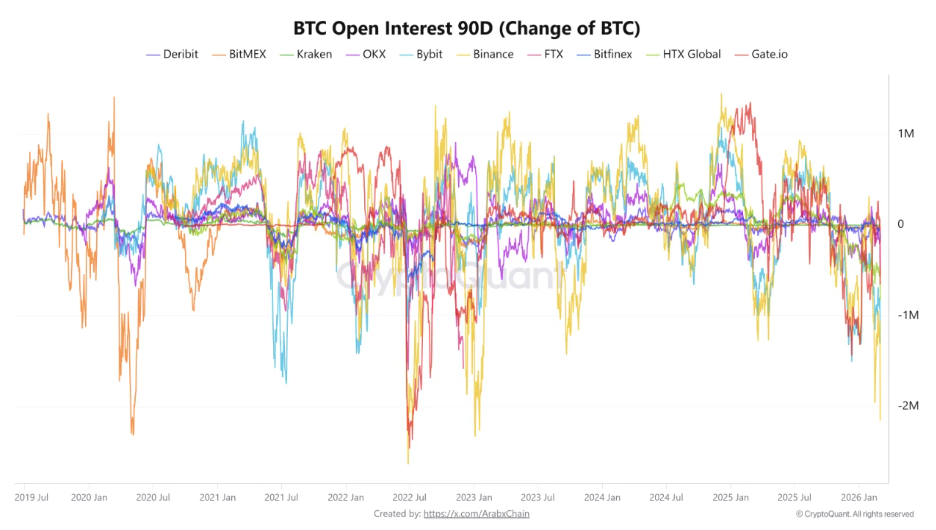
BTC open interest in 90 days. | Credit: CryptoQuant.com
These markets influence price through:
Hedging strategies by institutional traders
Options positioning around specific strike prices
Market makers adjusting exposure ahead of expirations
For example, derivatives data shows significant options positioning around higher price levels, including potential “max pain” zones near $75,000 to $80,000.
These positioning dynamics can keep Bitcoin trading within specific ranges as traders manage risk rather than pushing the price strongly upward.
3. Futures Demand Has Recently Weakened
Even though derivatives markets remain large, recent data indicate widespread deleveraging.
Bitcoin open interest across exchanges has declined significantly over the past 90 days, indicating that many traders are closing positions or reducing leverage.
Major exchanges recorded large reductions in open interest:
Binance: Decline of about 1.045 million BTC
Bybit: Drop of roughly 802,800 BTC
HTX: Decrease of about 456,700 BTC
These reductions suggest the market is currently in a reset phase, with speculative positions being unwound.
While this can suppress price momentum in the short term, historically, such periods often prepare the market for stronger directional moves later.
4. Global Geopolitical Risks Are Weighing on Markets
Bitcoin is also being affected by broader global events.
The escalating Iran conflict has increased geopolitical uncertainty across financial markets. After the assassination of Iran’s Supreme Leader Ayatollah Ali Khamenei, tensions in the region have intensified, raising fears of a prolonged war.
Authorized Participants often engage in basis trading, where they profit from small price differences between spot Bitcoin, ETF shares, and Bitcoin futures.
For example, if ETF shares trade at a premium compared with the underlying Bitcoin value (known as Net Asset Value or NAV), APs may:
Short ETF shares immediately
Hedge exposure with Bitcoin futures
Create new ETF shares later to close the trade
This strategy allows them to capture low-risk arbitrage profits while providing liquidity to the ETF market.
However, it can also delay actual Bitcoin purchases in the spot market, reducing immediate upward price pressure.
Importantly, this activity is not intended to suppress Bitcoin’s price; it simply reflects normal market-making behavior designed to keep ETF prices aligned with their underlying assets.
6. Current Cycle May Only Be a “Quasi Bull Market”
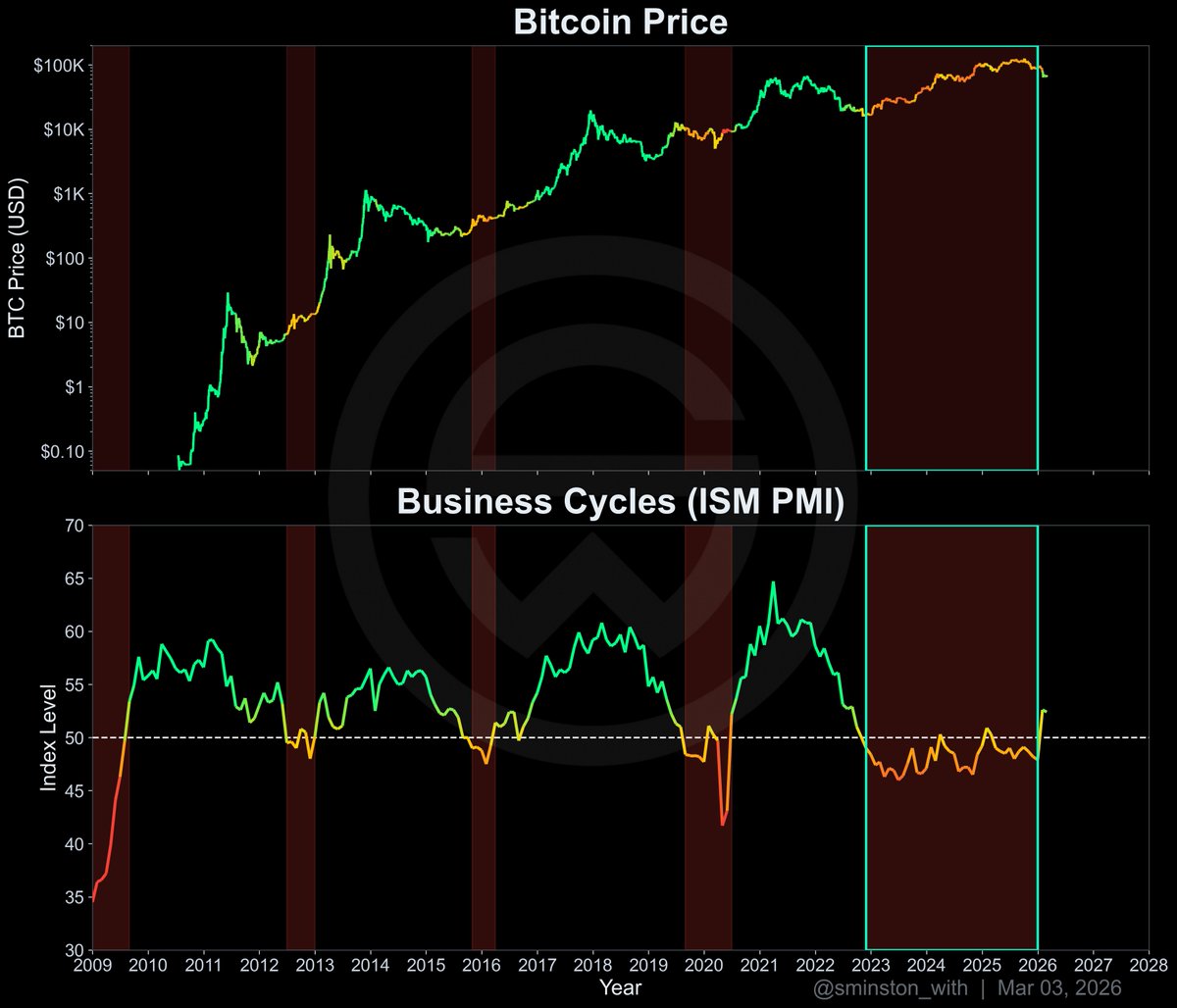
Historically, Bitcoin’s strongest bull runs have occurred during periods when the Purchasing Managers’ Index (PMI), a key indicator of economic activity, remains above 50, signaling substantial economic expansion.
Historically, Bitcoin’s strongest bull runs have occurred during periods when the Purchasing Managers’ Index (PMI). | Credit: Sminston
However, during much of the recent rally, the PMI has remained below 50, indicating weaker macroeconomic conditions.
This has led some analysts to describe the current period as a “quasi bull market.”
The term suggests that Bitcoin has experienced price gains, but those gains occurred within a broader bearish macroeconomic environment.
In this view, the recent rally may represent a prelude rather than the full cycle, meaning the most potent phase of the bull market could still lie ahead.
Bitcoin Price Outlook
Despite the current sideways price action, several indicators suggest Bitcoin may simply be consolidating before its next significant move.
Institutional interest remains strong, ETF inflows continue, and derivatives markets are still highly active.
At the same time, the recent decline in leverage and open interest could help reset market conditions, removing excess speculation and creating a healthier foundation for future growth.
If macroeconomic conditions improve, particularly if global liquidity expands and economic indicators strengthen, Bitcoin could transition from its current quasi bull market phase into a full-scale bull cycle.
If that happens, today’s frustrating price stagnation may ultimately be remembered as the calm before the next major breakout.
Bitcoin ETFs have attracted significant investment, but the inflows do not always translate into immediate spot Bitcoin purchases. Authorized Participants (APs) who create ETF shares may temporarily hedge their exposure using futures rather than buying Bitcoin directly, creating a delay between ETF demand and actual spot market buying.
What role do Authorized Participants (APs) play in Bitcoin ETFs?
Authorized Participants are large financial institutions that help create and redeem ETF shares to keep the ETF price aligned with Bitcoin’s market value. When demand for ETF shares increases, APs can short shares temporarily and hedge using futures before eventually acquiring Bitcoin, which helps maintain liquidity in the market.
How do derivatives markets influence Bitcoin’s price?
Bitcoin’s price is heavily influenced by derivatives markets such as futures and options. With tens of billions of dollars in open interest across exchanges, derivatives trading can dominate price discovery. Large positions, hedging strategies, and options expiration dates can all affect how Bitcoin’s price moves.
What does declining open interest mean for Bitcoin?
Open interest measures the total number of active futures or derivatives positions. A decline in open interest often signals that traders are closing positions and reducing leverage. This “deleveraging” phase can temporarily slow price momentum but often precedes a new trend as the market resets.
Disclaimer:
The information provided in this article is for informational purposes only. It is not intended to be, nor should it be construed as, financial advice. We do not make any warranties regarding the completeness, reliability, or accuracy of this information. All investments involve risk, and past performance does not guarantee future results. We recommend consulting a financial advisor before making any investment decisions.
Giuseppe Ciccomascolo began his career as an investigative journalist in Italy, where he contributed to both local and national newspapers, focusing on various financial sectors.
Upon relocating to London, he worked as an analyst for Fitch's CapitalStructure and later as a Senior Reporter for Alliance News. In 2017, Giuseppe transitioned to covering cryptocurrency-related news, producing documentaries and articles on Bitcoin and other emerging digital currencies. He also played a pivotal role in establishing the academy for a cryptocurrency exchange website. Crypto remained his primary area of interest throughout his tenure as a writer for ThirdFloor.


 Easy
Easy