Bitcoin Crashes Below $80K as Ethereum Loses $2.5K Support — 5 Reasons the Selloff Isn’t Over
Share
Key Takeaways
The recent crypto selloff is being driven by a clear macroeconomic shift. Bitcoin’s decline was triggered primarily by the nomination of Kevin Warsh as Fed Chair, which raised expectations for tighter monetary policy and strengthened the U.S. dollar.
Institutional behavior is now playing a central role. The single-day outflow of $817.9 million from spot Bitcoin ETFs highlights that large investors are actively reducing exposure rather than stepping in as buyers.
Ethereum’s underperformance during the drop is another warning sign. Its sharper decline relative to Bitcoin suggests that overall market risk appetite is deteriorating, especially among altcoins.
Unless Bitcoin can reclaim the $82,000 level and ETF outflows begin to reverse, the current trend remains decisively bearish with further downside still possible.
On January 31, 2026, the crypto market saw one of its sharpest single-day drops in over a year. Bitcoin broke decisively below the $80,000 mark, closing at $78,719.63, its lowest price since November 21, 2025. Ethereum followed suit, collapsing below the $2,500 threshold to end at $2,387.77.
BREAKING: Bitcoin drops below $79,000 and ETH drops below $2,400 as $1.4 billion worth of levered longs are liquidated.
This wasn’t a random, isolated correction. It was a highly synchronized market reaction to structural, macroeconomic, and technical stressors.
For instance, Gold dropped 12.5% in just two days, one of its sharpest recent declines, while Bitcoin fell only 4.3% in the same period, holding in the mid-$80,000s. Despite market volatility, Bitcoin remained more resilient than both gold and the S&P 500, highlighting its relative strength as traditional “safe haven” assets sold off sharply.
On January 30, gold plunged over 8%, while silver saw a staggering 25%+ drop. | Source: @santimentfeed
This article explains five reasons why the downturn may not be finished, and why risks remain elevated in the near term.
1. Warsh Nomination Sparks Macro Shock and De-Risking
On January 30, Kevin Warsh, a former Fed Governor known for advocating tighter monetary policy, was confirmed as the nominee to replace Jerome Powell as U.S. Federal Reserve Chair in May 2026.
Within hours, the U.S. Dollar Index (DXY) surged to 96.93, its highest level in months. Simultaneously, yields on U.S. Treasuries rose, and traders began pricing in fewer interest rate cuts for 2026.
Bitcoin, which had been holding above $82,000, fell sharply the following day as markets adjusted to the prospect of a more hawkish Fed leadership.
Why it matters?
Warsh is perceived as significantly less dovish than Powell. His appointment sent a clear signal to investors that the U.S. may not ease financial conditions as quickly as previously expected.
Warsh as Fed Chair would change how markets hear the same message.
He’s known as an inflation hawk and a strong-dollar voice. Not someone traders associate with easy policy.
So if that person ever leans toward cuts or looser conditions, it lands very differently than when a… pic.twitter.com/5FZkjMkyPS
In a tightening liquidity environment, investors often rotate out of high-risk, high-volatility assets like cryptocurrencies. The shift to “risk-off” affects both retail and institutional allocation models. BTC’s decline is part of a larger macro repricing in response to this Fed transition.
Is the Market Misreading Warsh? A Closer Look at Bond Yields and Rate Expectations
While the surge in the U.S. Dollar Index and sharp declines in precious metals sparked fears that Kevin Warsh’s nomination signaled a more hawkish Fed, not all analysts agree with that interpretation.
“Yesterday’s rise in the Dollar and the big crash in precious metals is fooling many into thinking that markets see Warsh as a hawk. They don’t. Here’s the 2-year yield, which fell steadily after the 6:48 a.m. Truth Social post. Warsh will cut early and hard.”
Despite the dollar rallying on January 30, the 2-year U.S. Treasury yield declined throughout the trading day — a counterintuitive move if markets were pricing in tighter monetary policy.
Typically, if investors expected the incoming Fed Chair to hold rates higher for longer, shorter-term yields would spike. Instead, they fell, suggesting the market may believe Warsh could pivot dovishly, especially in the face of weakening economic data.
It matters because crypto markets, particularly Bitcoin and Ethereum, sold off in response to the assumption of a more hawkish Fed. But if bond markets are correct, and Warsh ultimately moves to ease financial conditions sooner than expected, the current downturn may be an overreaction.
Markets are misreading Kevin Warsh.
He is not an inflation hawk. He is an interventionist hawk.
Warsh opposes QE, forward guidance, and asset-price management, not rate cuts. The Fed can ease at the front end while stepping back from balance-sheet intervention. Today’s… pic.twitter.com/X6wFYS45j7
This divergence between narrative and bond pricing is critical: if the latter proves right, risk assets could stabilize or even rebound once policy clarity emerges.
2. Record ETF Outflows Reveal Institutional Selling
This marked the largest single-day net outflow from BTC ETFs since their introduction. Ether ETFs also experienced significant redemptions that week, showing similar sentiment across institutional crypto exposure.
Bitcoin has dropped -$5,000 in last 4 hours and hit a 9-month low of $78k.. | Source: @BullTheoryio
Why it matters?
ETF flows are one of the most transparent indicators of institutional behavior. Sustained outflows imply that institutions are not just pausing, they’re actively reducing exposure.
Demand for the Bitcoin ETF is reversing, compared to previous years. | Source: @cryptoquant_com
Recent on-chain and market flow data from CryptoQuant reveals a sharp reversal in Bitcoin ETF demand in early 2026, marking the first net outflows year-to-date since spot ETFs were introduced.
Bitcoin ETF YTD Net Flows (by Year):
2024: +17,155 BTC
2025: +39,769 BTC
2026 (YTD): −4,595 BTC
The 2026 figure, negative 4,595 BTC, reflects net redemptions across major ETF products, led by sustained outflows from the U.S.-based funds in January. This pullback follows two consecutive years of aggressive accumulation, particularly in 2025 when net inflows exceeded 39,000 BTC.
Since ETFs became a major price support mechanism during the 2025 bull cycle, their withdrawal now removes one of the pillars holding up the market. Continued outflows can lead to sustained selling pressure.
3. $1.8 Billion Liquidated in 24 Hours as Leverage Unwinds
Over the 24-hour period ending January 31, the crypto market saw forced liquidations of approximately $1.8 billion in long positions:
Bitcoin: $793 million
Ethereum: $478 million
Other altcoins: $500+ million combined
These liquidations followed price breaks below $82,000 and $80,000 for BTC and $2,500 for ETH, major technical support levels.
The general consensus is that people are currently asking the following question: why is Bitcoin experiencing such a rapid and significant decline?
The answer to this question lies in the flow of funds, Please find below a detailed account of the events that transpired:… pic.twitter.com/8nfB6gbftp
This was a textbook long squeeze. As price breached key levels, leveraged traders were forced to sell into declining bids. The liquidation process accelerates drawdowns because positions are closed automatically by exchanges. These aren’t discretionary sales, they’re involuntary, and they pile onto existing weakness. Such cascades often trigger more volatility before stabilizing.
While Bitcoin fell 6.5%, Ethereum dropped 11.76%, underperforming significantly. The ETH/BTC ratio declined to 0.0307, its weakest point in months.
In absolute terms, ETH fell nearly $350 in just 48 hours, from $2,730 to $2,387, and broke through its long-held $2,500 support level.
Why it matters?
ETH is considered a higher-beta proxy for crypto market risk. When it falls faster than Bitcoin, it often means traders are rotating away from altcoins and into cash or stablecoins. This behavior signals not just weakness in ETH, but in the entire altcoin segment.
ETH’s underperformance has historically preceded deeper crypto-wide corrections. It’s also a signal that large players are reducing overall crypto risk exposure.
5. Bitcoin Technical Breakdown and Broader Correlations
Technically, BTC broke below two critical support zones:
$82,000: Held during January as a base
$80,000: A major psychological and technical level
The failure to hold $80,000, a psychological and technical level, has opened the door to deeper retracements. More importantly, Bitcoin no longer trades in isolation. It’s increasingly tied to macro trends and equity markets. When equities drop on macro risk, Bitcoin often follows. This correlation weakens BTC’s narrative as a hedge and makes it vulnerable during traditional market stress.
BitMine’s Massive Ethereum Losses and Stock Collapse: What’s Really Happening
According to recent reports, BitMine holds over 4 million ETH, making it one of the largest corporate holders of Ethereum in the world. At current ETH prices near the mid‑$2,000 range, the market value of those holdings is roughly $10 billion, down significantly from when many of those tokens were acquired at higher prices.
As a result, the company is now facing unrealized losses in the billions of dollars on its Ethereum book — with some observers estimating that the paper loss could exceed $6 billion based on average cost bases of around $3,600–$3,900 per ETH.
Part of the risk arises from how BitMine shifted its business model in 2025. Originally a crypto‑mining hardware company, it pivoted under Lee’s leadership to focus on building a large ETH treasury through ongoing purchases funded by equity and debt. This aggressive accumulation was partly designed to position the firm as a major institutional reserve for Ethereum, betting on long‑term appreciation and staking yield.
However, the sharp downward movement in ETH’s price throughout the latter half of 2025 and early 2026 has left that strategy vulnerable.
The impact on BitMine’s stock (BMNR) has been stark. Shares have collapsed from their mid‑2025 peaks, trading more than 80% below previous highs, a fall that dwarfs even Ethereum’s own price drop.
The scale of this decline reflects how investors are pricing in not just the falling value of the underlying ETH holdings, but also the risks of a concentrated, single‑asset treasury strategy that has little diversification or operating revenue.
“Tom Lee’s BitMine is currently sitting on a $6.9 billion loss on Ethereum. Their stock has dumped 84% and is now at risk of delisting and full liquidation.
The scary part? We haven’t even entered the bear market yet…”
Tom Lee’s BitMine is currently sitting on a $6.9 billion loss on Ethereum. | Source: @CryptoNobler
While the claim of an immediate bear market is speculative, there are real points of stress for BitMine:
Unrealized digital asset losses: Depending on the cost basis used, the value gap between ETH acquisition prices and current market value has grown into the multi‑billion‑dollar range.
Stock valuation collapse: BitMine’s share price has fallen far more sharply than Ethereum itself, indicating that investors see added execution and financial risk. This pricing disconnect suggests market skepticism about the sustainability of the firm’s strategy and potential future revenue.
Concentration risk: BitMine’s exposure is heavily concentrated in ETH, making it vulnerable during prolonged weakness in that single asset.
BREAKING: Tom Lee’s Bitmine $ETH portfolio is now down over $5.5 billion; bankruptcy now expected. pic.twitter.com/6GmroQG26O
These dynamics matter because BitMine’s losses are not merely paper figures on a balance sheet. A company facing such extreme unrealized deficits could be forced to face tough decisions: sell part of its holdings (which could further pressure ETH prices), dilute equity to raise capital, pivot business strategy, or potentially face risks to its stock listing if share prices remain depressed.
As of early 2026, BitMine’s situation stands as a dramatic example of how large, concentrated crypto treasuries can struggle in volatile markets — especially when prices move sharply against their core holdings.
What Crypto Traders and Investors Should Watch Next
1. ETF Flow Direction
Daily ETF flows will show whether institutions continue to de-risk. If net redemptions remain high, price pressure is likely to persist. A reversal into inflows could signal stabilization.
2. Critical Support Zones
BTC: $75,000 and $72,000 are immediate support levels. Breach of these could trigger further selling toward $70,000.
ETH: $2,250 and $2,100 are next downside zones. Only a recovery above $2,500 would negate short-term bearish momentum.
3. Macro Calendar & Fed Signals
Feb 2: U.S. Non-farm Payrolls
Feb 13: U.S. CPI release
Any commentary from Kevin Warsh will be market-moving. If Warsh emphasizes prolonged tightening, crypto will likely remain under pressure.
4. Correlations with Risk Assets
Bitcoin’s behavior is now intertwined with traditional financial markets. Watch the U.S. Dollar Index, Treasury yields, and equity indices. If macro volatility persists, Bitcoin is unlikely to decouple on its own.
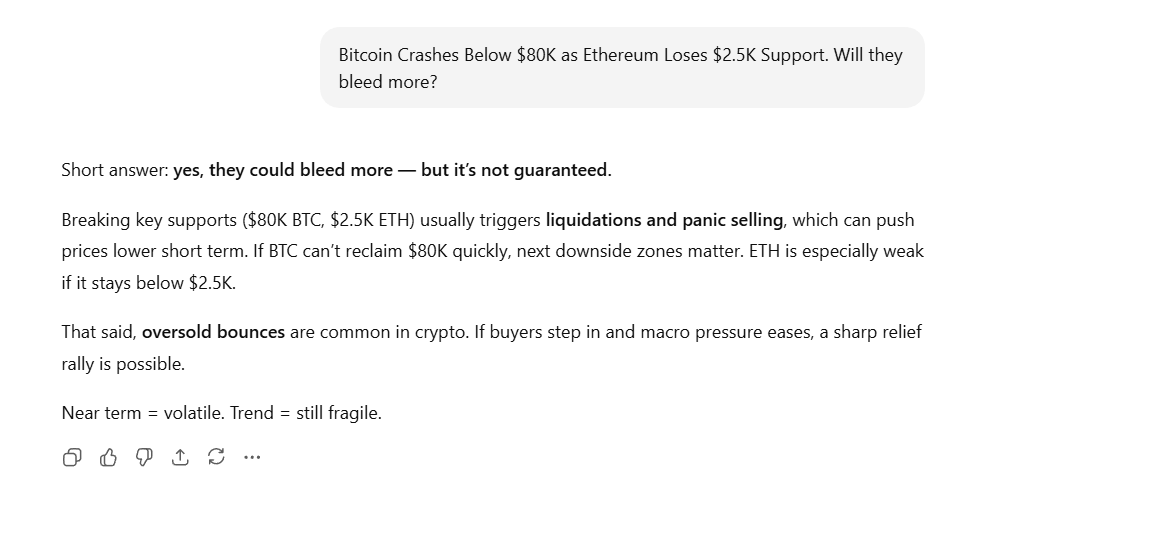
Could Bitcoin and Ethereum Drop Further? Here’s What ChatGPT Thinks
Short answer: Yes, further downside is possible in the short term.
Bitcoin dropping below $80,000 and Ethereum falling under $2,500 has broken key support levels. If these breakdowns continue, it could trigger more liquidations and intensify the selloff, especially with rising macro uncertainty, like hawkish Fed expectations and falling demand for speculative assets.
According to ChatGPT, BTC and ETH could bleed more, but it’s not guaranteed. | Source: ChatGPT Source
Potential Bearish Drivers:
Breach of technical levels invites more downside momentum
Liquidation cascades can deepen declines rapidly
Macro risk (e.g., strong dollar, high rates) discourages crypto appetite
But Don’t Ignore the Bullish Signals:
Crypto markets often bounce sharply after steep selloffs
Long-term holders tend to withstand short-term volatility
Buy-the-dip behavior can quickly reverse bearish momentum
ChatGPT’s Bottom Line:
Right now, the crypto market is clearly under pressure — both Bitcoin and Ethereum have broken major supports. More pain is possible if key levels fail again and panic continues.
However, this doesn’t mean recovery is off the table. Crypto trends can reverse quickly, especially if sentiment shifts, support holds, or fresh demand returns. It’s a highly reactive market and both bulls and bears should stay alert.
Where the Crypto Market Stands Now
The sharp declines in Bitcoin and Ethereum aren’t just technical failures, they’re structurally driven by a convergence of negative factors:
A hawkish shift at the Fed under incoming Chair Kevin Warsh
Tightening correlation with equities during market stress
This makes the current environment fundamentally different from a healthy dip. Until liquidity improves, ETF flows return, and macro pressure eases, the crypto market remains at elevated risk of further downside.
Bitcoin reclaiming $82,000 and Ethereum recovering $2,500 would be the first signs of potential reversal. Until then, traders and investors should remain cautious, closely monitoring macro data, institutional flows, and critical technical levels in the sessions ahead.
Why did Bitcoin drop below $80,000 — wasn’t it holding strong in early January?
Yes, BTC was consolidating above $82K earlier in January. The drop below $80K was triggered by a combination of factors: the nomination of Kevin Warsh as the next Fed Chair (seen as hawkish), a sharp spike in the U.S. dollar, record ETF outflows, and the breakdown of technical support levels. These forces converged in late January, overwhelming prior bullish momentum.
Is Ethereum’s drop below $2,500 more concerning than Bitcoin’s move?
In some ways, yes. ETH fell nearly 12%, almost double BTC’s percentage decline. Ethereum’s underperformance and the drop in the ETH/BTC ratio suggest that investors are reducing exposure to higher-risk assets. Historically, ETH weakness has preceded deeper market corrections in altcoins.
Are institutional investors losing confidence in crypto, or is this temporary?
The $817.9 million in ETF outflows on January 29 shows that institutional sentiment has turned defensive, at least in the short term. It doesn’t mean long-term interest is gone, but in the current macro environment, with tightening liquidity and policy uncertainty, institutions are choosing to reduce exposure rather than “buy the dip.”
What needs to happen for Bitcoin and Ethereum to recover?
Three things:
Macro clarity, especially around U.S. interest rates and Fed direction
Institutional inflows returning via ETFs
Technical recoveries, with BTC reclaiming $82K and ETH closing above $2,500
Without those, risk of continued selling remains high.
Disclaimer:
The information provided in this article is for informational purposes only. It is not intended to be, nor should it be construed as, financial advice. We do not make any warranties regarding the completeness, reliability, or accuracy of this information. All investments involve risk, and past performance does not guarantee future results. We recommend consulting a financial advisor before making any investment decisions.
Onkar Singh has three years of experience as a digital finance content creator. Throughout his career, he has collaborated with various DeFi projects and crypto media outlets. In his leisure time, he enjoys fitness activities at the gym and watching movies across different genres. Balancing his professional and personal interests, Onkar continues to contribute to the digital finance landscape while pursuing his hobbies.


 Easy
Easy