Home / Analysis / Crypto / Technical Analysis / Crude Oil Prices Rise Above $70 per Barrel, but $USOR Crashes 15%: Has the Solana-Based Token Failed the ‘War’ Test?
Here is why USOR's price is unlikely to rise alongside physical oil prices | Credit: CCN.com
Share
Key Takeaways
Physical crude oil prices have decoupled from the USOR token, with Brent crude surging to $82.37.
USOR collapsed 15%, as reports debunked its alleged backing by the U.S. Strategic Petroleum Reserve.
USOR’s price is trapped in a sustained downtrend, hovering above weak Fib support at $0.0047.
A stark decoupling has formed between the real-world energy market and the speculative crypto token designed to represent oil exposure.
Over the past 72 hours, physical crude oil has experienced explosive volatility and price increases. However, the Solana-native $USOR token has moved in the opposite direction.
Specifically, it has collapsed by 15% despite the geopolitical tensions. The catalyst, according to CCN’s findings in the physical markets, was a dramatic escalation in tensions in the Middle East.
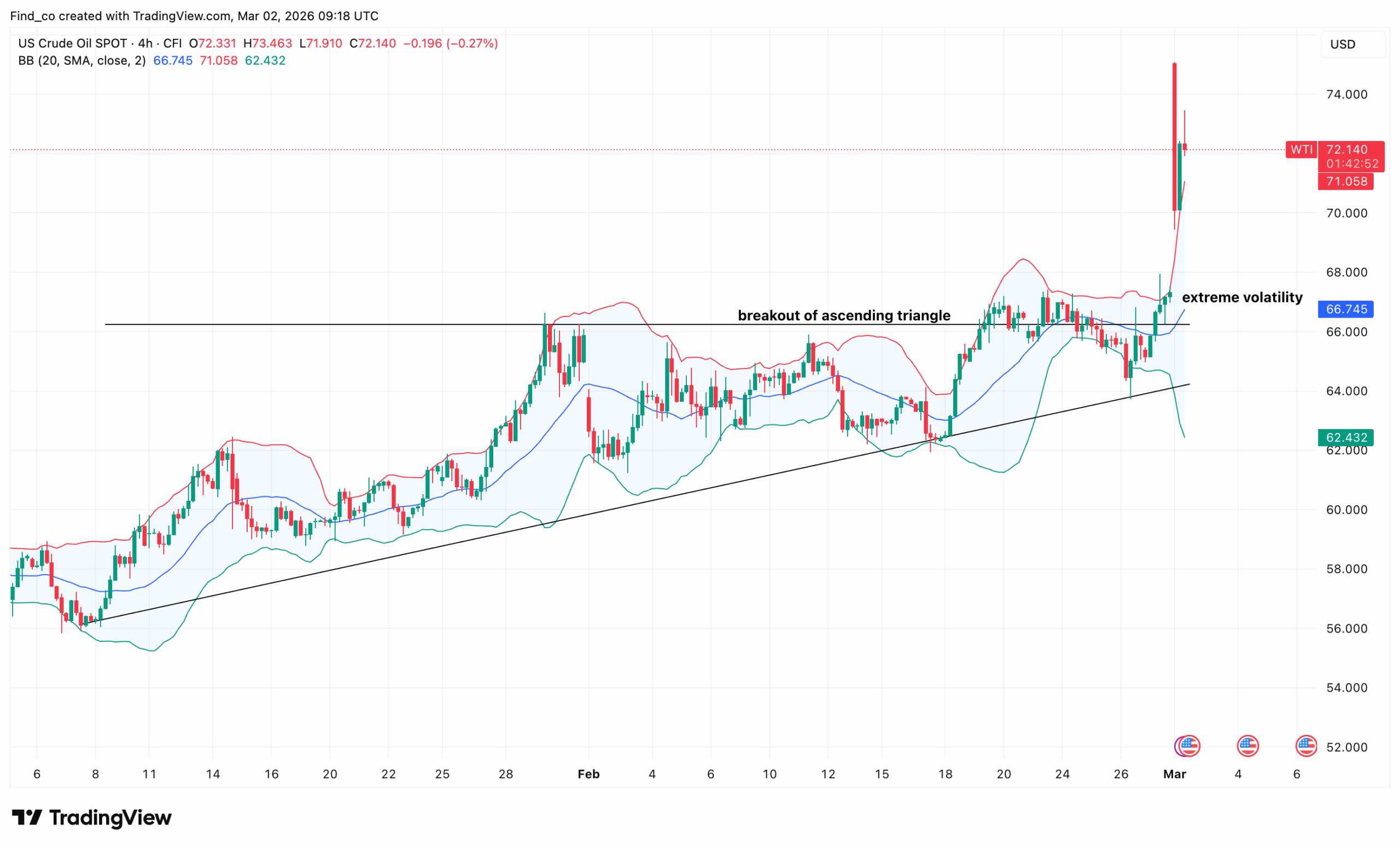
Crude Oil Prices See Extreme Volatility — Why?
Following an Iranian drone strike in the Persian Gulf, Saudi Arabia shut down Ras Tanura, one of the world’s largest oil refineries and export terminals.
This is a rare operational blackout in an already tight global supply environment. The shutdown immediately spiked risk premiums and sent global crude markets into a 12% volatility surge.
As a result, Brent oil pushed above $82 a barrel. This also forced WTI to fluctuate above and below $70 before settling back higher.
However, that reality stands in contrast to what’s happening with $USOR. The token, marketed as a proxy for U.S. oil exposure, has no verifiable peg to physical barrels or inventories.
Based on our findings, USOR does not have any audited custodial relationship with the U.S. Strategic Petroleum Reserve.
Investigative reports in late February confirmed what many sophisticated traders already suspected. Notably, there is no legal or custodial proof that the USOR token is backed by the Strategic Petroleum Reserve or any real crude assets.
Once that narrative was debunked, the token lost its sole anchor.
The mechanics of the sell-off have been textbook crypto, not energy. Speculators had been “buying the rumor” of war, accumulating USOR in anticipation of price appreciation tied to conflict headlines.
Besides that, liquidity amplified the downside.
On Solana DEXs like Meteora, the USOR token order books are shallow. A relatively small cluster of whales, estimated to control roughly 25% of the available supply, can exert an outsized influence.
When larger holders exited to take profit or reposition into real crude vehicles, the USOR price slid, even as physical oil traded higher.
Should this remain the same, it remains uncertain how high or low the USOR price will go.
USOR Price Analysis: Sideways Movement Ahead
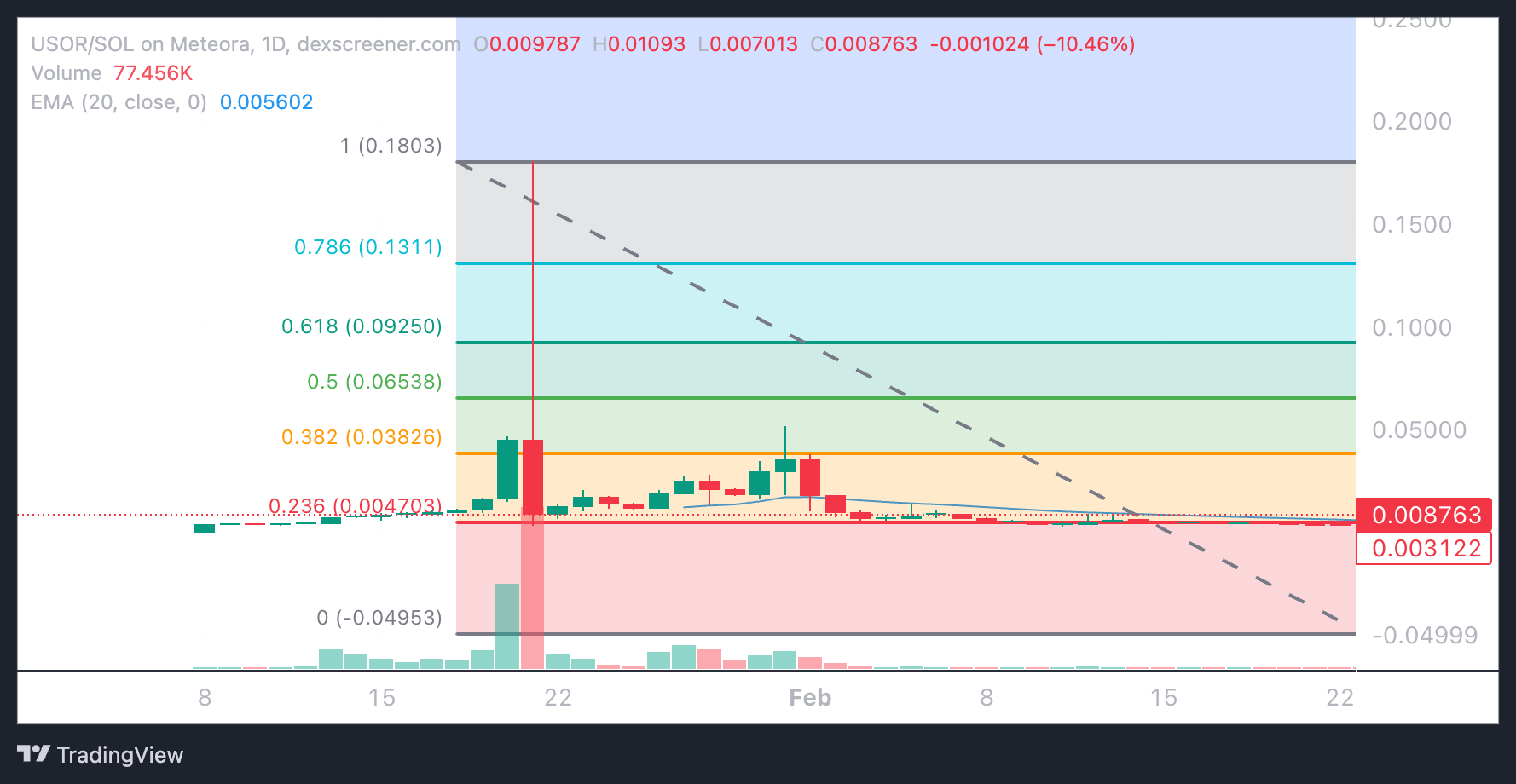
The final twist was technical. At the time of writing, the USOR token price has failed to reclaim its 20-day EMA near $0.010.
USOR/SOL on the daily timeframe shows a post-spike distribution and sustained downtrend.
After the initial explosive move toward $0.18 region, the USOR price was immediately rejected and has since been grinding lower under a clear descending trendline.
As seen below, the token is currently hovering just above the 0.236 Fibonacci level at $0.0047, which is acting as weak support.
However, the broader structure remains heavy. The descending dashed trendline continues to cap the price.
Due to that, every minor bounce has been sold into.
The EMA (20) sits below the early spike region, and the USOR price is now trading only marginally above it, reflecting the loss of bullish momentum.
Unless the USOR token can reclaim the $0.010 region and break above the descending trendline, the path of least resistance remains to the downside.
If the $0.0047 region fails, the price could revisit deeper support near the move’s origin. At this stage, the chart reflects a typical low-cap spike-and-fade pattern rather than a sustained trend reversal.
Disclaimer:
The information provided in this article is for informational purposes only. It is not intended to be, nor should it be construed as, financial advice. We do not make any warranties regarding the completeness, reliability, or accuracy of this information. All investments involve risk, and past performance does not guarantee future results. We recommend consulting a financial advisor before making any investment decisions.
Victor Olanrewaju is a crypto analyst and reporter at CCN with deep roots in on-chain research and technical analysis. His crypto journey began in 2017, but it was the 2020 Uniswap airdrop that sparked a full-time pivot into the space.
With a foundation in copywriting, Victor honed his craft creating high-converting content for leading crypto brokers — most notably an XRP price prediction that ranked #1 on Google during the 2021 bull run.
He later joined AMBCrypto in 2022, where he combined storytelling with technical and on-chain analysis to cover key market narratives.
In 2024, he expanded his expertise at BeInCrypto, collaborating with analysts and using tools like Glassnode, Santiment, and IntoTheBlock to break down Bitcoin and altcoin trends.
At CCN, Victor covers the top cryptocurrencies, memecoins, macro shifts, blending real-time insights with deep-dive metrics.
He holds a Bachelor’s degree in Physics from the University of Ibadan, equipping him to simplify complex data for a wide audience. Follow his work or connect on LinkedIn or X.