Is Jane Street alone responsible for Bitcoin price suppression. Credit: Spencer Platt/Getty Images/AFP.
Share
Key Takeaways
Jane Street has become a focal point for claims of Bitcoin price suppression.
Long-term holders and smaller wallets have offloaded heavily, while ETF flows recently shifted from outflows to renewed inflows.
The latest Bitcoin rally appears driven more by easing leverage and selective institutional buying than by the actions of any one firm.
In the crypto market, sharp price moves rarely travel alone.
They arrive with narratives—often tidy, sometimes conspiratorial, and almost always contested.
As Bitcoin rebounded toward $68,000 in late February, one such narrative resurfaced with force: that Jane Street, the secretive quantitative trading firm, has been systematically suppressing Bitcoin’s price.
On social media, critics claimed that without the firm’s alleged influence, Bitcoin would already be trading well above $150,000.
But a closer look at on-chain data, exchange flows, and ETF activity tells a more complex story—one in which selling pressure extends far beyond any single institution.
Try Our Recommended Crypto Exchanges
Sponsored
Disclosure
We sometimes use affiliate links in our content, when clicking on those we might receive a commission at no extra cost to you. By using this website you agree to our terms and conditions and privacy policy.
Filed by the bankruptcy administrator, the complaint alleges that Jane Street exploited non-public information during the 2022 TerraUSD depeg, withdrawing liquidity shortly before public disclosure.
That case—focused on events from nearly four years ago—has since been woven into a broader claim.
Critics argue that Jane Street’s role as an authorized participant in spot Bitcoin ETFs enabled systematic selling, particularly around the 10 a.m. ET market open, pressuring prices for months.
Viral posts on X amplified the idea, pointing to recurring intraday dips aligned with U.S. trading hours.
One widely shared thread even joked that Strategy’s Michael Saylor might sue Jane Street for keeping Bitcoin below his average purchase price.
Jane Street has denied the allegations.
A source close to the firm described the manipulation claims as “absolutely ridiculous,” emphasizing its role as a liquidity provider rather than a directional trader.
The firm has also rejected the lawsuit’s assertions, framing them as an attempt to deflect blame for Terraform’s failures.
On-Chain Metrics Tell a Different Story
Blockchain data suggests that selling pressure has been far more widespread than the Jane Street narrative implies.
Analytics from firms such as Glassnode and CryptoQuant show sustained distribution across multiple holder cohorts.
Long-Term Holders Lead Distribution
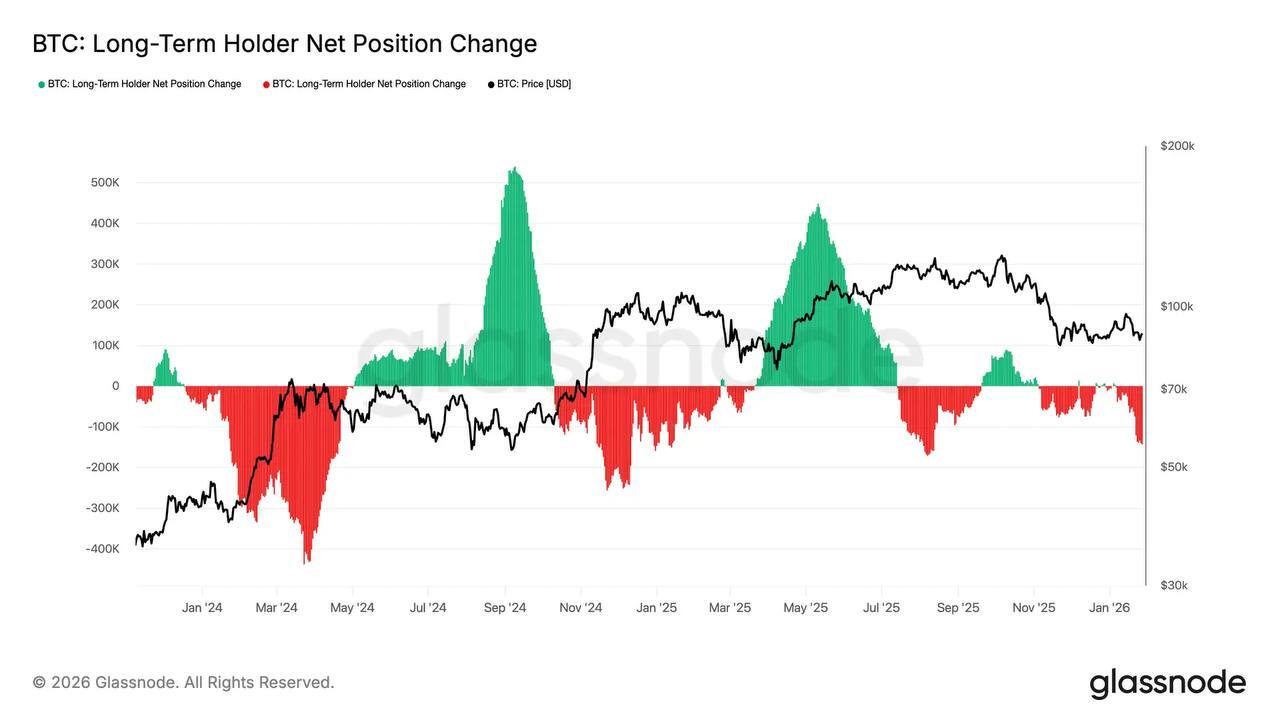
Long-term holders—defined as wallets holding Bitcoin for more than a year—sold an estimated 143,000 BTC over the past 30 days, marking the fastest pace of distribution since August 2025.
Rather than panic, analysts characterize this as profit-taking from mature positions—behavior that historically weighs on rallies until supply is absorbed.
Heavy selling among long-term holders. Credit: Glassnode.
Retail Wallets Sell Into Strength
Retail investors, particularly wallets holding less than 10 BTC, have also been active sellers during rebounds.
Wallet heatmaps indicate that while large holders accumulated during February’s dip—adding nearly 67,000 BTC in a single day—smaller wallets distributed into strength.
Net outflows of $258.5 million over a recent 24-hour period suggest retail selling into institutional bids, draining liquidity from trading venues.
U.S. Demand Signals Remain Soft
The Coinbase Premium Index, a proxy for U.S. institutional demand, remained negative for much of February, signaling continued selling pressure from American traders.
Although the premium has since stabilized, overall trading volumes remain sharply lower, with futures volume down 44% and spot volume down 50% from recent highs.
Miners and Seasonal Factors Add Pressure
Miners have added to the mix, facing tighter financing and offloading Bitcoin to fund operations amid the price slump.
Combined with seasonal factors, such as tax-loss harvesting in December 2025, these elements created a perfect storm of supply overhang.
Activity Softens as Valuations Reset
On-chain activity has softened overall, with layer-one revenues and active addresses declining, reflecting a pullback in marginal usage.
Bitcoin’s profitability metrics have reset toward long-term averages, a sign of valuation recalibration that often precedes demand revival.
CryptoQuant’s founder noted the turnaround in this premium as evidence of easing pressure on U.S. exchanges, but volumes have dropped sharply with futures down 44% and spot down 50% from highs, indicating reduced speculative frenzy rather than a demand revival.
Signs of Stabilization Emerge
Nearly half of Bitcoin’s circulating supply is now held at a loss, yet on-chain signals, such as the Unspent Transaction Output Realized Price Distribution, show accumulation between $60,000 and $70,000, lifting non-exchange supply in that range to over 8%.
This points to a stabilization phase, where retail capitulation absorbs the selling, setting the stage for potential upside once leverage unwinds fully.
ETF Flows: From Outflows to Renewed Inflows
Institutional flows via spot Bitcoin ETFs provide another layer of insight, showing a shift from heavy redemptions to fresh capital.
After five weeks of net outflows totaling $3.8 billion through mid-February, reversing much of 2025’s gains, flows turned positive.
On Feb. 25, ETFs recorded $506.5 million in inflows, the highest in three weeks, led by BlackRock’s IBIT, which recorded $297.4 million.
This followed $257.7 million the prior day, pushing weekly totals into the green for the first time since January.
Earlier in the month, outflows were stark: $133.3 million on February 18 alone, with BlackRock and Fidelity leading the exits.
Cumulative outflows since year-start exceeded $4 billion, correlating with Bitcoin’s 23% drop in the first 50 days of 2026, its worst annual opening on record.
Yet, as prices stabilized, inflows rebounded, with no fund posting outflows on Feb. 25.
Total ETF holdings now stand at about 1.257 million BTC, valued at $80.8 billion, or 6% of the supply.
This reversal aligns with easing leverage: futures open interest fell 45% from October peaks, and $3-4 billion in liquidations cleared speculative positions.
While outflows fueled doubts about institutional commitment, the recent surge, coupled with trading volumes hitting $4.3 billion, suggests a tentative return of buyers.
European crypto ETFs, meanwhile, bucked the trend with positive flows in early February, offsetting brief outflows during peak volatility.
Relief Rally, Not a Smoking Gun
Taken together, the data paints a picture that is less dramatic—but more grounded—than social media narratives suggest.
Retail selling, long-term holder distribution, miner liquidations, and ETF redemptions collectively exerted far more pressure on Bitcoin’s price than any alleged manipulation.
Nearly half of Bitcoin’s circulating supply remains underwater, yet on-chain metrics show accumulation emerging between $60,000 and $70,000, hinting at stabilization rather than capitulation.
As on-chain pressures ease and ETF inflows cautiously resume, Bitcoin may be positioning for recovery.
For now, however, the rebound looks more like a relief rally than a structural breakout.
The Jane Street story makes for compelling drama.
The blockchain, however, tells a broader tale—one shaped by many sellers, many buyers, and market forces that rarely bend to a single culprit.
Prashant Jha is a seasoned crypto journalist based in Delhi, India, with a Bachelor’s Degree in Computer Science Engineering. Passionate about the evolving world of blockchain and cryptocurrencies, he has been a dedicated voice in the industry since 2018. Prashant’s expertise lies in regulatory reporting, where he unravels complex legal and financial developments with clarity and precision. Before joining CCN in 2024, he honed his craft at Cointelegraph, establishing himself as a trusted name in crypto journalism.
His coverage spans major industry events, including the high-profile collapses of FTX, Three Arrows Capital (3AC), and LUNA, offering readers insightful analyses of their regulatory and market implications. Prashant’s technical background enables him to bridge the gap between intricate blockchain technology and its real-world applications, making his work accessible to novices and experts.
Beyond his professional pursuits, Prashant is an avid music enthusiast, often exploring diverse genres to unwind. A sports lover, he has a particular passion for cricket and frequently engages in discussions about the game. His multifaceted interests and sharp journalistic instincts make him a valuable contributor to CCN, where he continues shaping the crypto landscape's narrative.