Home / Education / Crypto / Investing / Is the Bitcoin Price Really ‘Not Your Market Price’? Nick Szabo on Jane Street and Why Crypto ETFs Are Draining
The crypto market lost $13 billion today as investors rotated into US stocks. Bitcoin tested key support while Zcash led altcoin losses amid fading trading volume. | Credit: CCN.com
Share
Key Takeaways
The 21 million supply cap is enforced by code, but price discovery happens in human-run financial markets.
If Bitcoin’s price depends heavily on large Wall Street intermediaries, then investors are once again relying on trusted third parties.
Traders observed repeated sell-offs at the U.S. market open, leading to speculation about algorithmic selling. These claims remain unverified.
If one firm had a guaranteed edge in suppressing Bitcoin, other major trading firms would likely arbitrage it away.
Bitcoin was designed to remove trust from money. No central bank. No middleman. Just code, math, and a hard cap of 21 million coins.
But what happens when most people don’t hold Bitcoin directly and instead buy it through Wall Street products like ETFs?
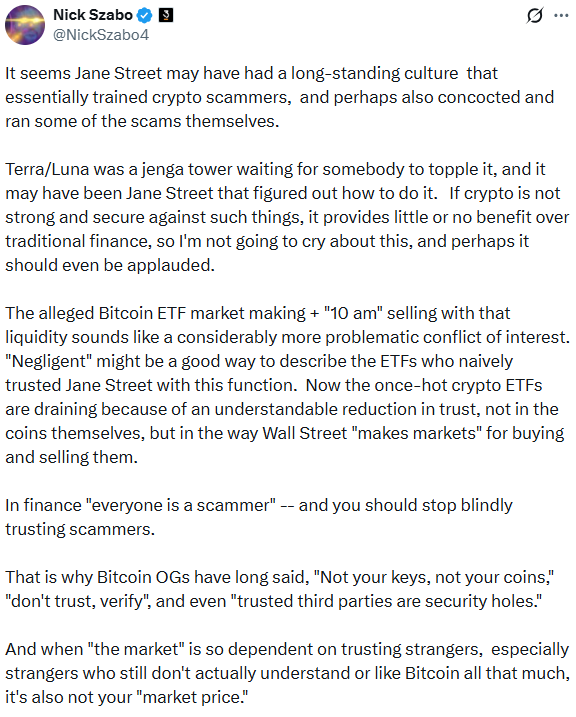
That’s the question at the center of a growing debate sparked by comments from Bitcoin pioneer Nick Szabo. After lawsuits and trading patterns linked to Jane Street Capital made headlines, Szabo suggested something deeper: when markets depend on powerful intermediaries, the price you see may not truly be “your market price.”
Let’s break this down.
Jane Street’s Broader Legal and Regulatory Scrutiny
Long before the current Bitcoin ETF debate, Jane Street had already faced regulatory attention in other markets.
In 2025, India’s Securities and Exchange Board (SEBI) issued a detailed enforcement order accusing Jane Street entities of manipulating the BANKNIFTY index derivatives. According to the regulator, the firm used coordinated strategies between cash markets and options markets to influence index levels and profit from derivative positions layered on top.
SEBI estimated billions of dollars in profits over a multi-year period and imposed interim trading restrictions. The regulator described the strategy as exploiting structural advantages in speed, liquidity access, and derivatives positioning.
Jane Street has not admitted wrongdoing in that case, and enforcement standards vary by country. However, the episode demonstrated how a large quantitative trading firm can use complex cross-market strategies that attract regulatory scrutiny when influence over one layer of a market appears connected to profits in another.
Because Jane Street operates as a significant market maker across equities, derivatives, and crypto-linked products, these past enforcement actions have intensified scrutiny of how it manages positions in newer markets, such as Bitcoin ETFs.
Importantly, no U.S. regulator has concluded that Jane Street manipulated Bitcoin markets. But its history in other jurisdictions has made it a focal point in discussions about market structure and institutional power.
The Terra Collapse and the Bitcoin Trust Debate
The current controversy resurfaced after a U.S. federal lawsuit connected to the 2022 collapse of TerraUSD (UST) and Luna.
The complaint alleges that Jane Street benefited from material nonpublic information during a critical liquidity event shortly before TerraUSD lost its dollar peg. Jane Street has strongly denied the allegations and described the case as meritless.
Regardless of how the case is resolved, it reopened a deeper philosophical debate inside the Bitcoin community.
Nick Szabo questions whether Bitcoin’s market price reflects real demand. | Credit: Nick Szabo X profile
Nick Szabo and other early Bitcoin advocates argue that the system was designed specifically to reduce reliance on powerful intermediaries. Bitcoin’s core principles, “Not your keys, not your coins,” and “Don’t trust, verify”, reflect a belief that trust in financial gatekeepers creates systemic risk.
At the heart of the debate are several key concerns:
Large financial firms may have structural advantages in liquidity access.
ETF market makers sit between investors and actual Bitcoin.
Derivatives and complex trading strategies can influence short-term price action.
Disclosure rules do not always reveal full net exposure.
The Terra episode, combined with Jane Street’s central role in the Bitcoin ETF market making, has raised a broader question:
If large Wall Street firms control key liquidity channels connecting ETFs to actual Bitcoin, how much of the market depends on trusting institutions rather than code?
Is Bitcoin’s supply decentralized while its price discovery becomes increasingly centralized?
Does institutional convenience come at the cost of ideological purity?
Bitcoin removes trust from monetary policy. But price discovery still happens in markets shaped by human actors.
For critics, that distinction matters.
10 am Drop: Coincidence or Market Structure?
Beginning in late 2024, traders noticed something strange: almost every trading day at 10 am Eastern, when U.S. stock markets opened, Bitcoin would suddenly drop 2-3%.
The pattern was sharp and precise. Prices would fall quickly, wipe out leveraged traders, and then often recover later in the day.
Some analysts suggested this was algorithmic selling. Jane Street, as an authorized participant in major Bitcoin ETFs like BlackRock’s IBIT, can create and redeem ETF shares using real Bitcoin. That gives it access to large amounts of liquidity at predictable times.
Critics argue this setup could allow a firm to temporarily push prices down, trigger liquidations, and buy back at lower prices.
Supporters say that’s speculation.
After the lawsuit filings became public, some traders claimed the 10 am pattern paused, only to resume later. To critics, that looked suspicious. To skeptics, it was a coincidence.
Importantly, no regulator has ruled that Bitcoin prices were manipulated. These are accusations and theories, not proven facts.
ETFs, 13F Filings, and the “Invisible” Derivative Book
Here’s where it gets complicated.
Jane Street disclosed holding hundreds of millions of dollars in IBIT shares in its 13F filings. Many media outlets reported this as bullish, a prominent Wall Street firm “buying Bitcoin.”
But experienced traders pointed out something crucial: a 13F only shows long stock positions. It does not show options, futures, or swaps.
That means a firm could report owning $790 million in ETF shares while secretly holding $790 million in offsetting short positions through derivatives.
In simple terms:
On paper, it looks like they’re long.
In reality, their net exposure could be zero.
Or even negative (meaning they profit if Bitcoin falls).
Market makers often hedge their positions. That’s normal. Their job is not to “believe in Bitcoin.” Their job is to provide liquidity and earn spreads.
Still, this creates confusion. Retail investors may think institutions are accumulating Bitcoin when, in fact, they may simply be running neutral trading strategies.
Szabo’s concern is philosophical: if Bitcoin’s price is heavily influenced by institutions that don’t hold real exposure, and may not even like Bitcoin, is the price discovery process clean?
Why Some Say ETFs Are “Draining”
Crypto ETFs saw massive inflows when first approved. But more recently, flows have slowed or reversed.
Critics argue this reflects declining trust, not in Bitcoin itself, but in how Wall Street structures and trades these products.
Bitcoin = fool’s gold. | Credit: Steve Hanke X profile
If investors believe ETF market makers can influence short-term price action, confidence may weaken.
But there’s another explanation.
Bitwise CIO Matt Hougan pushed back strongly against conspiracy theories. In his view, Bitcoin’s downturn is simple:
Some investors sold.
Some unwound leverage.
Some rotated into AI stocks.
Some feared regulatory or macro risks.
Why is Bitcoin down? | Credit: Matt Hougan X profile
Crypto has always moved in four-year cycles. Booms. Busts. Winters. Springs.
No villain required.
Could Other Firms Just Front-Run It?
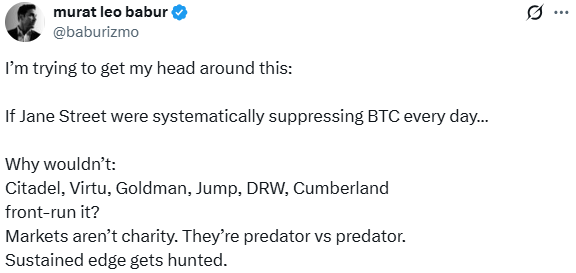
Another key argument comes from traders like Murat Leo Babur.
Markets are competitive. If one firm had a guaranteed edge suppressing Bitcoin every day, other giant firms, such as Citadel, Virtu, Goldman, and Jump, would notice and attack that edge.
What’s really behind Bitcoin’s drop? | Credit: Murat Leo Babur X profile
Finance is predator versus predator. Free money does not last.
If Jane Street were systematically manipulating Bitcoin in an obvious way, other sophisticated players would likely arbitrage it.
This doesn’t prove innocence. But it highlights how difficult sustained manipulation would be in a deep global market.
Market makers don’t care about ideology; they only care about profit.
Bitcoin’s design assumes skepticism. It assumes users verify rather than trust. Whether the current concerns prove valid or not, the core lesson remains simple: if one wants full sovereignty, they should hold their own keys.
If investors buy through financial wrappers, they are part of a system that runs on trust.
It’s a phrase inspired by “Not your keys, not your coins.” It suggests that if Bitcoin’s price is heavily influenced by large financial institutions, derivatives, and ETFs, instead of direct buying and selling of actual Bitcoin, then the price may reflect institutional trading strategies, not just real supply and demand.
What is Jane Street and why is it important here?
Jane Street is a large Wall Street trading firm and market maker. It helps create and redeem shares for major Bitcoin ETFs like BlackRock’s IBIT. Because of this role, it has direct access to the system that connects ETFs to actual Bitcoin liquidity. Some critics believe this position gives it structural advantages in trading. The firm denies any wrongdoing.
Has Jane Street been proven to manipulate Bitcoin?
No. There is currently no regulatory ruling that Jane Street manipulated Bitcoin’s price. The discussion is based on lawsuits, trading patterns observed by analysts, and public filings, not confirmed findings of wrongdoing.
What was the “10am drop” pattern?
Traders noticed that Bitcoin often fell sharply around 10 a.m. Eastern Time, when U.S. stock markets opened. Some believe this may have been algorithmic selling tied to ETF liquidity windows. Others say this is normal market behavior during high-volume trading periods. There is no official confirmation of manipulation.
Disclaimer:
The information provided in this article is for informational purposes only. It is not intended to be, nor should it be construed as, financial advice. We do not make any warranties regarding the completeness, reliability, or accuracy of this information. All investments involve risk, and past performance does not guarantee future results. We recommend consulting a financial advisor before making any investment decisions.
Giuseppe Ciccomascolo began his career as an investigative journalist in Italy, where he contributed to both local and national newspapers, focusing on various financial sectors.
Upon relocating to London, he worked as an analyst for Fitch's CapitalStructure and later as a Senior Reporter for Alliance News. In 2017, Giuseppe transitioned to covering cryptocurrency-related news, producing documentaries and articles on Bitcoin and other emerging digital currencies. He also played a pivotal role in establishing the academy for a cryptocurrency exchange website. Crypto remained his primary area of interest throughout his tenure as a writer for ThirdFloor.


 Easy
Easy