Bitcoin at 18: How 9 Pages Became a $1.7T Monetary Network
Share
Key Takeaways
Bitcoin’s nine-page white paper turns 18 on Oct. 31, after growing into a roughly $1.7 trillion monetary network.
Wall Street adoption has accelerated, with spot Bitcoin ETFs holding more than $100 billion in assets.
Epstein files reveal links to Bitcoin’s later institutional ecosystem, but no evidence that he funded Bitcoin’s creation or was Satoshi Nakamoto.
On Oct. 31, 2008, an unknown programmer using the name Satoshi Nakamoto introduced a proposal for electronic money that required neither a bank nor a central authority.
Eighteen years later, Bitcoin is approaching another anniversary with a market capitalization of roughly $1.7 trillion, more than 20 million BTC issued, and a mining network performing close to a sextillion hashes every second.
The transformation is extraordinary, partly because of how little Bitcoin needed to begin with.
The Bitcoin white paper runs just nine pages in its familiar form. It proposed a peer-to-peer payment system built around proof-of-work, cryptographic verification, and a distributed timestamp server.
As Bitcoin approaches the 18th anniversary of the white paper on Oct. 31, however, its history is also being reexamined. Newly surfaced Jeffrey Epstein records have reopened uncomfortable questions about who funded parts of Bitcoin’s early institutional ecosystem years after Satoshi disappeared.
None of that establishes that Epstein created Bitcoin. But it complicates the story of how a cypherpunk experiment became institutional financial infrastructure.
Bitcoin’s Journey: From 9 Pages to $1.7 Trillion
Bitcoin’s original proposition was relatively narrow: allow two parties to transact electronically without relying on a trusted financial institution.
The network launched a little over two months later, on Jan. 3, 2009.
Today, the scale is almost unrecognizable.
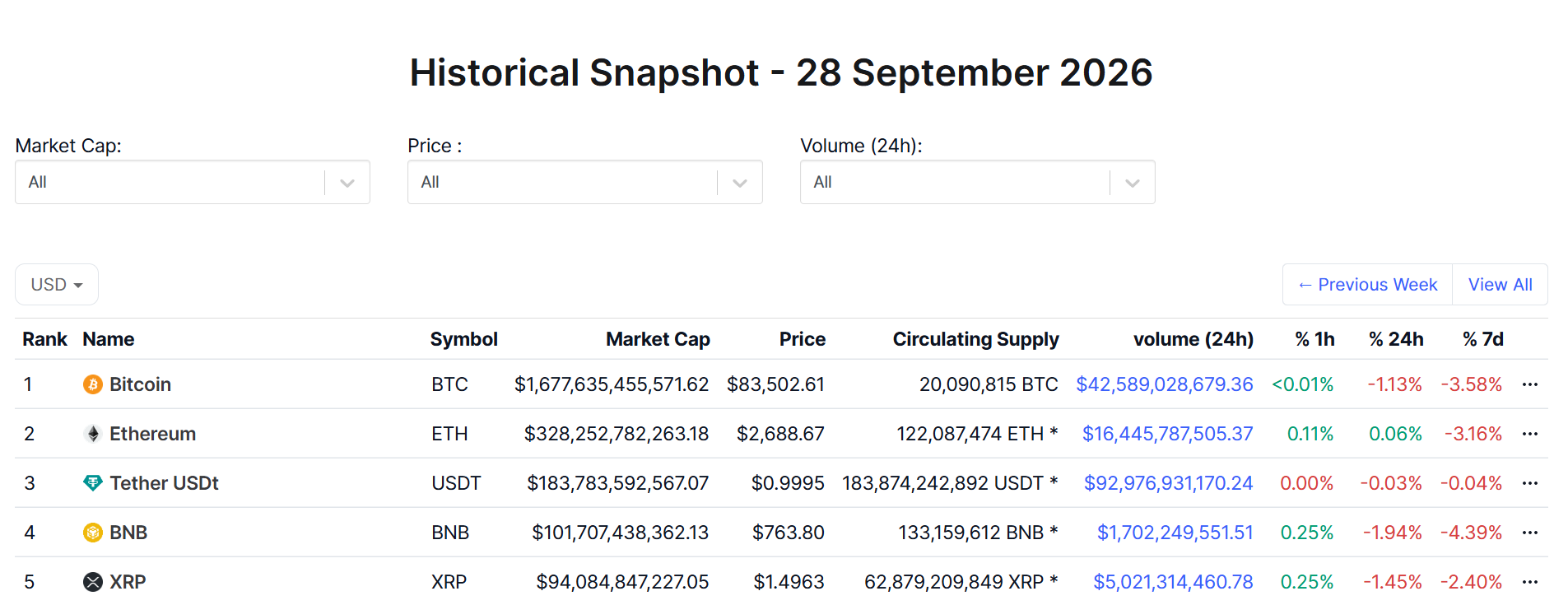
Bitcoin had a market capitalization of approximately $1.68 trillion on Sept. 28, when BTC traded around $83,503 (at the time of writing).
Circulating supply had reached roughly 20.09 million BTC, meaning more than 95% of the maximum 21 million supply had already entered circulation.
Top 5 cryptocurrency rankings and valuations as of September 28, 2026. | Source: CoinMarketCap
That scarcity remains central to Bitcoin’s monetary proposition.
Unlike fiat currencies, new Bitcoin issuance follows a predetermined schedule. The block subsidy began at 50 BTC and has fallen to 3.125 BTC through successive halvings.
But scarcity alone would mean little without a network capable of enforcing it.
Bitcoin’s estimated daily hashrate stood at around 884 exahashes per second on Oct. 3, illustrating how far mining has evolved from CPUs running in bedrooms to industrial operations deploying specialized hardware and enormous amounts of capital.
Bitcoin did not simply become more valuable. The infrastructure that protects its monetary rules became an industry in its own right.
Wall Street Eventually Came to Bitcoin
Bitcoin’s institutional evolution contains one of its greatest contradictions.
Satoshi designed the system specifically to reduce dependence on financial intermediaries. Eighteen years later, some of the world’s largest financial institutions have become major gateways into Bitcoin.
US spot Bitcoin ETFs collectively ended the third quarter with roughly $108 billion in net assets, after attracting another $6.3 billion during Q3.
Bitcoin did not eliminate Wall Street.
Wall Street built regulated wrappers around Bitcoin.
That raises a bigger question about what Bitcoin has actually become.
Its base layer still allows users to hold and transfer an asset without requiring a bank. Yet an increasing share of investment exposure now comes through custodians, ETFs, public companies and regulated trading platforms.
The protocol remained decentralized while the financial infrastructure around it became increasingly institutional.
Jeffrey Epstein Files Complicate Bitcoin’s Early History
The latest anniversary also arrives under a more uncomfortable historical spotlight.
Documents released in 2026 revealed that convicted sex offender Jeffrey Epstein had financial connections to parts of the cryptocurrency industry years after Bitcoin itself was created.
The records indicate Epstein invested in crypto companies, including Coinbase, and had connections to funding that reached MIT’s Digital Currency Initiative, which became an important institutional home for Bitcoin developers.
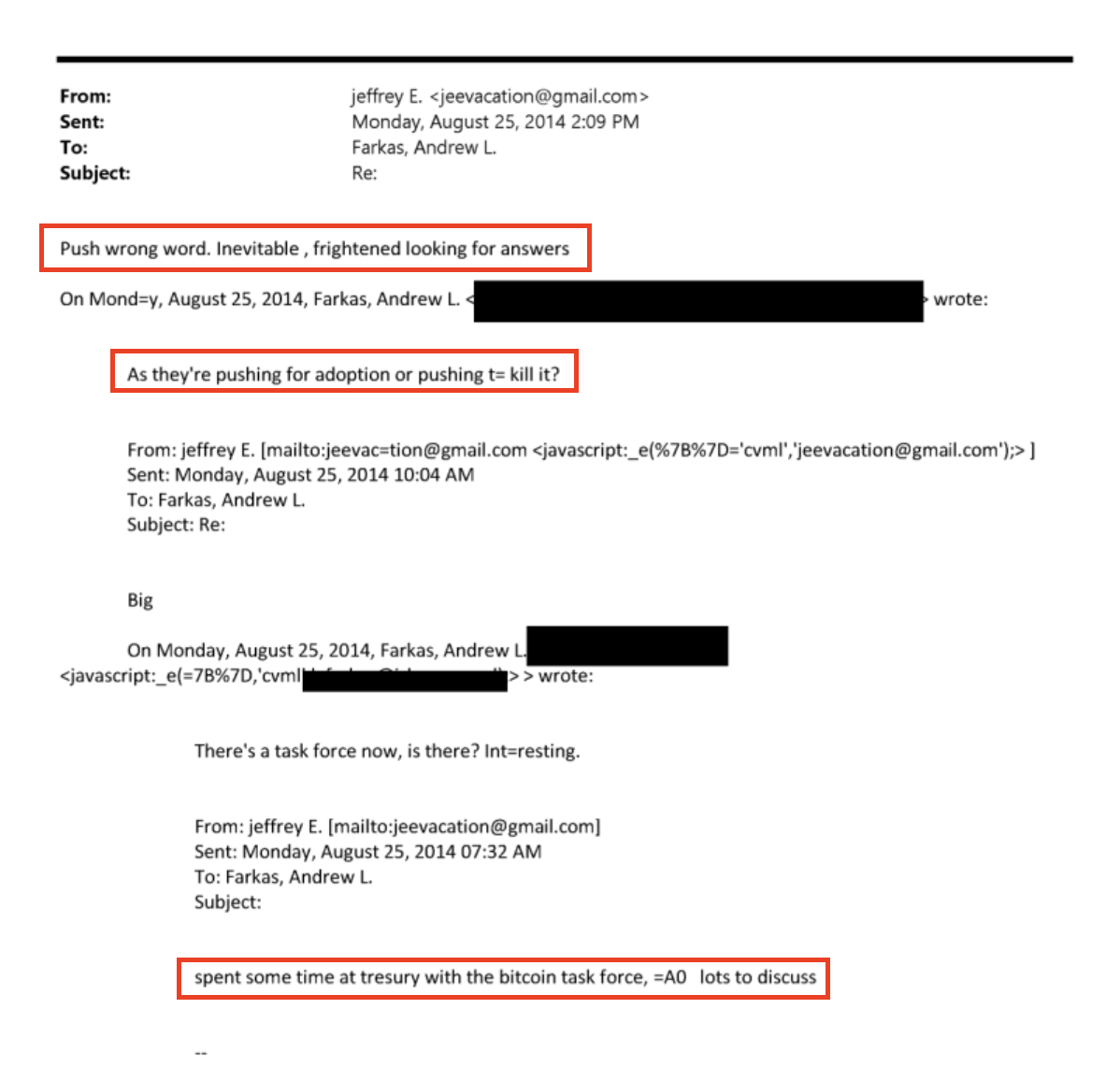
Correspondence between Jeffrey Epstein and Andrew Farkas | Credit: US Department of Justice
One particularly notable April 2015 email from then-MIT Media Lab director Joi Ito discussed launching the Digital Currency Initiative.
Ito told Epstein that he had used gift funds to underwrite the initiative, adding that doing so allowed MIT to move quickly. Epstein replied about Bitcoin developer Gavin Andresen: “gavin is clever.”
The records therefore establish connections between Epstein and parts of Bitcoin’s later institutional ecosystem, not evidence that Epstein financed Bitcoin’s creation or was Satoshi Nakamoto.
This has become particularly important after fabricated material circulated online claiming Epstein was secretly behind the Satoshi identity. Reviews of the released records found no evidence supporting the viral claim, and the supposed email used as proof contained multiple indications of fabrication.
🚨EPSTEIN USED WORLD OF WARCRAFT TO LAUNDER MONEY THROUGH IN GAME GOLD🚨
It’s simple, buy gold with real money then trade gold around accounts and sell gold for real money. An untraceable way to move it.
The documented story is still significant without turning it into a conspiracy.
Bitcoin was already operating independently when Epstein became involved with people and organizations around its ecosystem. More importantly, no donor to MIT could rewrite Bitcoin’s 21 million supply, reverse transactions, or unilaterally change its consensus rules.
The difference between funding developers and controlling the protocol is fundamental to understanding Bitcoin.
Bitcoin Survived Its Creators, Backers, and Institutions
Perhaps Bitcoin’s most important achievement at 18 is therefore not its $1.7 trillion valuation.
It is institutional independence.
Satoshi disappeared. Developers changed. Exchanges collapsed. Governments restricted mining. Wall Street arrived. Wealthy investors funded companies and research around the ecosystem.
Yet Bitcoin continued producing blocks.
That does not make the network immune to risk. Mining economics will become increasingly dependent on transaction fees as block subsidies decline.
Custody is concentrating large amounts of BTC inside ETFs and corporate treasuries, while the network continues debating scalability, privacy and long-term security.
But the experiment Satoshi proposed in 2008 has already crossed an extraordinary threshold.
Bitcoin.org describes the network as open-source infrastructure that nobody owns or controls, with changes ultimately dependent on adoption by network participants.
That principle helps explain how nine pages survived the people and institutions that later gathered around them.
On Oct. 31, 2026, Bitcoin’s white paper turns 18.
The document proposed electronic cash without a trusted intermediary. What emerged instead was something considerably larger: a scarce digital asset, an industrial computing network, a Wall Street product and a $1.7 trillion monetary experiment that still has no CEO, headquarters or known founder.
Disclaimer:
The information provided in this article is for informational purposes only. It is not intended to be, nor should it be construed as, financial advice. We do not make any warranties regarding the completeness, reliability, or accuracy of this information. All investments involve risk, and past performance does not guarantee future results. We recommend consulting a financial advisor before making any investment decisions.
Dr. Guneet Kaur is a senior editor at CCN.com and a Science Fellow at Exponential Science. She is a fintech and blockchain expert with extensive experience in digital finance education, blockchain ecosystems, and cryptocurrency markets. She has worked with global media such as Cointelegraph, as well as education and blockchain platforms, to design and lead strategic content and learning initiatives. As an educator and assessor for top-tier executive programs, she bridges real-world fintech trends with academic insight.
Dr. Kaur is also a published researcher and peer reviewer across fintech and data science journals, including Financial Innovation Journal and International Journal of Big Data Intelligence and Applications. Her work spans data-driven analysis, Web3 innovation, and technical content development. With a strong foundation in both industry and academia, she translates complex financial technologies into practical applications, empowering learners, professionals, and institutions across the rapidly evolving digital finance landscape.


 Easy
Easy