Key Takeaways
- Bessent acknowledged that he cannot set bond-market prices, defending larger Treasury buybacks as a form of liquidity support.
- The remarks highlight the limits of intervention but do not confirm that a debt crisis has begun.
- Bitcoin’s August rally coincided with renewed demand for assets seen as hedges against dollar weakness.
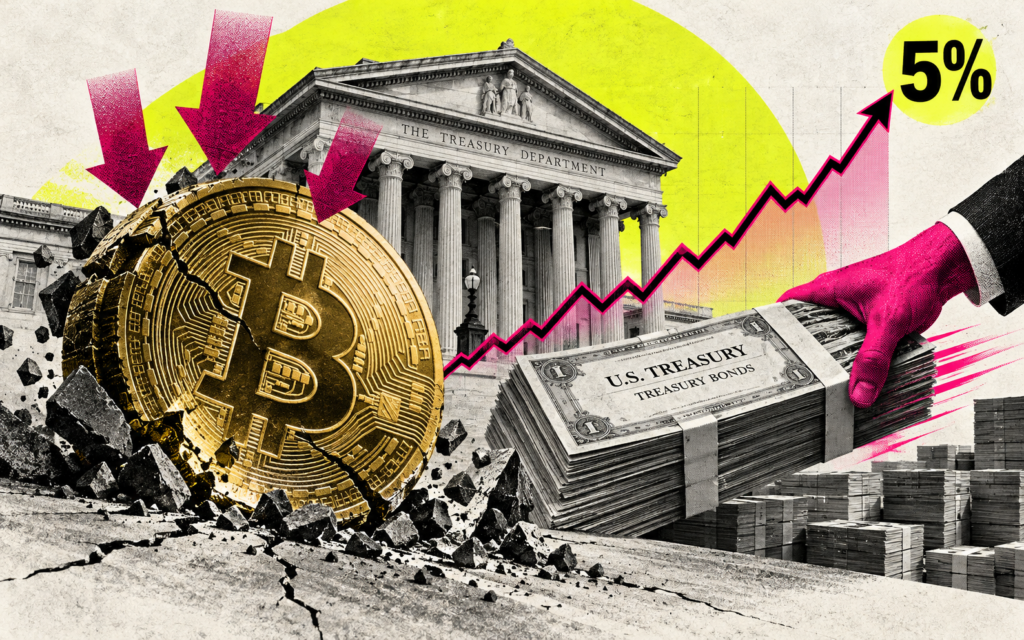
US Treasury Secretary Scott Bessent has acknowledged the limits of government intervention in the bond market, sharpening a debate over whether efforts to support Treasury liquidity could strengthen Bitcoin’s appeal as an alternative store of value.
Speaking on CNBC, Bessent defended larger government bond buybacks during thin trading conditions, while conceding: “I can’t set the equilibrium price.”
His remarks have circulated among crypto commentators as evidence of a looming debt crisis. However, the interview supports a narrower conclusion: Bessent believes Treasury can improve market functioning, while fundamental forces ultimately determine bond prices.
For Bitcoin, that distinction matters. Liquidity support and concerns about fiscal credibility can encourage demand, while rising yields and a funding squeeze can work against it.
Bessent Draws a Line Between Liquidity and Price Control
Bessent said he increased buyback sizes because the market was illiquid and moving quickly. He described markets as continually moving toward or away from equilibrium, saying he believed conditions had been moving away.
The comments followed Treasury’s Aug. 19 announcement that it would at least double liquidity-support buybacks for nominal government bonds in the 10-to-20-year and 20-to-30-year maturity sectors.
The previous ceiling of $2 billion per operation would rise to at least $4 billion, effective Sept. 9 through the remainder of the refunding quarter ending Nov. 4.
By September, announced purchase limits had reached $6 billion for certain longer-dated operations. That figure represents a maximum purchase amount, rather than a guarantee that Treasury would buy the full allocation.
Treasury’s published framework says liquidity-support buybacks provide a predictable opportunity to sell older, off-the-run securities. These bonds can trade less readily than newly issued benchmark debt.
The operations therefore address trading conditions rather than eliminate the government’s borrowing needs. Treasury’s FAQ also says the program is not intended to mitigate acute market stress.
Bessent separately linked long-term yields to oil prices and the Iran conflict during the interview, arguing that improved energy supply could help rates decline. That explanation differs from treating every increase in yields as proof of sovereign distress.
Bitcoin’s Debasement Trade Has Already Shown Its Appeal
Investors interpreted the intervention through competing lenses. Some saw an effort to stabilize an important market. Others viewed it as reinforcing concerns about inflation, borrowing, and the purchasing power of dollar-denominated assets.
That second interpretation underpins the “debasement trade,” in which investors buy assets they expect to benefit from a weaker currency.
Bitcoin’s fixed supply gives it a place in that narrative, although its price remains volatile and sensitive to speculative positioning.
The August rally also involved short covering and favorable crypto policy developments, according to the FT, making a single-cause explanation incomplete.
Bridgewater founder Ray Dalio added to the debate in August, warning that expanded buybacks fit a broader pattern of fiscal vulnerability. CNBC reported that he favored reduced debt exposure, alongside gold and some Bitcoin.
His warning was a conditional assessment of the government’s financial trajectory, rather than evidence that a crisis had already begun.
A Bond-Market Shock Could Cut Both Ways for Crypto
Bitcoin’s potential role as a fiscal hedge does not guarantee protection during a liquidity crisis.
One possible outcome is that declining confidence in government debt encourages investors to seek assets outside sovereign balance sheets.
Another is that rising yields and urgent cash needs trigger selling across risk assets, including cryptocurrencies.
International funding arrangements also complicate the picture.
The Federal Reserve’s FIMA repo facility lets approved foreign monetary authorities temporarily exchange Treasury holdings for dollars, providing an alternative to outright bond sales. It has been a standing facility since 2021.
Its existence helps explain why dollar funding and Treasury liquidity are connected.
Bessent’s admission establishes the limits of intervention. Bitcoin’s next response will depend on whether investors interpret those limits as manageable market friction or a more serious threat to confidence.
The information provided in this article is for informational purposes only. It is not intended to be, nor should it be construed as, financial advice. We do not make any warranties regarding the completeness, reliability, or accuracy of this information. All investments involve risk, and past performance does not guarantee future results. We recommend consulting a financial advisor before making any investment decisions.

Giuseppe Ciccomascolo began his career as an investigative journalist in Italy, where he contributed to both local and national newspapers, focusing on various financial sectors.
Upon relocating to London, he worked as an analyst for Fitch's CapitalStructure and later as a Senior Reporter for Alliance News. In 2017, Giuseppe transitioned to covering cryptocurrency-related news, producing documentaries and articles on Bitcoin and other emerging digital currencies. He also played a pivotal role in establishing the academy for a cryptocurrency exchange website. Crypto remained his primary area of interest throughout his tenure as a writer for ThirdFloor.