17 Years of the Bitcoin White Paper: Satoshi’s Trick That Turned Into a $2 Trillion Treat
Share
Key Takeaways
Seventeen years after Satoshi Nakamoto’s Halloween-night white paper, Bitcoin has evolved from a cryptography experiment into a multi-trillion-dollar asset class.
While Satoshi designed Bitcoin as a peer-to-peer digital cash system, it has largely become “digital gold,” a store of value favored by investors and institutions.
The Federal Reserve’s decision to end quantitative tightening (QT) on December 1, 2025, could ease liquidity pressures.
Bitcoin’s short-term price may remain volatile between $100,000 – $115,000, but if the Fed signals deeper rate cuts or if liquidity improves in early 2026.
At the time, amidst the global financial crisis and faltering banks, it looked like a fringe cryptography project. Fast-forward 17 years: the idea has morphed into an asset class worth many hundreds of billions of dollars, widely held by institutions, and increasingly woven into global finance.
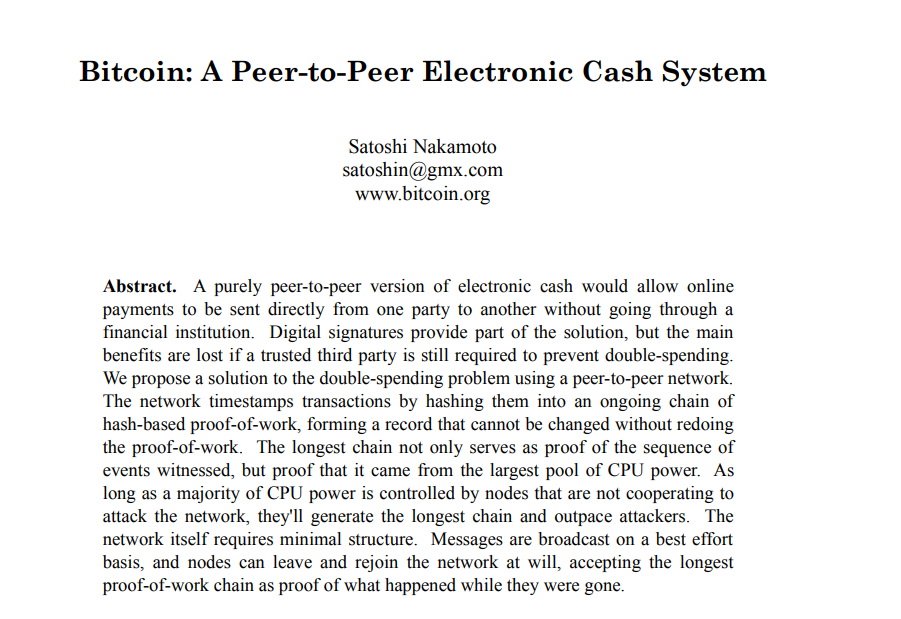
Bitcoin White paper. | Source: bitcoin.org
Here’s how the trick became a massive treat for Bitcoiners — and why it still haunts traditional finance.
The document was posted to a cryptography mailing list; the domain bitcoin.org was registered earlier in August 2008.
The date, 31 October, has sparked lore: was the timing deliberate (Halloween) or a coincidence? Bitcoin’s creation didn’t emerge in isolation; it was shaped by the cypherpunk culture that thrived in the early days of the internet. Those pioneers believed that privacy and autonomy were essential rights, not privileges controlled by governments or banks.
In that sense, Satoshi Nakamoto’s decision to unveil Bitcoin on Halloween feels like more than a coincidence. The date itself, synonymous with rebellion, disguise, and breaking convention, mirrors Bitcoin’s mission to upend traditional finance. By launching the whitepaper on a night that celebrates the unconventional, Nakamoto delivered a quiet message: financial freedom should belong to the individual, not the institution.
In effect, the white paper is the blueprint for what became the Bitcoin protocol and network.
From Experimental Code to Bitcoin Becoming a Global Asset Class
Over the next decade, Bitcoin grew from an obscure cryptography experiment to the largest cryptocurrency by market capitalization.
As of 2025, institutional demand has surged: for example, global crypto ETFs recorded an inflow of about $5.95 billion in the week ending 4 October 2025, with Bitcoin taking a large portion.
Spot Bitcoin ETFs saw net inflows of approximately $4.57 billion, bringing assets under management near US $154.8 billion, roughly 6.8 % of Bitcoin’s total market cap at that time.
Bitcoin’s price reached new highs in early October 2025, trading above $125,000.
What began as a white paper trick has matured into a global treat: an established asset class, major institutional participation, and widespread financial ecosystem integration.
How Satoshi’s Vision has Transformed (and Not)
The white paper envisioned “a purely peer-to-peer version of electronic cash” that does not rely on a trusted third party.
In practice, Bitcoin today is often used, or referenced, more as “digital gold” (a store of value) than as a daily payments medium.
Institutional adoption and ETF flows mean large funds, corporate treasuries, and regulated vehicles are now major stakeholders, far removed from the early cypherpunk community.
The core architecture remains decentralized, but the dynamics (wealth concentration, layer-2 payment adoption lagging) show divergence from the original ideal.
Why Satoshi’s White Paper Became a Multi-Trillion-Dollar Treat
Scarcity plays a role: Bitcoin’s capped supply (21 million) gives it an inherent structural appeal.
Institutional frameworks (spot ETFs, regulated funds) now provide access to large investors.
Global macro factors, such as inflation hedge narrative, alternative-asset demand, and regulatory clarity, all contribute to the treat.
The narrative transformation: from fringe to mainstream. What was once a ‘digital cash’ experiment now operates in the global financial architecture.
How Bitcoin Continues to Haunt Traditional Finance
Seventeen years after its creation, Bitcoin continues to disrupt and challenge traditional finance, not through open confrontation, but by steadily reshaping how money, trust, and value flow across the global system.
Research published in 2025 shows that Bitcoin’s relationship with conventional markets has deepened, with its correlation to major U.S. equity indices reaching peaks near 0.87 in 2024. This tightening connection highlights how Bitcoin, once viewed as an outsider, has become an integral component of modern financial portfolios.
According to the European Central Bank’s 2025 report, crypto-assets (including Bitcoin) are creating new interconnectedness with traditional finance systems, such as bank exposure, shared infrastructure risks, and overlapping investor bases.
Banks now face exposure through ETF products, custody services, and shared investor bases, which increases both opportunity and systemic risk. The Bank for International Settlements also notes that Bitcoin plays a growing role in cross-border capital flows, often moving outside traditional banking rails and responding directly to global liquidity cycles and volatility in risk assets.
Furthermore, the rise of peer-to-peer finance and self-custodied digital assets represents a quiet revolution in financial autonomy. Bitcoin enables users to transact and store wealth without reliance on banks, bypassing the intermediaries that have dominated global finance for centuries. This dynamic has begun to pressure traditional banking models, from international remittances to asset management and payment networks.
In essence, Bitcoin doesn’t need to overthrow traditional finance to challenge it, it merely needs to exist. Each market cycle strengthens its foothold, each technological improvement increases its usability, and every new wave of institutional adoption forces the legacy system to adapt.
Like a persistent echo from its 2008 whitepaper, Bitcoin continues to haunt traditional finance by proving that trust, once the domain of banks, can also be coded into mathematics.
What’s Next for Bitcoin?
As 2025 closes, Bitcoin finds itself at another macro-inflection point, the Federal Reserve’s decision to end quantitative tightening (QT) on Dec. 1, 2025, and its latest 25-basis-point rate cut at the end of October. These two policy moves could define the next leg of Bitcoin’s journey and determine whether the market’s Halloween-era rally continues or fades.
End of QT: A Liquidity Shift
The Fed’s announcement that it will stop reducing its balance sheet marks a turning point in global liquidity. QT, the process of shrinking the central bank’s balance sheet, has been a steady drain on risk-asset markets since mid-2022. Ending it means the Fed will reinvest maturing Treasuries, effectively halting liquidity withdrawal.
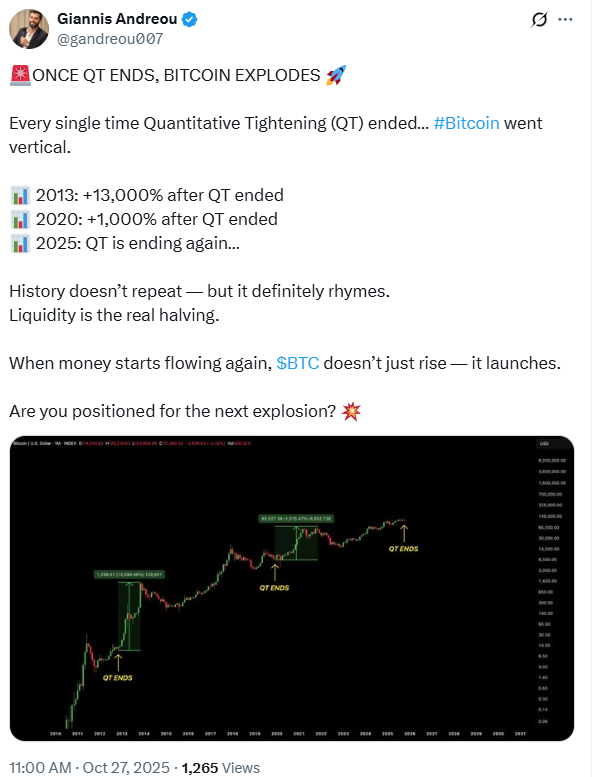
For Bitcoin, this shift matters. Historically, when liquidity tightens, speculative and high-beta assets like crypto suffer. Conversely, when liquidity expands or even stabilizes, capital tends to flow back into risk markets.
Every single time QT Bitcoin went vertical. | Source: @gandreou007 on X
Immediate Reaction: Sell the News
Surprisingly, Bitcoin fell sharply after the announcement, dropping from recent record highs near $125,000 to around $109,000–$113,000 in late October. This counterintuitive move reveals a simple truth: markets had already priced in the end of QT and expected a more aggressive easing cycle.
The Fed’s cautious tone, signaling that no further cuts are guaranteed, injected uncertainty. Traders realized that liquidity support may come slower than hoped, prompting short-term profit-taking after Bitcoin’s massive year-to-date run.
Short-Term Outlook: Calm Before the Next Surge
Between November and December, Bitcoin’s path will likely depend on the speed and scale of new liquidity entering the system. Ending QT alone doesn’t instantly release funds; it merely stops the drain.
If the Fed complements this move with another rate cut or a dovish message at its December meeting, Bitcoin could resume its climb, potentially retesting the $120,000 level or higher.
ETF inflows remain robust, and institutions continue to accumulate BTC exposure. Combined with the ongoing post-halving supply shock, even modest liquidity expansion could trigger renewed upward momentum before year-end.
Medium-Term Scenario: Macro Integration Deepens
Looking beyond December, Bitcoin’s trajectory is increasingly tied to institutional capital and macro policy rather than retail speculation. ETF adoption, corporate treasury participation, and sovereign interest have anchored Bitcoin inside the global financial system. As a result, its performance now tracks liquidity cycles much like equities.
If central banks worldwide transition from tightening to balance-sheet neutrality, or even mild expansion, Bitcoin could benefit from a prolonged liquidity tailwind through 2026. Analysts already forecast a potential new cyclical peak between $150,000 and $200,000 if this scenario unfolds.
Caution! A Trick Behind the Treat
Yet there’s a risk hidden beneath the optimism. Bitcoin’s post-pandemic bull runs were often driven by aggressive liquidity injections and zero-rate environments. Today’s setup is far more conservative.
Inflation remains a concern, and the Fed has little appetite to flood markets again. If economic data surprises to the upside or inflation re-accelerates, policy could tighten once more, turning the treat of ending QT into a trick of renewed restraint.
The Bottom Line
Bitcoin’s next chapter hinges on liquidity. The end of QT is a symbolic and structural win, signaling the end of a long tightening cycle, but not yet a green light for unlimited risk-taking. In the near term, volatility may persist as investors gauge the Fed’s December tone.
If monetary easing gains traction and institutional inflows continue, Bitcoin could solidify its position above six figures and potentially launch another leg higher in early 2026. If policy stalls, however, the market may consolidate in the $100,000-$115,000 range.
Either way, as the 17th anniversary of Satoshi’s white paper passes, Bitcoin once again stands at the crossroads of technology, policy, and psychology, a creation born of crisis, now shaped by the very system it once sought to escape.
Why was Bitcoin’s white paper released on Halloween 2008?
The timing has become part of Bitcoin folklore. While there’s no confirmed reason, some in the crypto community believe the Halloween release symbolized rebirth from the ashes of the 2008 financial crisis, a fitting moment for a project meant to challenge the banking system.
What is the significance of the Federal Reserve ending QT for Bitcoin?
Ending QT means the Fed stops shrinking its balance sheet, effectively reducing liquidity pressure in the economy. For Bitcoin, which thrives in liquidity-rich environments, this could act as a medium-term tailwind, though short-term gains depend on how dovish the Fed remains in December 2025.
Why did Bitcoin’s price fall after the Fed’s “soft pivot”?
Bitcoin dropped from about $125,000 to near $110,000 after the Fed’s late-October announcement because investors expected more aggressive rate cuts. The cautious tone signaled that liquidity may improve slower than hoped, prompting traders to take profits.
What could drive Bitcoin’s next major rally?
A combination of factors could set up Bitcoin’s next surge: sustained ETF inflows, the full impact of the 2024 halving reducing supply, easing monetary policy post-QT, and continued institutional adoption. If macro conditions align, Bitcoin could push toward new all-time highs in early 2026.
Disclaimer:
The information provided in this article is for informational purposes only. It is not intended to be, nor should it be construed as, financial advice. We do not make any warranties regarding the completeness, reliability, or accuracy of this information. All investments involve risk, and past performance does not guarantee future results. We recommend consulting a financial advisor before making any investment decisions.
Onkar Singh has three years of experience as a digital finance content creator. Throughout his career, he has collaborated with various DeFi projects and crypto media outlets. In his leisure time, he enjoys fitness activities at the gym and watching movies across different genres. Balancing his professional and personal interests, Onkar continues to contribute to the digital finance landscape while pursuing his hobbies.


 Easy
Easy