Home / Education / Crypto / Investing / Bitcoin’s 21M Supply Cap Failed in 2010 and 2018 — Nearly 75% of Bitcoin Core Code Was Written After the Epstein Funding Era
82 crypto project shutdowns happened in 2026 as weak demand, funding shortages, and security breaches expose unsustainable businesses. | Credit: CCN.com
Share
Key Takeaways
Bitcoin’s supply cap is enforced by software and social consensus, not by immutable law. Bugs have tested that system before.
The 2010 inflation incident was real and required a rollback, while the 2018 vulnerability was a near miss that highlighted ongoing technical risk.
Most Bitcoin Core development occurred after its early years, reflecting normal open-source evolution rather than evidence of hidden control.
Recent price volatility toward key levels like $50,000 is driven by market forces, including liquidity, macro conditions, and investor sentiment, not by historical code exploits alone.
Bitcoin’s fixed supply of 21 million coins is central to its monetary narrative. That limit, however, is enforced by software, not physics. Bitcoin’s history includes one confirmed failure of that rule and one later incident in which the rule was put at risk but ultimately preserved.
Bitcoin has had two previously known code exploits where someone could "mint infinite free bitcoin" for themselves.
The CVE-2010-5139 bug was announced on 2010-8-15, it minted 184 Billion BTC, and required a Bitcoin chain roll-back.
These events continue to shape debates about Bitcoin’s resilience, governance, and long-term credibility, especially as new claims circulate about Bitcoin Core’s development history and external influence.
2010 Bitcoin Supply Failure: A Confirmed Violation
On August 15, 2010, a software bug known as the value overflow incident allowed a single transaction to create approximately 184.47 billion Bitcoin, far exceeding the protocol’s intended supply cap.
The cause was an integer overflow error that allowed outputs to pass validation when their summed value exceeded allowable limits. The network responded by releasing a patched version of the software and performing a chain reorganization, effectively erasing the invalid transaction.
The excess coins did not persist in Bitcoin’s current ledger history, but the episode demonstrated a critical reality: Bitcoin’s scarcity relies on correct code and collective coordination when failures occur.
2018 Bitcoin Inflation Risk: A Near Miss
On September 17, 2018, an anonymous researcher reported a crash bug in Bitcoin Core to multiple developers across Bitcoin Core and other Bitcoin implementations. Within hours, developers identified that the issue also carried a potential inflation risk, meaning it could have allowed the creation of invalid bitcoin under specific conditions.
Bitcoin Core developers quickly coordinated with major mining pools and infrastructure providers, shared a patch privately, and ensured key participants upgraded before public disclosure. By late September 17, a patched version of the software was released, followed by broad public warnings urging all users to upgrade.
Over the next two days, additional alerts were issued to reinforce the urgency. No publicly documented inflation event occurred, and the vulnerability was closed before it could be exploited at scale.
The flaw carried two risks:
Vulnerable nodes could be remotely crashed (a denial-of-service vector).
Under specific conditions, an inflation event could have occurred.
The issue was patched before any publicly documented inflation took place. Unlike 2010, there is no evidence that additional Bitcoin were successfully minted and retained due to this bug. The incident is therefore best described as an inflation risk, not a confirmed supply breach.
What Bitcoin Supply Failure Incidents Actually Prove
Together, the 2010 and 2018 events illustrate that Bitcoin’s supply cap is not self-executing. It depends on:
Correct implementation of consensus rules
Review processes within Bitcoin Core development
Broad adoption of patched software by the network
They also highlight the social layer of Bitcoin: when bugs occur, human coordination, not automation alone, determines outcomes.
Bitcoin Core Development and the 2015 Baseline
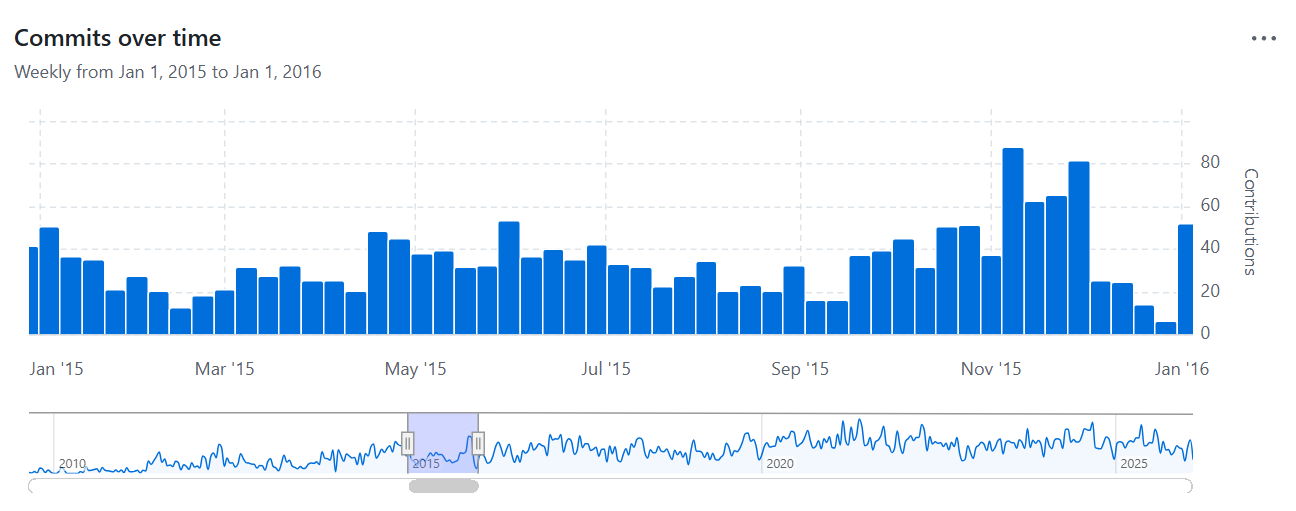
Public development data shows that Bitcoin Core was already under active, sustained development by 2015. Weekly commit activity throughout that year reflects ongoing maintenance, optimization, and feature work rather than a static or abandoned codebase.
Modern analyses of the Bitcoin Core repository report roughly 47,000–48,000 total commits today, depending on counting methodology (branches included, merged commits, and mirrors).
🚨🚨🚨 When that letter was penned, Bitcoin's codebase had roughly 12,000 commits. Fast forward to now, and it's up to 47,583 commits.
So, about 74.79% of the core Bitcoin development and coding happened after Jeffrey Epstein stepped in as the unofficial top benefactor. He… pic.twitter.com/M8crimUCdd
Reportedly, this means that approximately 74–75% of Bitcoin Core commits occurred after a specific historical period, often described as the “Epstein funding era.” That percentage is derived by comparing current commit totals with an assumed earlier snapshot of roughly 12,000 commits.
Bitcoin code commits. | Source: Github
What this means:
Bitcoin Core development accelerated significantly after 2015.
The majority of Bitcoin’s codebase has been modified, expanded, or refactored since its early years.
What cannot be stated as established fact:
That a single individual or benefactor exercised executive control over Bitcoin Core development.
That later commits imply the existence of intentional backdoors or hidden monetary controls.
Commit volume alone does not indicate motive, direction, or malicious intent. Large open-source projects routinely see most of their code written after initial release as security standards, operating systems, and network conditions evolve.
Claims Involving Jeffrey Epstein: What Is Known and What Is Not
Jeffrey Epstein (a sex offender) is a documented financier whose donations to academic institutions and limited involvement in technology investments have been established through court records and investigative reporting.
What is verifiable:
Epstein donated money to several research institutions.
Epstein invested in at least one major cryptocurrency company during the early 2010s.
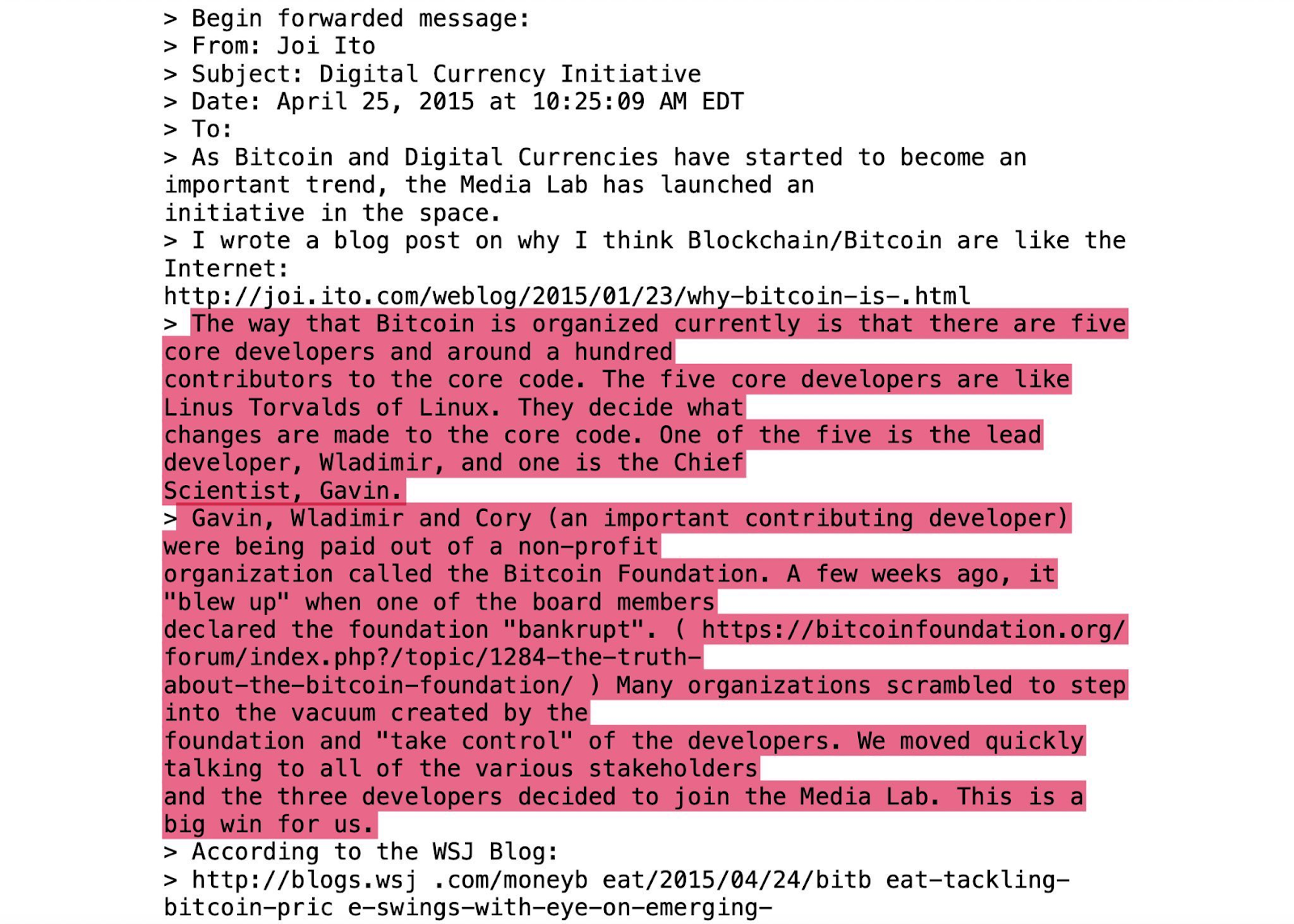
Epstein’s email to MIT Media Lab. | Credit: U.S. Department of Justice
What remains unproven:
That Epstein directed Bitcoin Core development.
That Bitcoin’s code contains intentional backdoors linked to any intelligence agency or private individual.
These claims circulate widely online but are not supported by primary technical or governance evidence.
FBI, Ransomware and ‘Recovered Bitcoin’
Bitcoin’s transparency has occasionally been misinterpreted as a weakness or a secret control mechanism. In cases such as the 2021 Colonial Pipeline ransomware incident, law enforcement recovered funds not by altering Bitcoin’s supply or ledger, but by gaining access to private keys through investigative means.
Colonial Pipeline, a major U.S. fuel infrastructure operator, was targeted by a ransomware attack carried out by the DarkSide hacking group. To restore operations quickly, the company paid a ransom of approximately 75 bitcoin, worth about $4.4 million at the time.
Shortly afterward, the U.S. Department of Justice announced it had recovered roughly 63.7 bitcoin from a wallet associated with the attackers. This led to public speculation that authorities had the ability to “reverse” Bitcoin transactions or seize funds directly from the network.
Blockchain transparency allows funds to be traced; it does not imply centralized control of the protocol itself.
Bitcoin’s market performance in early 2026 has been marked by sustained price weakness, breaking key support levels that had stood since its late-2025 all-time highs.
On February 5, 2026, Bitcoin fell below $70,000, reaching prices not seen since late 2024 and extending a multi-session slide in value. The drop followed broad weakness across risk assets, including technology stocks, Bitcoin’s centralization debate, and contributed to a rout that wiped out roughly $2 trillion in crypto market capitalization since late 2025.
Bitcoin has broken below the 2021 ATH trading near $68k.
Order books show most demand under $66k as support bids were hit or pulled.
That can set up a relief bounce, but without stronger spot demand and ETF flows any move risks being just a lower high in a fragile market. pic.twitter.com/wxMZgqP22O
In the same session, the price slump resulted in almost 8% intraday losses, testing levels below $70,000 amid thinning liquidity and renewed selling pressure.
Notably, Bitcoin’s decline has reflected a wider “risk-off” sentiment among global investors. Investments once buoyed by expectations of favorable policies and strong institutional demand have given way to caution, with some analysts expecting further downside risk.
Analysts and Commentary on Possible Further Downside
Market analysts have pointed to a range of factors contributing to continued price stress:
Several technical indicators suggest Bitcoin may be vulnerable to additional losses if key support levels fail to hold, potentially retracing toward lower thresholds around the mid-$60,000s and lower.
Prominent investor warnings have emerged, including forecasts that Bitcoin could decline toward $50,000, a psychologically significant level and one cited by some analysts as a possible bottom if bearish momentum accelerates.
Broader price forecasts range from modest retracements to projections of deeper downturns toward the $40,000 range if market conditions deteriorate further or selling pressure intensifies.
The recent period of volatility has also impacted companies with heavy exposure to Bitcoin. For example, firms with large Bitcoin holdings (e.g. Strategy) or mining operations have seen significant valuation declines amid the price slide.
Factors Influencing Market Conditions
Analysts have attributed the market downturn to several intersecting forces:
A related sell-off in global technology equities has been correlated with renewed weakness in Bitcoin and other digital assets, illustrating Bitcoin’s increasing alignment with broader risk assets.
Liquidity conditions in crypto markets remain thin, magnifying price moves and potentially increasing the severity of drawdowns when selling pressure mounts.
Despite the downturn, some market participants continue to view the price action as part of an expected cycle of volatility for a nascent and highly speculative asset class.
Did Bitcoin’s 21 million supply cap ever actually fail?
Yes, once. In August 2010, a software bug allowed more than 184 billion bitcoin to be created in a single block. The error was quickly fixed, and the blockchain was reorganized to remove the invalid coins. In 2018, a separate bug posed an inflation risk but was patched before any publicly documented supply violation occurred.
Does the 2018 vulnerability mean Bitcoin created extra coins?
There is no public evidence that additional bitcoin were successfully minted and retained due to the 2018 vulnerability. Developers patched the flaw after recognizing its potential impact, preventing a repeat of the 2010 incident.
Does law enforcement’s recovery of ransomware bitcoin mean Bitcoin is centrally controlled?
No. In cases such as the Colonial Pipeline ransomware incident, authorities recovered funds by obtaining private keys, not by altering Bitcoin’s protocol or reversing transactions. Control of bitcoin depends on private key access, not centralized network authority.
Do claims about Epstein funding prove Bitcoin was secretly controlled?
There is no verified evidence that Jeffrey Epstein controlled Bitcoin development or directed Bitcoin Core. While some financial donations and investments by Epstein are documented, claims linking him to Bitcoin governance or hidden backdoors remain unproven.
Disclaimer:
The information provided in this article is for informational purposes only. It is not intended to be, nor should it be construed as, financial advice. We do not make any warranties regarding the completeness, reliability, or accuracy of this information. All investments involve risk, and past performance does not guarantee future results. We recommend consulting a financial advisor before making any investment decisions.
Onkar Singh has three years of experience as a digital finance content creator. Throughout his career, he has collaborated with various DeFi projects and crypto media outlets. In his leisure time, he enjoys fitness activities at the gym and watching movies across different genres. Balancing his professional and personal interests, Onkar continues to contribute to the digital finance landscape while pursuing his hobbies.


 Easy
Easy