Jacob & Co. $40K Bitcoin Mining Watch: Jacob & Co. Bitcoin Mining Watch: How the Epic X GoMining Model Really Works
Share
Key Takeaways
Bitcoin mining economics are structurally changing.
Active treasury management could become a survival tool.
Not all miners can pivot to AI infrastructure.
Bitcoin mining firms are facing a structural shift in their economics as shrinking revenues and rising costs squeeze profitability, prompting some firms to pivot into artificial intelligence infrastructure while others search for new ways to survive.
A new report from crypto market maker Wintermute argues that the current cycle represents a fundamentally different phase for the industry.
While miners have endured downturns before, the firm says the combination of slower Bitcoin price growth, rising operating costs and weak transaction fee revenue means the traditional mining business model is under increasing strain.
Try Our Recommended Crypto Exchanges
Sponsored
Disclosure
We sometimes use affiliate links in our content, when clicking on those we might receive a commission at no extra cost to you. By using this website you agree to our terms and conditions and privacy policy.
Bitcoin Mining Economics Are “Breaking”, Wintermute Says
Wintermute said the current Bitcoin mining cycle — which it calls “Epoch 5” — is structurally different from previous ones, warning that the economic assumptions underpinning the sector may no longer hold.
“Peak margins this cycle are where prior cycles bottomed,” said Jasper De Maere, Wintermute’s head of research, in the report.
Bitcoin miners earn revenue through block rewards and transaction fees, while their costs are largely tied to electricity and computing hardware.
Every four years, however, the Bitcoin protocol halves the block reward — meaning miners must rely on higher Bitcoin prices or rising fees to maintain profitability.
Historically, this model worked because Bitcoin’s price surged dramatically between halvings.
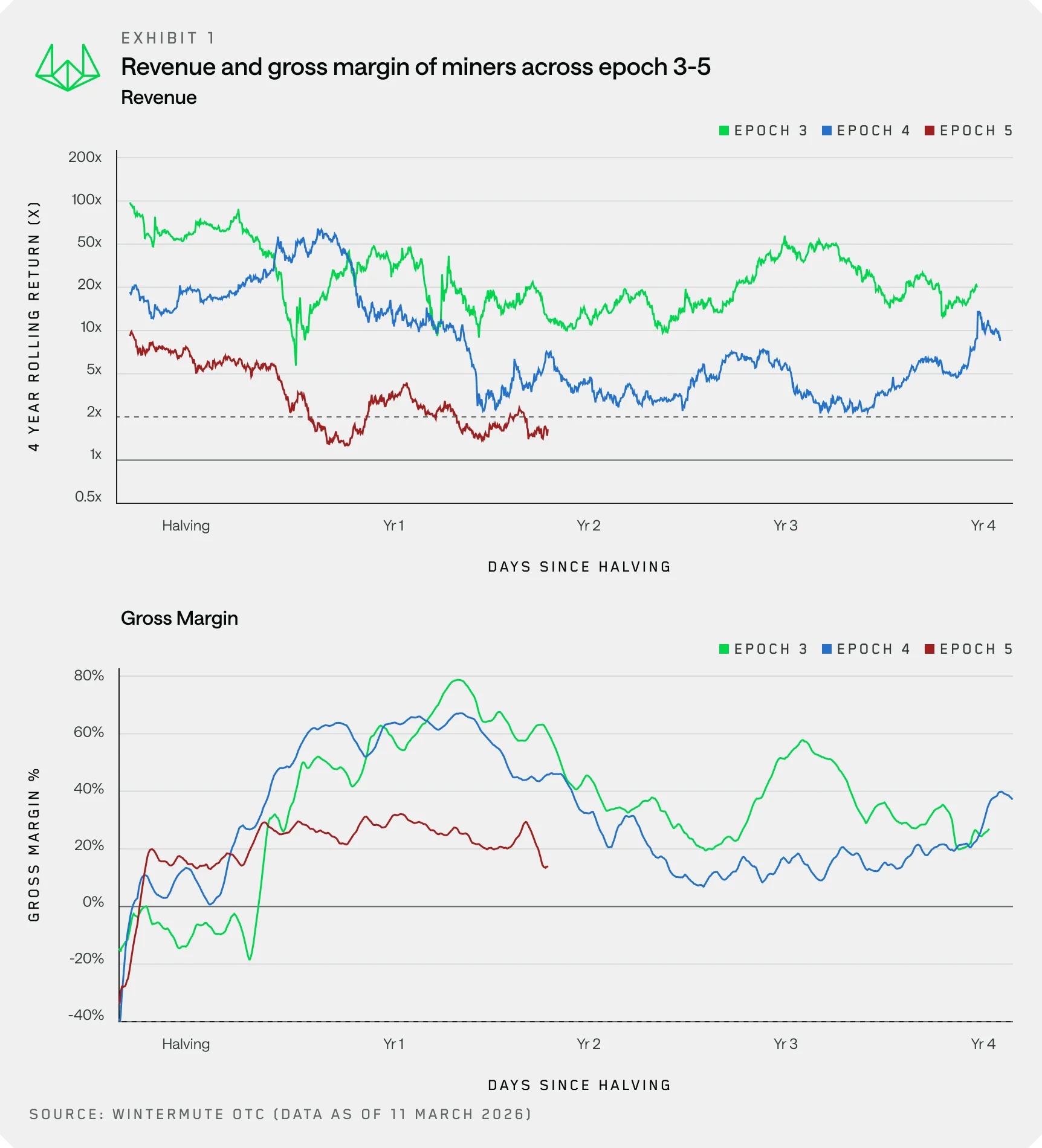
Source: Wintermute OTC (Data as of March 11 2025)
According to Wintermute, that pattern appears to be weakening.
“Block rewards halve every four years by design. If BTC doesn’t at minimum double over that same window, miner revenue is in structural decline,” the report said.
So far in the current cycle, Bitcoin has delivered roughly 1.15× returns on a four-year basis, well short of the 2× threshold miners typically need to offset the halving, the report said.
At the same time, transaction fees — long expected to replace block subsidies — have not meaningfully filled the gap.
“Fee revenue is episodic, not structural,” Wintermute said. “A business cannot be underwritten on recurring congestion.”
As a result, the firm argues that what miners are experiencing today is not just a temporary downturn but a deeper shift in industry economics.
“The break is structural, not cyclical,” the report said. “Bitcoin is maturing.”
Three Ways Bitcoin Mining Can Survive the New Cycle
Wintermute says miners must adapt to the new environment by focusing on three main strategies:
1. Repurpose Infrastructure For AI
One increasingly popular option is converting mining facilities into high-performance computing (HPC) infrastructure to serve the artificial intelligence sector.
“Hyperscalers and AI compute operators are in a race to secure power at scale,” Wintermute said.
Bitcoin miners often operate large energy-connected facilities in low-cost regions — infrastructure that can be repurposed for data centers.
“Bitcoin miners spent years building large-scale power infrastructure in low-cost energy markets. They now find themselves sitting on exactly what the AI industry needs most urgently and cannot easily replicate.”
Such conversions can dramatically increase asset valuations, with sites previously valued under mining economics now fetching much higher prices when repositioned as AI infrastructure.
Still, Wintermute cautioned that the pivot is not available to every operator.
“Not every miner has the site quality, balance sheet, or bandwidth to reposition as an infrastructure company,” it wrote
2. Focus Aggressively On Input Costs
Mining remains a simple but unforgiving business: revenue is determined by Bitcoin’s price and network competition, while costs are driven primarily by energy and hardware.
“With so few levers to pull, when revenue compresses, margin compresses with it,” the report said.
Wintermute noted that margins have steadily declined across successive Bitcoin cycles, with peak margins in the current epoch reaching roughly 30% — levels that previously marked bear-market lows.
This means operators must compete more aggressively on energy sourcing, hardware efficiency and operational scale to remain viable.
3. Use Active Treasury Management
The possibly most underused survival strategy, according to Wintermute, is active management of Bitcoin holdings.
Miners collectively control nearly 1% of the total Bitcoin supply, much of it sitting idle on company balance sheets.
“Active treasury management represents another lever — one that is often underexplored,” the report said.
Rather than simply holding Bitcoin reserves, miners could generate yield through derivatives strategies or lending markets.
“The miners who treat their BTC holdings as a working asset rather than a passive reserve will carry a structural edge into the next halving.”
Miners Increasingly Pivot to AI
The pressures facing the mining sector have already triggered a strategic shift among several companies, many of which are exploring partnerships with AI firms.
Tiger Research estimates the average cost to mine one Bitcoin has climbed to roughly $74,600, with total production costs reaching about $130,000 per coin once depreciation and stock-based compensation are included.
“These moves reflect a broader trend,” the research firm said. “As mining profitability weakens, mining companies are seeking business models better aligned with the AI era.”
The pivot could ultimately reduce forced selling of Bitcoin by stabilizing miners’ cash flows, researchers said.
Meanwhile, a sharp recent drop in Bitcoin’s total computing power has reignited debate over whether miners are capitulating.
Investor Charles Edwards warned that Bitcoin’s hashrate had fallen about 40% from recent highs, calling it the largest miner capitulation since 2021.
Other analysts dispute that interpretation, arguing that temporary declines often occur during periods of rising electricity prices or extreme weather events.
A recent winter storm in the U.S. forced several large mining operations to curtail activity temporarily.
Despite the turbulence, Wintermute argues the shake-up may ultimately strengthen the industry.
“The industry is being forced to grow up,” the report said. “The ones who do it fastest will still be here for Epoch 6.”
Kurt Robson is a London-based reporter at CCN, specialising in the fast-moving worlds of crypto and emerging technology. He began his career covering local news in Cornwall after graduating from Falmouth University with First Class Honours in Journalism. There, he cut his teeth on everything from council meetings to missing swans.
He quickly rose through the ranks to become a frontline journalist at several of the UK’s leading national newspapers. Over the years, he has interviewed musicians and celebrities, reported from courtrooms and crime scenes, and secured multiple front-page exclusives.
Following the upheaval of the COVID-19 pandemic, Kurt shifted his focus to technology journalism—just ahead of the AI boom. With a natural curiosity and a trained eye for emerging trends, he has found a new rhythm in reporting on innovation.
At CCN, Kurt's work focuses on the cutting edge of crypto, blockchain, AI, and the evolving digital world. Drawing on his background in people-first reporting and his deep interest in disruptive tech, Kurt delivers stories that are insightful, entertaining, and human-centric.