Home / Education / Crypto / Regulation / Did Jeffrey Epstein ‘Spend Time at Treasury With the Bitcoin Task Force’ and Launder Money Through World of Warcraft? What the DOJ Files Reveal
Did Jeffrey Epstein 'Spent Time at Treasury With the Bitcoin Task Force' and Launder Money Through World of Warcraft? What the DOJ Files Reveal
Share
Key Takeaways
Epstein claimed to consult with a “Bitcoin Task Force” of the U.S. Treasury, implying that he had early access to federal regulatory discussions.
According to allegations, Epstein’s donations to the MIT Media Lab aided in the transition of Bitcoin Core development to academia, potentially affecting the protocol’s early governance.
Evidence suggests Epstein used World of Warcraft’s in-game gold market as an undetectable link to launder millions of dollars in illicit cash.
Internal correspondence hints at an effort to suppress “centralization threats” like Ripple in favor of infrastructure stacks aligned with Epstein’s network.
As of February 2026, a new wave of files from the United States Department of Justice has revealed Jeffrey Epstein’s engagement with the crypto space. Among the millions of pages made public under the Epstein Files Transparency Act, a 2014 email thread stands out.
In one email, Epstein casually indicates a meeting with a “Bitcoin task force” at the U.S. Treasury Department, raising concerns about what discussions took place and whether they are still relevant today. The fact that someone as controversial as Epstein may have been influencing, or at least privy to, the U.S. Treasury’s internal deliberations on Bitcoin (BTC) complicates the overall history of crypto regulation.
The article examines the emails, their historical background, Epstein’s crypto ties, and the long-term implications for digital assets and regulation.
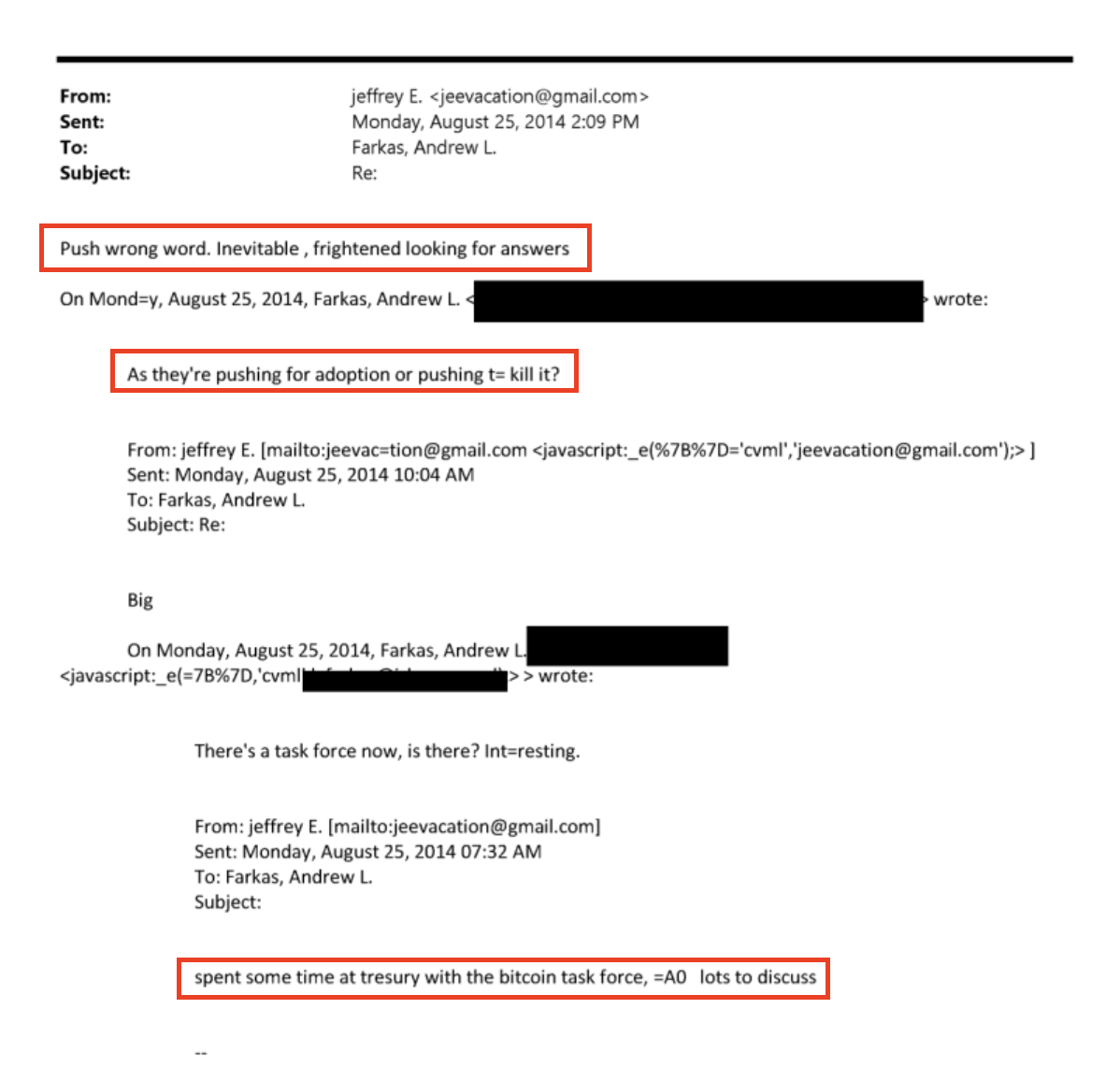
Correspondence between Jeffrey Epstein and Andrew Farkas | Credit: U.S. Department of Justice
What Is the 2014 Bitcoin Task Force About?
In this context, a “task force” typically refers to an interagency council that is assigned to determine how to apply current financial regulations to decentralized technologies. This group frequently includes officials from the IRS, DOJ, and SEC.
Bitcoin rose sharply in 2014, with prices exceeding $1,000 before it dropped. In 2013, the Treasury Department’s Financial Crimes Enforcement Network (FinCEN) classed virtual currencies as money services businesses and required registration to fight illegal use.
That year, Treasury Secretary Jacob Lew warned of cryptocurrency’s potential for abuse, while the IRS classified Bitcoin as property for tax purposes. Epstein’s access could be through Summers or other sources, as he advised Steve Bannon on regulatory issues in emails in 2018.
The fact that Epstein claimed to have spent “some time” with this group implies that the Treasury was looking for insights from private wealth managers on how the “old guard” of finance regarded the “new guard” of cryptography.
What Do the Epstein Emails Reveal About Treasury Access?
The core of this email correspondence is a series of emails received on August 25, 2014. In these texts, Epstein talks about his recent activities with real estate executive Andrew Farkas. In this thread, Farkas acts as a sounding board, probing Epstein’s Treasury intel. Their relationship underscores Epstein’s network: Farkas connected him to figures like Larry Summers, who appeared in Epstein’s drafts as a potential will executor. This elite circle amplified Epstein’s influence, even post-2008 conviction.
This exchange is telling for several reasons. First, it may depict a federal government believing that power was slipping away from it. The word “inevitable” can imply that Epstein, and possibly the officials he spoke with, realized that Bitcoin could not be “turned off” or banned.
Second, the description of the Treasury as “frightened” implies a lack of technical understanding within the halls of power at that time. They were “looking for answers” from anyone they perceived as having an edge in the financial markets.
These brief exchanges carry confidentiality disclaimers, marking them as potentially privileged. Released in DOJ Data Set 11, they align with Epstein’s pattern of flagging sensitive topics as “=AO” (Adults Only) in other files, suggesting discretion. There are no direct recordings of Treasury meetings available in the public record, but the emails suggest Epstein had close access during a key year for crypto regulation.
Did Epstein Connections Affect Digital Assets?
Debates of socials arose whether Epstein’s influence extended beyond the Treasury and into the very code of Bitcoin. Epstein’s network funneled resources into Bitcoin’s infrastructure. His MIT donations may shifted Bitcoin Core development from the collapsing Bitcoin Foundation to academia.
🚨 THE EPSTEIN BITCOIN TASK FORCE & THE TREASURY 🚨
The newly released Jmail archives have uncovered a 2014 email chain that rewrites the history of early crypto. It reveals Jeffrey Epstein claiming he "spent some time at Treasury with the Bitcoin Task Force".
This “institutional capture” is linked to internal emails showing a strategic backlash against early rivals like Ripple (XRP), which the network allegedly viewed as a threat to the more centralized financial models they sought to protect. Proponents of this theory argue that the SEC’s subsequent aggressive litigation against Ripple was a second-order effect designed to safeguard “Epstein-approved” infrastructure stacks.
While no direct evidence has surfaced linking Epstein’s personal estate to specific SEC enforcement decisions, the timeline of his involvement with Bitcoin’s foundational players continues to fuel questions about the elite ties that steered early crypto regulation.
Allegations That Jeffrey Epstein Exploited Online Game Economies
In addition to the above, Epstein allegedly exploited digital backdoors through the massive multiplayer online game World of Warcraft (WoW). Reports suggest he utilized the game’s internal economy to launder funds by purchasing in-game gold with illicit cash and later selling it for clean, real-world money.
🚨🇺🇸 BREAKING: Epstein supposedly had a hand in the appearance of microtransactions in video games. pic.twitter.com/fjlxghkIHJ
This process was relatively simple: one could buy gold with real money, trade it between various anonymous accounts, and then sell the gold back for real cash. Back in 2007, Steve Bannon was coincidentally running Internet Gaming Entertainment (IGE), a company that specialized in selling in-game gold for real-world currency.
This intersection has led many to speculate that some WoW players might have unwittingly traded “Epstein gold” as it was laundered through the game’s massive digital marketplace.
🚨EPSTEIN USED WORLD OF WARCRAFT TO LAUNDER MONEY THROUGH IN GAME GOLD🚨
It’s simple, buy gold with real money then trade gold around accounts and sell gold for real money. An untraceable way to move it.
This intersection of high-finance figures and digital marketplaces suggests that “gold farming” may have served as an untraceable bridge for moving millions across borders long before Bitcoin reached the mainstream.
Jeffrey Epstein was reportedly banned from Xbox Live in 2013, with the platform citing behavior described as “harassment, threats, and/or abuse of other players” that was “severe, repeated, and/or excessive,” according to available accounts.
Jeffrey Epstein was banned from Xbox Live in 2013 due to “harassment, threats, and/or abuse of other players” that was “severe, repeated, and/or excessive.”
How Behind-the-Scenes Influence Helped Shape Crypto Regulation
These disclosures matter to investors and users because they offer insight into how regulatory frameworks are often developed. In many cases, policy formation involves informal education and consultation between government officials and private sector participants, particularly when new technologies emerge faster than existing rules.
If officials were uncertain or seeking guidance during Bitcoin’s early years, those who engaged with policymakers may have influenced how regulatory infrastructure evolved. This raises broader questions about how early narratives and expert perspectives contributed to shaping today’s crypto regulatory environment.
As of 2026, the release of additional historical records related to Epstein underscores the importance of transparent, public-facing regulatory processes, especially in areas involving rapidly evolving financial technologies. Open consultation and clear documentation help reduce reliance on informal task forces and closed-door discussions.
Bitcoin’s transition from an unfamiliar and disruptive technology to a core component of global financial markets is now well established. At the same time, newly available archives continue to shed light on the individuals and ideas that influenced its early regulatory treatment.
Were there emails between Epstein and former SEC Chair Gary Gensler?
A correspondence reveals Epstein praising Gary Gensler and discussing crypto regulation, fuelling speculation about his influence on SEC moves regarding specific projects.
How Much Did Epstein Invest in Early Crypto Exchanges Like Coinbase?
Through his Virgin Islands-based entity IGO Company LLC, Epstein committed $3 million to Coinbase’s Series C funding round in 2014–2015, securing less than 1% equity stake introduced by associate Brock Pierce.
Did Epstein's connections spark calls for resignations in the crypto industry?
Bitcoin Core developer Luke Dashjr publicly requested Blockstream CEO Adam Back’s resignation following reports of Epstein’s recurring interactions with the company’s founders during its early years.
What Investments Did Epstein Make Through Peter Thiel's Funds?
Epstein invested $40 million into funds operated by Valar Ventures, backed by Peter Thiel, and sought Thiel’s advice on other opportunities, including crypto-related ventures post-2008 conviction.
Disclaimer:
The information provided in this article is for informational purposes only. It is not intended to be, nor should it be construed as, financial advice. We do not make any warranties regarding the completeness, reliability, or accuracy of this information. All investments involve risk, and past performance does not guarantee future results. We recommend consulting a financial advisor before making any investment decisions.
Curious about how technology and crypto reshape global finance, Elizaveta Savenko explores blockchain, AI, decentralized systems, their applications, and regulatory requirements. She contributes to research, educational initiatives, and industry collaborations, examining trends in digital assets and fintech innovation, increasing awareness of the crypto space and its impact on financial systems.


 Easy
Easy