Ripple Joins x402 Foundation to Advance XRP and RLUSD AI Payments
Share
Key Takeaways
XRP Ledger surpassed one million agentic transactions; each costs a fixed $0.0002.
40 Premier Members include AWS, Google, Visa, Mastercard, Stripe, Circle, and Coinbase.
Coinbase’s Base leads with 119 million x402 payments; XRPL’s million marks early-stage positioning.
The x402 Foundation launched under the Linux Foundation on July 14, formally receiving the x402 protocol that Coinbase contributed as an open standard for internet-native payments.
When an AI agent requests access to a paid service, the server responds with a required amount, an accepted asset, and a receiving address. The agent’s wallet signs and sends the payment.
The server delivers the content, data, or compute immediately after settlement. No human approves the transaction, and no bank account is required.
Ripple is proud to join the x402 Foundation as a Premier Member.
As AI agents begin to take on more of the transaction lifecycle, they'll need a way to pay that's as fast and reliable as the way they already exchange data. We've been helping build that future on the XRP Ledger… https://t.co/eSzTyXBQFm
Ripple joined as a Premier Member on the same day, placing both XRP and RLUSD, its dollar-backed stablecoin with a $1.26 billion market cap, inside the payment standard that 40 major institutions across finance, cloud infrastructure, payments, and blockchain are now building on.
Try Our Recommended Crypto Exchanges
Sponsored
Disclosure
We sometimes use affiliate links in our content, when clicking on those we might receive a commission at no extra cost to you. By using this website you agree to our terms and conditions and privacy policy.
The foundation membership caps months of deliberate infrastructure work rather than arriving as a standalone announcement. In June, Ripple released the XRPL AI Starter Kit, a developer toolkit including an MCP documentation server, an agent wallet skill, and a payment tutorial that guides developers from initial setup to a confirmed XRPL transaction supporting x402 payments in XRP and RLUSD.
Ripple-backed t54.ai followed with the XRPL AI Hub, providing resources for developers building AI-powered applications on the ledger. The XRPL Foundation confirmed the network surpassed one million agentic transactions shortly after x402 support launched, reflecting growing developer testing of autonomous payment workflows.
In the same period, Mastercard named Ripple as one of more than 30 launch partners for its own agent-payments network.
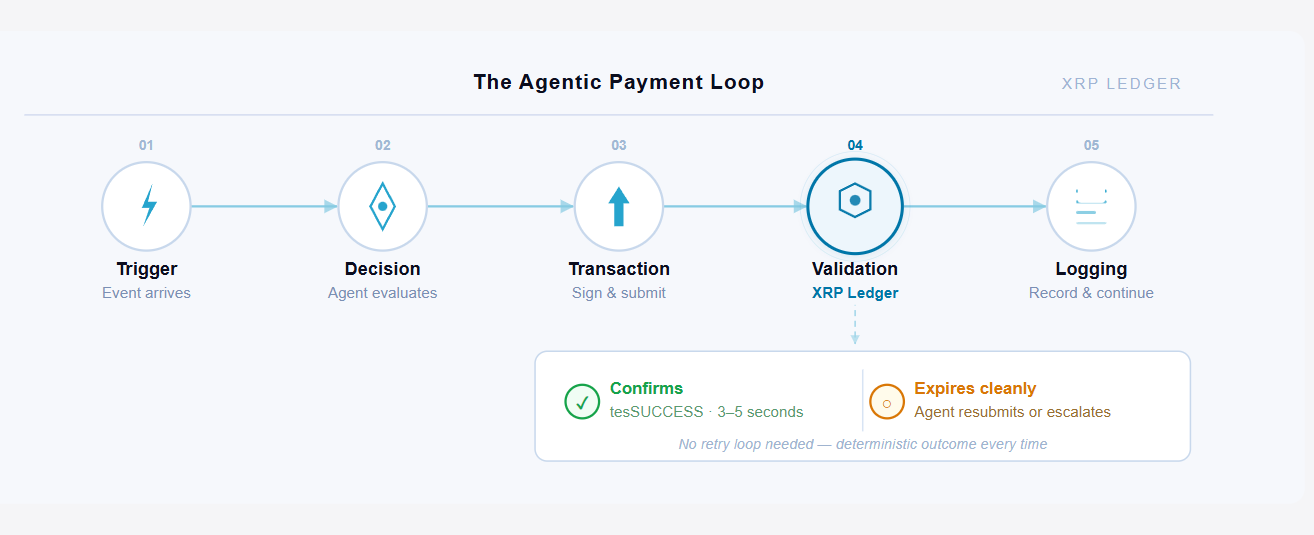
The XRPL’s technical characteristics suit the use case. Transactions achieve deterministic finality in three to five seconds. Fees are predictable and fixed at approximately $0.0002.
Agents can operate non-custodial wallets funded with XRP or RLUSD, paying for APIs, storage, and cloud computing without relying on banks, and can retain XRP earned from completed tasks to fund future operations.
Where XRPL Sits Against USDC in the x402 Race
The competitive backdrop is an important context. Coinbase’s Base network has processed more than 119 million x402 payments. Solana has handled approximately 35 million.
Both had a year’s head start and settled most of their volume in USDC. XRPL’s one million transactions are early-stage by comparison.
How agentic payments work on XRPL. | Source: xrpl.org
The x402 Foundation is explicitly network-neutral, meaning XRP competes alongside USDC, traditional cards, and other blockchains under the same protocol.
Foundation membership gives Ripple a governance role in how the standard evolves, which matters more at this stage than raw transaction counts.
The foundation’s broader membership underscores how seriously the largest technology and payments companies are treating the machine-economy payment layer.
AWS, American Express, Cloudflare, Fiserv, Shopify, the Solana Foundation, and the Stellar Development Foundation are all Premier Members.
The standard the foundation governs will likely become the default payment infrastructure for AI agents across the internet within this decade.
Where XRP and RLUSD land in that standard’s adoption curve depends on whether Ripple can convert its governance position and developer toolkit into the kind of institutional-grade transaction volume that USDC currently holds on Base.
The foundation brings together 40 major organizations, including AWS, Google, Visa, Mastercard, Stripe, Coinbase, and Circle, to develop an open payment standard for AI agents, placing XRP alongside some of the largest names in finance and cloud computing.
The bigger question is adoption. XRP Ledger has already processed more than one million agentic payments, but it still trails Coinbase’s Base network, which has handled over 119 million x402 transactions.
That suggests XRP is still in the early stages of the AI payments race.
If AI agents become mainstream users of blockchain infrastructure, demand for assets that can settle payments quickly and cheaply could increase.
XRP’s low fees and three-to-five-second settlement time make it technically competitive, but sustained price appreciation will depend on whether Ripple can convert its governance role, developer tools, and institutional partnerships into meaningful transaction volume rather than announcements alone.
Disclaimer:
The information provided in this article is for informational purposes only. It is not intended to be, nor should it be construed as, financial advice. We do not make any warranties regarding the completeness, reliability, or accuracy of this information. All investments involve risk, and past performance does not guarantee future results. We recommend consulting a financial advisor before making any investment decisions.
Dr. Guneet Kaur is a senior editor at CCN.com and a Science Fellow at Exponential Science. She is a fintech and blockchain expert with extensive experience in digital finance education, blockchain ecosystems, and cryptocurrency markets. She has worked with global media such as Cointelegraph, as well as education and blockchain platforms, to design and lead strategic content and learning initiatives. As an educator and assessor for top-tier executive programs, she bridges real-world fintech trends with academic insight.
Dr. Kaur is also a published researcher and peer reviewer across fintech and data science journals, including Financial Innovation Journal and International Journal of Big Data Intelligence and Applications. Her work spans data-driven analysis, Web3 innovation, and technical content development. With a strong foundation in both industry and academia, she translates complex financial technologies into practical applications, empowering learners, professionals, and institutions across the rapidly evolving digital finance landscape.