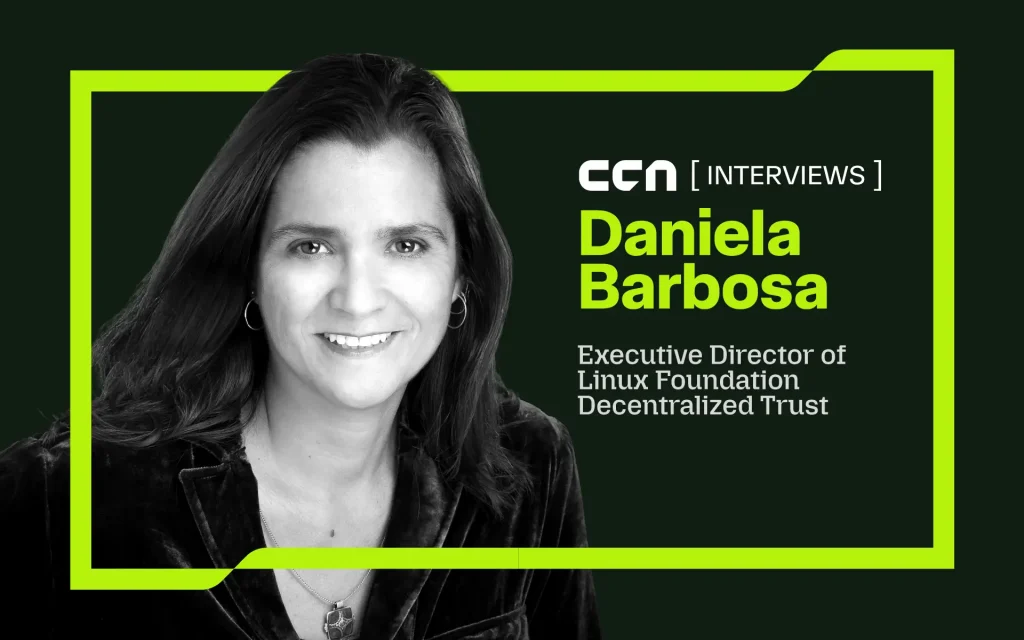
“It’s not going to be one blockchain-related. It’s going to be across multiple systems”| Image credit: CCN
Share
Key Takeaways
Linux Foundation Decentralized Trust has expanded beyond Hyperledger into interoperability, decentralized identity, cryptography, and enterprise blockchain infrastructure.
Daniela Barbosa believes open governance and code neutrality strengthen blockchain ecosystems by encouraging broader participation and collaboration.
Digital identity and AI verification systems could become critical infrastructure as deepfakes, AI agents, and data ownership concerns accelerate.
Barbosa expects blockchain to evolve into invisible infrastructure powering industries without users constantly discussing the technology itself.
Blockchain infrastructure continues to move beyond cryptocurrency speculation as financial institutions, governments, developers, and enterprise systems increasingly adopt decentralized technologies.
Over the past decade, open-source initiatives such as Hyperledger have helped introduce distributed ledger technology (DLT) into industries focused on payments, tokenization, identity, interoperability, and financial infrastructure.
Linux Foundation Decentralized Trust, formerly known as Hyperledger, sits at the center of many of those efforts.
In an interview with CCN, Linux Foundation Decentralized Trust Executive Director Daniela Barbosa discussed how open source governance shapes blockchain ecosystems, why interoperability remains difficult, and how decentralized identity could become increasingly important in the AI era.
How Linux Foundation Moved Beyond Hyperledger
Barbosa explained that the Linux Foundation has spent decades supporting major open source projects across industries ranging from cloud computing to AI.
“For the last 30 years, the Linux Foundation has been the home for, I would say, the most important open source projects, including the Linux kernel as well,” Barbosa says.
She said blockchain initiatives emerged inside the foundation around 2016, when major technology firms and financial institutions started collaborating on distributed ledger infrastructure.
“At the time, distributed ledger technology was how it mostly was described,” Barbosa says.
According to Barbosa, the organization later expanded beyond blockchain ledgers into a broader decentralized trust infrastructure.
“We have open source projects and open source communities that are really diverse. They’re not just about ledgers anymore because the adoption of these technologies into production systems today it’s not just a blockchain,” she says.
Barbosa said Linux Foundation Decentralized Trust now supports interoperability projects, cryptography tools, decentralized identity frameworks, tokenization initiatives, and enterprise blockchain systems.
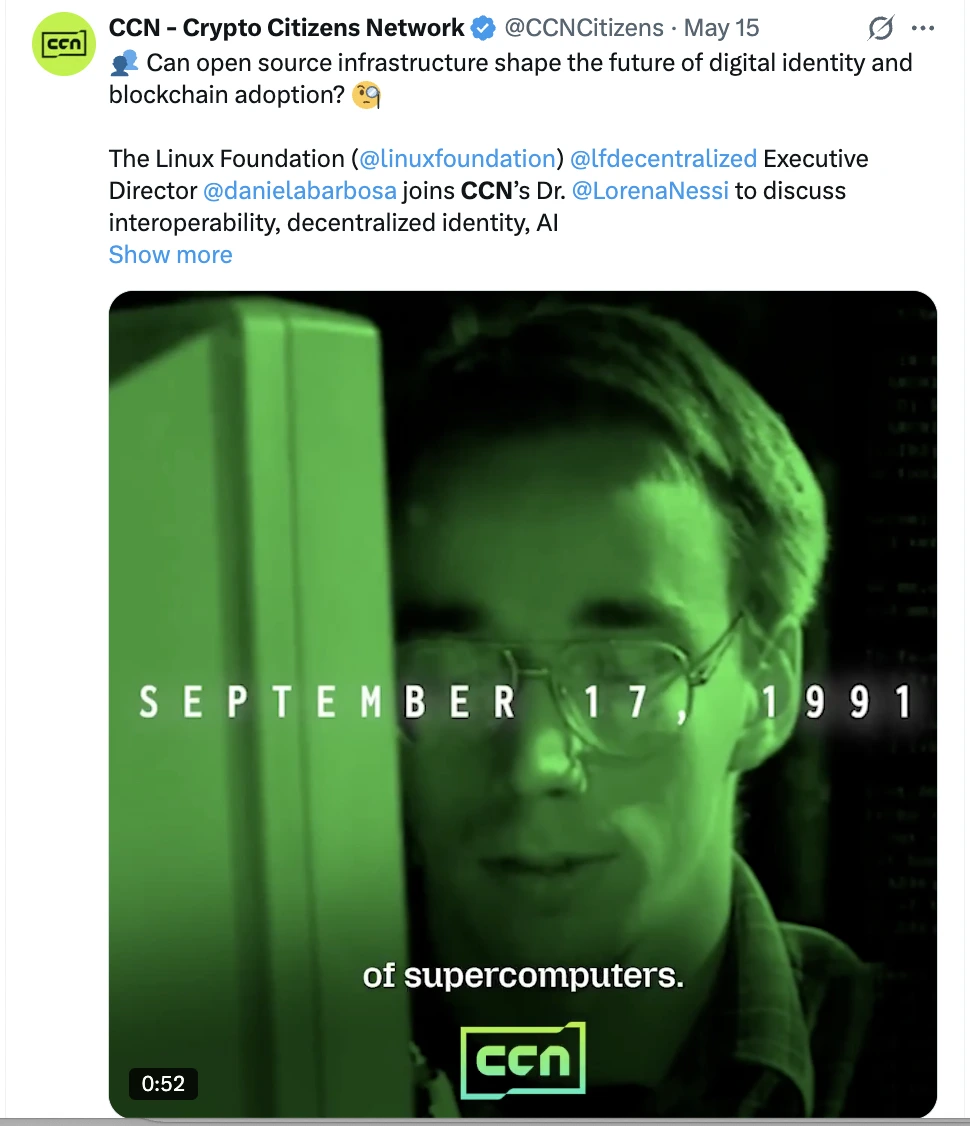
Interview teaser on CCN | Source: X @CCNCitizens
Three Pillars Behind Blockchain Adoption
Barbosa described three main priorities driving Linux Foundation Decentralized Trust.
The first centers on developers and open source contributors.
“If we’re not making the developers happy and successful, we’re not doing our job,” she says.
The second focuses on education and workforce development.
Barbosa pointed to the foundation’s introductory blockchain course launched in 2017, which attracted hundreds of thousands of participants.
“Close to 300,000 people took that course and got certified to be intro to blockchain,” she says.
She said education now extends into advanced certifications covering blockchain engineering, decentralized identity, and enterprise deployment.
The third pillar involves building commercial ecosystems around open source projects.
“Open source doesn’t mean that you get abandoned,” Barbosa says.
According to Barbosa, enterprises still require vendors, support providers, certified developers, and service agreements to deploy blockchain systems at scale.
“Our job, that third pillar, remember I’ve talked about that building that healthy, growing commercial ecosystem that enterprises can rely on,” she says.
Why Code Neutrality Matters in Blockchain
The conversation later shifted toward decentralization and governance.
Barbosa said neutral governance structures encourage broader collaboration and reduce concerns around corporate control.
“How do you make sure that these protocols, how do you make sure that these tools and even standards and specs are not controlled by one company?” she says.
She highlighted Hiero, Hedera’s open-source codebase hosted under the Linux Foundation Decentralized Trust, as an example of how public blockchain ecosystems are attempting to decentralize governance.
“Hedera is the first public blockchain, so a public layer one that has its entire code base in a neutral foundation,” Barbosa says.
According to Barbosa, open governance helps attract contributors who may hesitate to support ecosystems dominated by single organizations or treasury structures.
According to Barbosa, open governance helps attract contributors who may hesitate to support ecosystems dominated by single organizations or treasury structures.
At the same time, she acknowledged that transitioning toward neutral governance models creates coordination challenges and requires significant long-term collaboration between maintainers, developers and organizations.
Watch the full interview here:
Interoperability Still Faces Major Challenges
Barbosa argued that interoperability extends beyond simple cross-chain asset transfers.
“I think a lot of people in our industry, when they think of interoperability, cross-chain asset transfers, right? But there’s a lot of different requirements on the interoperability side,” she says.
Linux Foundation Decentralized Trust currently hosts interoperability-focused projects, including Hyperledger Cacti, the ecosystem’s primary blockchain interoperability framework designed to connect heterogeneous distributed ledgers, alongside broader standards initiatives.
Barbosa also referenced the recently announced Open Tokenization Asset Standard (OTIS), which aims to create shared token standards across blockchain ecosystems.
“It’s not going to be one blockchain-related. It’s going to be across multiple systems,” she says.
She believes collaboration between protocols, standards bodies, developers, and enterprises remains essential if tokenized assets and decentralized systems are expected to scale globally.
“Across multiple ecosystems, work needs to get done,” Barbosa says.
Why Digital Identity May Become Critical in the AI Era
Digital identity became one of the central themes of the interview.
Barbosa said decentralized identity systems will likely become more important as AI agents, deepfakes, and automation increase concerns around authenticity and privacy.
“Identity is critical and has been in our community, we said it’s been critical for the last 10 plus years,” she says.
She discussed initiatives around self-sovereign identity, trust registries, and agent verification systems designed to protect privacy while verifying authority.
“How do you verify that that agent has the authority to do that action or that thing on my behalf?” Barbosa says.
According to Barbosa, future systems will need stronger protections around personal data ownership, digital identity portability, and privacy-preserving authentication.
“How do you create ownership of that as well?” she says.
Barbosa believes AI agents could accelerate the adoption of self-sovereign identity systems.
“I really think that agents are going to be the path to getting human identity self-sovereign,” she says.
Barbosa Expects Blockchain To Become Invisible Infrastructure
Looking ahead, Barbosa believes blockchain technology will eventually fade into the background as infrastructure powering multiple industries.
“In five years’ time, from a blockchain perspective, no one’s gonna talk about blockchain anymore,” she says.
Instead, she expects blockchain systems to become embedded across finance, healthcare, payments, identity, and enterprise networks.
“It’s just gonna be core technology that powers all industries,” Barbosa says.
At the same time, she warned that the industry will continue facing security incidents, regulation challenges, and infrastructure risks as adoption accelerates.
“There’s going to be a huge, huge breach,” Barbosa emphasizes.
Despite those concerns, Barbosa remains optimistic about the role of open source collaboration.
“I am always feeling that open source and open governance and open development, how we started our conversation, is going to be the core to really building an inclusive world for all of us,” she says.
Open source governance, interoperability, digital identity, and AI infrastructure are increasingly converging as blockchain technology moves into mainstream systems.
Daniela Barbosa believes the next phase of adoption will depend less on speculation and more on collaboration, education, regulation, and trusted infrastructure capable of supporting financial systems, enterprise operations, and digital identity frameworks at scale.
Disclaimer:
The information provided in this article is for informational purposes only. It is not intended to be, nor should it be construed as, financial advice. We do not make any warranties regarding the completeness, reliability, or accuracy of this information. All investments involve risk, and past performance does not guarantee future results. We recommend consulting a financial advisor before making any investment decisions.
Dr. Lorena Nessi is an award-winning journalist and media technology expert with 15 years of experience in digital culture and communication. Based in Oxfordshire, UK, she combines academic insight with hands-on media practice.
She holds a PhD in Communication, Sociology, and Digital Cultures, and an MA in Globalization, Identity, and Technology.
Lorena has taught at Fairleigh Dickinson University, Nottingham Trent University, and the University of Oxford. She is a former producer for the BBC in London, with additional experience creating television content in Mexico and Japan.
Her research focuses on digital cultures, social media, technology, capitalism, and the societal impact of blockchain innovation.
She has written extensively on digital media and emerging technologies, with her work featured in both academic and media platforms. Her Web3 expertise explores how blockchain technologies shape culture, economics, and decentralized systems.
Outside of work, Lorena enjoys reading science fiction, playing strategic board games, traveling, and chasing adventures that get her heart racing. A perfect day ends with a relaxing spa and a good family meal.


 Easy
Easy