XRPL just crossed $2B in tokenized assets. As real-world finance moves on-chain, could this milestone set up XRP price for a new all-time high? | Credit: CCN.com
Share
Key Takeaways
Ripple is exploring Amazon Bedrock AI for XRPL operations to improve efficiency by using AI agents to analyze XRP Ledger system logs.
The AWS-Ripple connection is visible within Amazon’s partner ecosystem and technical demonstrations.
Faster log-to-code correlation, lower operational risk, and smoother scaling make XRPL more attractive for banks and payment processors.
Improved infrastructure supports long-term utility, liquidity, and derivatives markets rather than short-term speculative pumps.
The convergence of artificial intelligence and blockchain infrastructure is no longer theoretical. It is happening quietly, inside enterprise systems, cloud platforms, and production-grade tooling.
One of the clearest signals of this shift is Ripple’s growing integration with Amazon Web Services (AWS), specifically its exploration of Amazon Bedrock AI to improve efficiency and scalability on the XRP Ledger (XRPL).
This development is not a flashy partnership announcement aimed at retail traders. It is infrastructure-level experimentation that could significantly alter how XRPL operates and how the market ultimately values XRP.
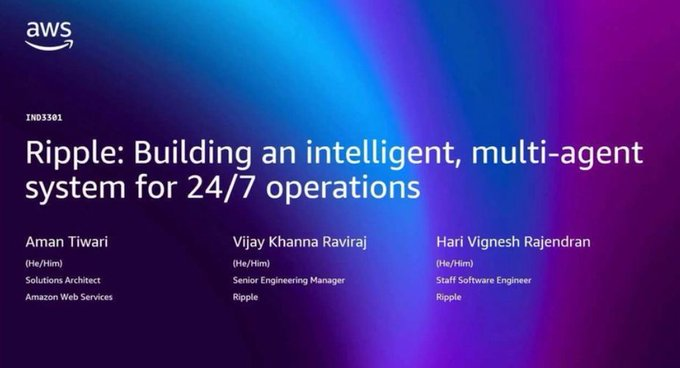
Please note that iInformation currently circulating within the XRP and blockchain community regarding Ripple and Amazon Web Services (AWS) has not been released through a formal press announcement by either company. Instead, the discussion originates from publicly available conference materials and presentations, most notably an AWS re:Invent 2025 session titled “Ripple: Building an intelligent, multi-agent system for 24/7 operations.”
Ripple-AWS integration. | Credit: RealAllinCrypto X profile
The session, presented by Ripple engineers alongside an AWS solutions architect, outlines how Ripple has been experimenting with advanced AWS tooling, including generative AI capabilities associated with Amazon Bedrock, to enhance internal operational monitoring and diagnostics related to the XRP Ledger (XRPL).
🚨 BOOOOOOOOOMMB 🚨
AWS x RIPPLE
AWS and Ripple are exploring an Amazon Bedrock integration with the XRP Ledger.
While these materials are authentic and hosted within AWS’s official event ecosystem, they represent technical disclosures and architectural discussions, rather than a commercial partnership announcement or product launch.
To understand what is known so far regarding Ripple and Amazon Web Services, and why the topic matters, it is necessary to look beyond headlines and consider how XRPL’s operational efficiency could improve if these technologies are implemented.
Amazon Web Services and Ripple: How Amazon Bedrock AI Integrates With the XRP Ledger (XRPL)
Amazon Bedrock is AWS’s managed service for deploying and orchestrating large language models (LLMs) and AI agents at enterprise scale. It allows organizations to analyze massive datasets, correlate signals, and automate decision-making across complex systems.
Ripple has demonstrated how Bedrock could be used to support a 24/7 multi-agent operating system for the XRP Ledger. The initial focus is efficient: analyzing XRPL system logs.
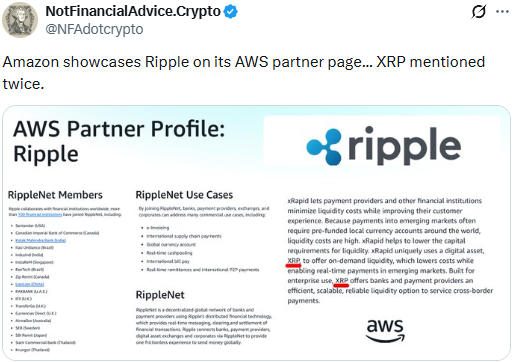
AWS-Ripple partnership details. | Credit: NotFinancialAdvice.Crypto X profile
Today, diagnosing ledger issues, correlating errors, or tracing performance bottlenecks can take days. With AI-assisted log-to-code correlation, that process could be reduced to minutes. Faster issue triage means:
For a blockchain positioning itself as mission-critical financial infrastructure, these improvements are not cosmetic: they are foundational.
Ripple CEO Brad Garlinghouse had previously hinted at this direction during public presentations, but the technical exploration now confirms that AI-native operations are part of XRPL’s long-term roadmap.
What Is Amazon AWS Bedrock AI and How It Could Help Scale XRPL
Amazon Bedrock is Amazon Web Services’ fully managed generative AI platform that allows organizations to build, deploy, and operate AI applications using multiple large language models (LLMs) through a single API. Instead of training models from scratch, Bedrock enables teams to apply AI to existing data, workflows, and infrastructure with enterprise-grade security, observability, and governance.
Key capabilities of Amazon Bedrock include:
Foundation model access (for reasoning, summarization, and code analysis).
Knowledge bases with retrieval-augmented generation (RAG) to ground AI responses in trusted internal data.
Agent-based orchestration, allowing AI agents to perform tasks such as querying logs, correlating events, and producing actionable diagnostics.
Native integration with AWS services like CloudWatch, S3, Lambda, and graph databases for large-scale data analysis.
How Bedrock AI Could Support XRPL Scaling (Operationally, Not Consensus)
It’s important to distinguish between ledger-level scaling (consensus speed, throughput, fees) and operational scaling (monitoring, reliability, engineering velocity). Amazon Bedrock applies to the second category.
1. Faster Network Monitoring and Incident Resolution
XRPL is a globally distributed network with validators, nodes, and applications generating massive volumes of logs and telemetry data. Traditionally, diagnosing issues across such a system can take hours or days and require deep expertise in XRPL’s C++ codebase.
By using Bedrock-powered AI agents to:
ingest XRPL node logs,
automatically query and correlate anomalies,
cross-reference issues with relevant sections of the XRPL codebase and protocol standards,
Ripple engineers can reduce investigation and resolution times from days to minutes. Faster recovery improves network uptime, which is a critical prerequisite for large-scale institutional adoption.
2. Scaling Engineering Capacity Without Linear Headcount Growth
As XRPL usage grows, the complexity of maintaining and upgrading the network increases. AI-driven operational tooling allows Ripple and XRPL contributors to:
reduce dependency on a small number of specialized engineers,
onboard new developers more quickly,
and scale support for the network without proportionally increasing engineering teams.
This improves XRPL’s ability to grow sustainably as transaction volumes, integrations, and use cases expand.
3. Improved Reliability for Institutional and Enterprise Use
While this does not change XRPL’s transaction speed or fees directly, it raises confidence among banks, payment providers, and enterprises building on the ledger.
4. Enabling Faster Protocol Upgrades and Feature Deployment
Operational bottlenecks slow innovation. When troubleshooting and testing become faster, protocol improvements and amendments can be:
validated more quickly,
deployed with lower risk,
and monitored more effectively after launch.
Over time, this accelerates XRPL’s evolution cycle, indirectly supporting scalability by allowing the ledger to adapt more rapidly to new demands.
Why XRPL Efficiency Matters for Enterprise Adoption
Amazon Web Services does not casually associate its brand with blockchain projects. Every integration showcased in AWS partner materials undergoes legal, technical, and enterprise reviews. Ripple being featured, with XRP mentioned explicitly, is a signal of credibility by proximity.
This is not about marketing hype. It is about fit.
AWS is the backbone of global cloud infrastructure, powering governments, banks, payment processors, AI systems, and financial institutions. Ripple’s integration into that ecosystem suggests that XRPL is being positioned not as a speculative network, but as a production-grade distributed ledger capable of supporting regulated, high-throughput use cases.
Importantly, this connection has been years in the making.
As far back as seven years ago, Ripple executive Asheesh Birla casually referenced “Ripple’s partner Amazon” during a talk at Payment Canada. At the time, it was dismissed as a slip of the tongue. In hindsight, it appears more like an early indication of a relationship developing quietly in the background, exactly how large enterprise integrations typically form.
The broader context matters. Across the industry, AI and distributed ledger technology (DLT) are converging around a common problem: trust in data.
AI systems are only as reliable as the data they ingest. Without provenance, auditability, and verifiable history, AI outputs become opaque and untrustworthy. Blockchain, on the other hand, excels at immutability, timestamping, and consensus, but struggles without real-world utility.
XRPL sits at an interesting intersection. It already supports:
By layering AI-driven operational intelligence on top of this foundation, Ripple is effectively future-proofing XRPL for an environment where automated agents, real-time settlement, and continuous monitoring become the norm.
Algorand, which leaned early into Python, the dominant language of AI development. Hedera, anchoring AI verification and auditability with partners like Accenture and NVIDIA.
Constellation, focused on data provenance for large-scale AI training datasets.
Bittensor, experimenting with decentralized AI model markets.
The difference is that Ripple is applying these ideas directly to live financial infrastructure, not experimental networks.
What This Means for XRP’s Market Structure
From a price perspective, it is crucial to distinguish between short-term speculation and structural demand.
AI-driven operational efficiency does not immediately pump token prices. What it does is make XRPL more attractive to institutions that care about uptime, predictability, and risk management. Over time, that feeds into liquidity, usage, and derivative markets.
Several signals already point in this direction:
CME adjusting XRP options strike listings, reflecting real hedging demand.
FXRP going live for spot trading on Hyperliquid via Flare, expanding cross-chain execution paths.
Growing interest in tokenized assets and always-on settlement rails.
These are not retail-driven narratives. They are signs of XRP integrating deeper into the financial market infrastructure.
If XRPL becomes easier to operate, faster to troubleshoot, and cheaper to scale thanks to AI tooling, it strengthens the case for XRP as a utility asset, not just a speculative one.
What Amazon Bedrock Does Not Do for XRPL
To avoid confusion or hype, it’s critical to note that Amazon Bedrock:
does not participate in XRPL consensus,
does not control validators or transactions,
does not directly increase throughput or reduce transaction fees,
and does not make XRPL dependent on AWS for ledger operation.
Its role is supportive and off-ledger, focused on operational intelligence rather than protocol mechanics.
Potential Implications for XRP Price
The following analysis addresses how developments around XRPL operations and infrastructure may influence market narratives related to XRP, not forecasts or investment recommendations.
XRP’s market price is shaped by multiple variables, including regulatory developments, liquidity conditions, macroeconomic factors, and overall digital asset market sentiment.
1. Indirect Influence Through Market Perception
Ripple’s use of advanced operational tooling, such as AI-driven monitoring and diagnostics, may influence how market participants perceive the maturity and reliability of the XRP Ledger ecosystem.
From a pricing perspective, this type of development can:
reinforce the perception of XRPL as stable, enterprise-oriented infrastructure,
reduce concerns related to prolonged outages or operational fragility,
and support long-term confidence among institutions evaluating XRPL-based solutions.
However, perception-based effects are indirect and do not automatically translate into increased demand for XRP.
2. No Direct Impact on Token Economics
The operational improvements discussed do not alter XRP’s core economic variables, including:
total supply or issuance schedule,
transaction fee structure,
consensus or settlement mechanics,
or token distribution.
As a result, there is no direct mechanical pathway by which these developments would change XRP’s price in the short term.
3. Role in Long-Term Adoption Narratives
In digital asset markets, price appreciation over longer horizons is often associated with:
sustained network usage,
clear utility demand,
and institutional participation.
Operational resilience and faster issue resolution may support adoption over time, but only if accompanied by:
increased on-ledger activity,
broader real-world use cases,
and favorable regulatory conditions.
Without those accompanying factors, infrastructure improvements alone typically have limited pricing impact.
4. Short-Term Market Reactions vs. Structural Value
Announcements or media coverage related to major technology providers can sometimes trigger short-term sentiment-driven price movements. Such movements are often:
speculative in nature,
influenced by headline interpretation rather than fundamentals,
and subject to rapid reversal.
These reactions should not be conflated with structural value creation.
XRPL Infrastructure Before XRP Price
The key takeaway is not that “Amazon is bullish on XRP” in a simplistic sense. The real story is that Ripple is aligning XRPL with the future architecture of enterprise systems, where AI agents continuously monitor, optimize, and interact with financial networks.
AI without data provenance is untrustworthy. DLT without real utility remains speculative.
The convergence of the two is where lasting value is created.
Ripple’s exploration of Amazon Bedrock for XRPL efficiency suggests that XRP is being positioned for that convergence. Quietly, deliberately, and at the infrastructure layer where real adoption begins.
Price may follow later. Infrastructure always comes first.
Amazon Bedrock is an AWS service that enables enterprises to build, deploy, and manage AI applications using large language models (LLMs) and autonomous agents. It is designed for high-scale, production environments where reliability, security, and data control are critical.
How is Ripple using Amazon Bedrock with the XRP Ledger?
Ripple is exploring how Amazon Bedrock can be used to analyze XRP Ledger system logs and operational data. The goal is to dramatically reduce the time needed for log-to-code correlation, issue detection, and system diagnostics, cutting processes that currently take days down to minutes.
Is this an official Amazon–Ripple partnership announcement?
No. This is not a traditional partnership press release. It is a forward-looking technical exploration showcased within AWS’s partner ecosystem, signaling real infrastructure-level integration rather than a marketing-driven collaboration.
Does this mean Amazon is building on the XRP Ledger?
Amazon is not building applications on XRPL. Instead, AWS is providing cloud and AI infrastructure that Ripple can use to operate, monitor, and scale the XRP Ledger more efficiently. The relationship is infrastructure-focused, not application-level.
Disclaimer:
The information provided in this article is for informational purposes only. It is not intended to be, nor should it be construed as, financial advice. We do not make any warranties regarding the completeness, reliability, or accuracy of this information. All investments involve risk, and past performance does not guarantee future results. We recommend consulting a financial advisor before making any investment decisions.
Giuseppe Ciccomascolo began his career as an investigative journalist in Italy, where he contributed to both local and national newspapers, focusing on various financial sectors.
Upon relocating to London, he worked as an analyst for Fitch's CapitalStructure and later as a Senior Reporter for Alliance News. In 2017, Giuseppe transitioned to covering cryptocurrency-related news, producing documentaries and articles on Bitcoin and other emerging digital currencies. He also played a pivotal role in establishing the academy for a cryptocurrency exchange website. Crypto remained his primary area of interest throughout his tenure as a writer for ThirdFloor.


 Easy
Easy