MPP, ACP, AP2, and x402 protocols handle several layers of the payment stack, including authorization and settlement.
Using the HTTP 402 status code, x402 permits straightforward, crypto-native micropayments.
For agent-merchant interactions, ACP standardizes checkout processes, frequently using fiat rails.
AP2 emphasizes secure authorization via mandates that are cryptographically signed.
MPP facilitates session-based streaming payments between stablecoins and fiat.
AI agents are self-sufficient software programs carrying out tasks, making choices, and now also managing financial transactions. Traditional payment systems, which were designed for people and involve clicks, logins, and checkout pages, fail when agents need to get API access, data, compute resources, or services in real time without human intervention. This article explores why AI agents need dedicated payment rails and compares four leading protocols, like MPP, ACP, AP2, and x402, that are shaping agentic commerce in the crypto ecosystem.
Why AI Agents Need Payment Rails Now
Credit cards and other traditional payment methods struggle with micropayments due to high fees (typically 2.9% + $0.30), chargeback risks, and long settlement times. They cannot effectively manage machine-to-machine (M2M) flows and presume human presence. A better fit can be provided through cryptocurrency, offering near-zero fees, immediate settlement, and programmable logic with stablecoins and fast blockchains.
In crypto operations, this matters deeply. Agents can coordinate across decentralized finance (DeFi) protocols, pay for on-chain data, or settle services programmatically. Without proper rails, agents remain limited, stifling the agent economy’s growth. The “why” is clear: as AI scales, so does its economic activity. Payment rails must evolve to support autonomy, security, and efficiency in a machine-first world. These agents would find it difficult to figure out “how” to pay one another across various platforms without any standardized protocols. This is when specialized payment rails like MPP, ACP, AP2, and x402 come in handy.
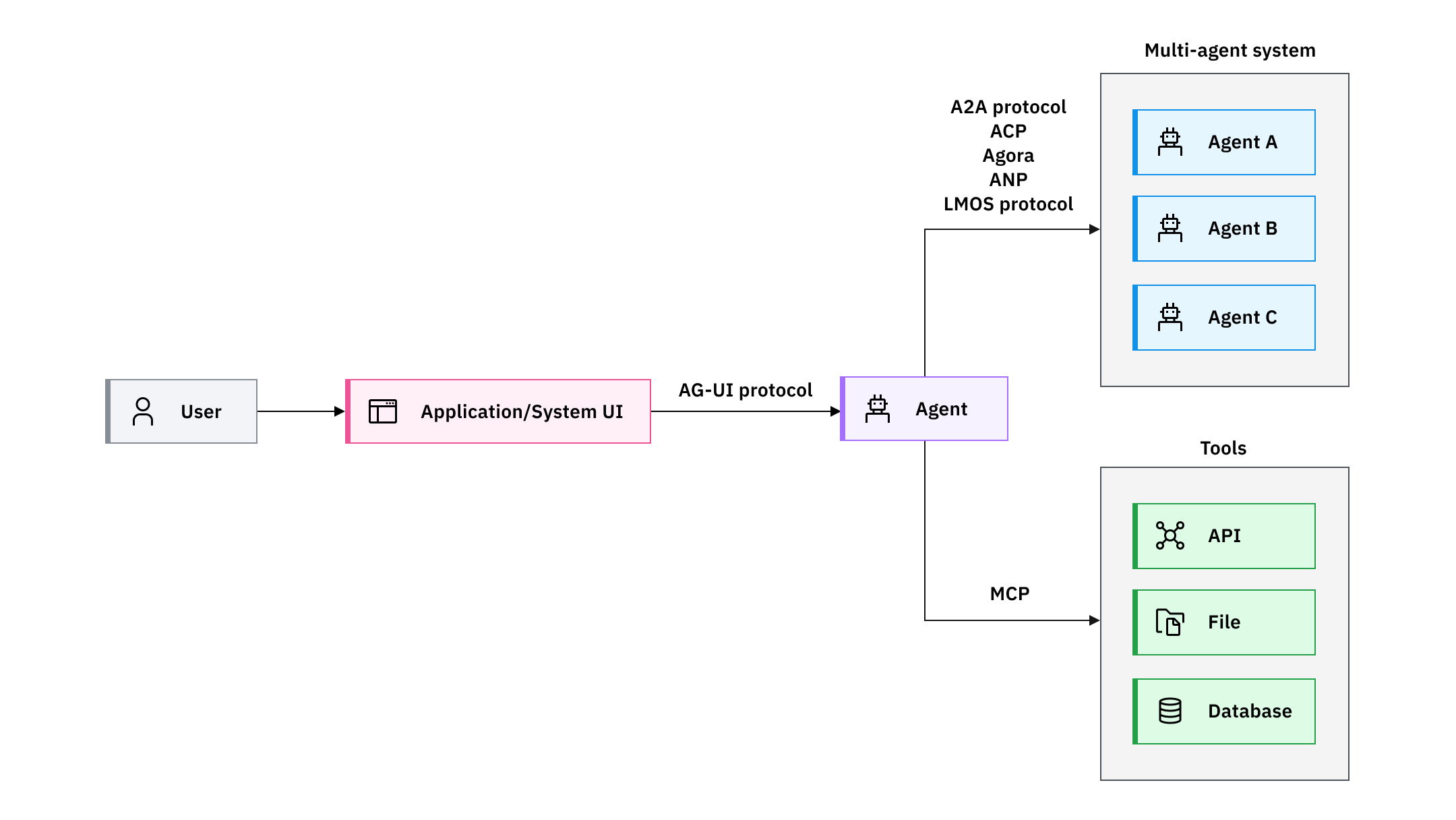
What are AI Agent protocols | Credit: IBM.com
The Agentic Payments Stack
Agent payments are not one-size-fits-all. The developing stack consists of three layers: authorization (proving intent), commerce/checkout (merchant interaction), and settlement (real money flow). Although protocols function independently, they frequently come together.
MPP
Stripe and Tempo, a Layer 1 blockchain, introduced session-based pre-authorization using Machine Payments Protocol (MPP), which went live on March 18, 2026. Agents stream micropayments that batch into fewer on-chain transactions on Tempo, which provides 0.5-second finality and stablecoin fees via a native AMM with no gas token required, after approving a spending limit up front. MPP connects crypto, like Bitcoin Lightning, with fiat like cards via Stripe, Visa, and Mastercard. With compliance features, MPP can be enterprise-ready and complements x402 at the settlement layer.
ACP
OpenAI and Stripe co-developed Agentic Commerce Protocol (ACP), which standardizes how agents communicate with merchants. In addition to single-use endpoints, it specifies four RESTful endpoints for generating, changing, completing, or cancelling checkouts. SharedPaymentTokens have a time and amount scope.
It debuted in production in early 2026 via ChatGPT’s Instant Checkout and excels at conversational commerce for items, relying on fiat rails through Stripe’s ecosystem. It incorporates merchant tooling for crypto users while remaining more human-focused than pure M2M.
AP2
Agent Payments Protocol (AP2) manages trust and authorization. Google developed it with over 100 partners, and it employs verifiable digital identities and tamper-proof mandates such as Intent, Cart, or Payment kinds to demonstrate that a user authorized an agent’s operations.
It still accepts bank transfers, cards, and cryptocurrency using extensions like A2A x402. This layer provides auditability and non-repudiation, which are essential for enterprise compliance in crypto operations with high fraud risks.
x402
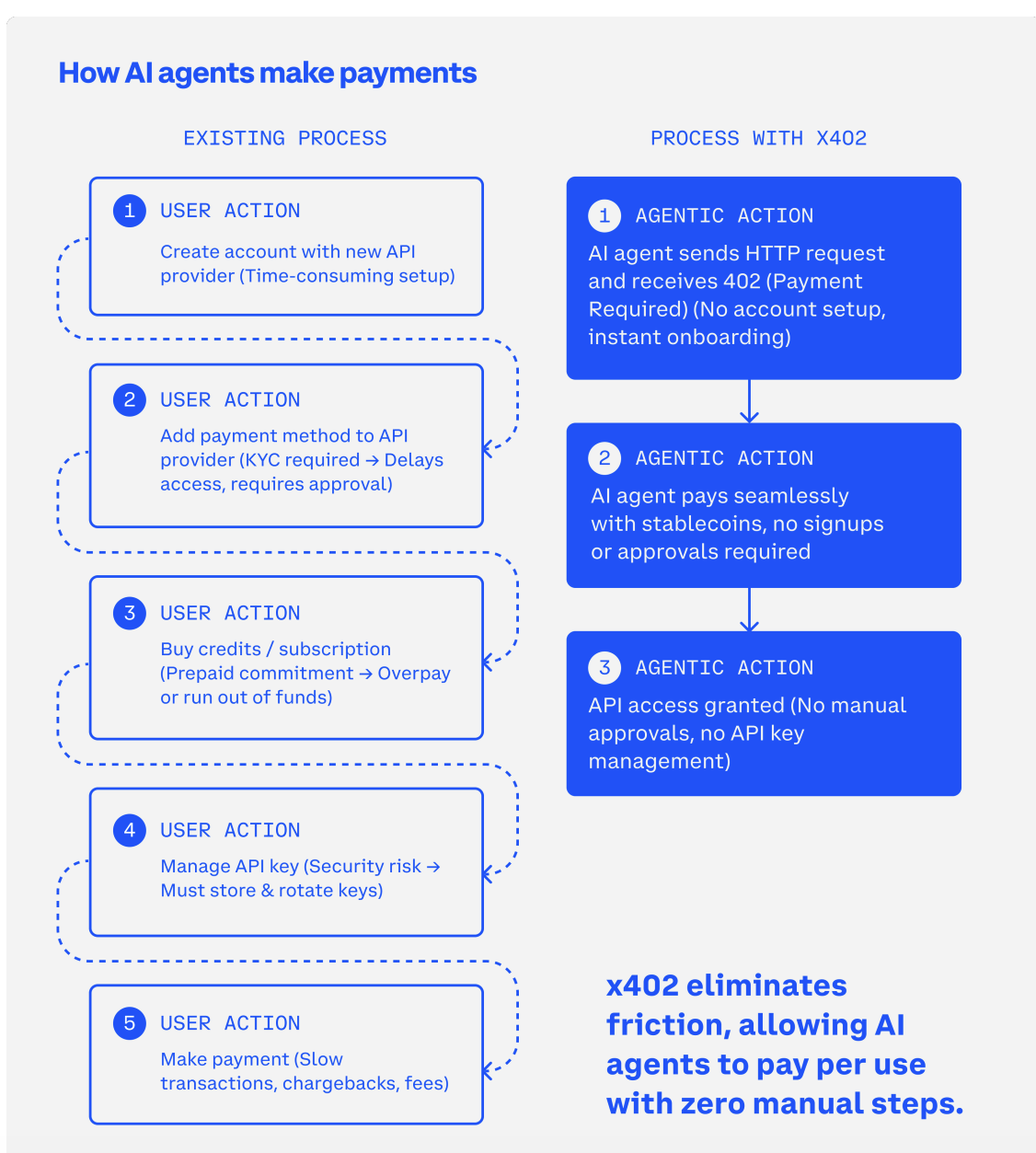
Coinbase invented x402, which is open-source under Apache 2.0 that brings back the long-dormant HTTP 402 “Payment Required” status code for quick stablecoin settlements. An agent requests a resource, and the server answers with a 402 and payment information: for example, USDC on Base or Solana.
The agent signs an authorization, and a facilitator validates and settles on-chain in under 200ms with small fees of ~$0.0001. It has completed more than 140 million transactions and is appropriate for pay-per-request scenarios such as API monetization or agent-to-agent services. Multi-chain support of Base, Ethereum, Polygon, Solana, and others makes it suited to crypto-native operations.
x402 can improve AI Agents’ payment flow | Credit: x402.org
How MPP, ACP, AP2 and x402 Compare
Use case, payment method, and degree of autonomy all influence which protocol is optimal. Here is a neutral breakdown:
Authorization and trust: AP2 takes the lead here, with cryptographic specifications that produce auditable trails. Both autonomous and real-time human-present scenarios are supported. Prior authorization or wallet control is presumed by x402 and MPP, but ACP focuses on scoped tokens rather than mandated ones.
Checkout and merchant Integration: ACP excels at structured purchases of products or services, simulating real-world checkout lifecycles and providing merchant management over inventories and compliance. Compared to actual carts, MPP and x402 are lighter and better for resource access.
Settlement and execution: x402 supports stateless, per-request cryptocurrency payments, making it perfect for high-frequency, low-value M2M crypto activities. MPP supports hybrid fiat/crypto, reduces on-chain load through batching, and provides sessions for ongoing processes. Both make advantage of fast chains; x402 frequently employs L2s like Base for sub-cent costs, while Tempo stresses deterministic finality.
Speed and cost: Cards cannot match the near-instantaneous, low-cost micropayments made possible by x402 and MPP. Chargebacks are a concern for traditional rails, but on-chain finality helps cryptocurrency counterparts avoid them.
Features
MPP (Machine Payments Protocol)
ACP (Agentic Commerce Protocol)
AP2 (Agent Payments Protocol)
x402
Primary Role
Settlement + streaming payments
Checkout & merchant interaction
Authorization & trust layer
Settlement (per request)
Core Function
Session-based micropayment streaming
Standardized agent-to-merchant checkout
Cryptographic mandates & identity
Pay-per-request crypto payments via HTTP 402
Payment Style
Continuous / batched payments
One-time purchases (cart-style)
Authorization (not payment itself)
Instant, per API call
Rails Supported
Crypto (stablecoins, Lightning) + fiat (cards)
Mainly fiat via Stripe
Rail-agnostic (cards, bank, crypto)
Crypto-native (mostly stablecoins like USDC)
Best Use Case
Ongoing services, streaming, subscriptions
Buying products/services via agents
Secure delegation & compliance
API access, data, M2M micropayments
Speed & Cost
Fast, low-cost via batching
Depends on fiat rails (slower, higher fees)
Depends on underlying rails
Ultra-fast (~milliseconds), ultra-cheap
Autonomy Level
High (agent-driven sessions)
Medium (still human-like flows)
High (secure agent delegation)
Very high (fully automated M2M)
Trust Mechanism
Pre-approved spending limits
Scoped tokens
Cryptographic mandates (Intent, Cart, Payment)
Wallet signature + on-chain settlement
Merchant Integration
Limited (not checkout-focused)
Strong (full checkout lifecycle)
Indirect (via extensions)
Minimal (API/payment endpoint)
Crypto Alignment
Hybrid (crypto + fiat bridge)
More fiat-oriented
Hybrid
Fully crypto-native
Key Advantage
Efficient streaming + hybrid payments
Familiar commerce flow for agents
Strong auditability & compliance
Simple, instant micropayments
Key Limitation
Needs pre-funded sessions
Not ideal for M2M micropayments
Adds complexity layer
Regulatory & custody concerns
Payment rails supported:
MPP: Stablecoins on Tempo + fiat cards + Lightning Bitcoin
In crypto contexts, x402 and MPP align best with on-chain efficiency, while AP2 and ACP bridge to traditional finance for broader adoption.
Trade-offs and Risks of Agentic Payments
No protocol is flawless. Permissionless solutions, such as x402, prioritize speed and affordability but raise regulatory concerns about custody and stablecoins. Compliance and fiat bridges are provided by enterprise-focused ones like MPP or AP2, but they also increase reliance on centralized suppliers.
If protocols do not fully interoperate, the risk of fragmentation remains. Ongoing issues include user intent verification, wallet security for agents, and scalability at millions of transactions per second. On-chain hazards in cryptocurrency operations include network congestion and smart contract vulnerabilities, but L2s and specialized chains reduce many of these. As of April 2026, these four open standards are the most talked about, while other options exist.
x402 is an open standard that allows AI agents to make instant stablecoin micropayments using HTTP 402.
What is ACP's main focus?
ACP uses scoped tokens and defined endpoints to standardize agent-merchant checkout processes.
How does AP2 work?
AP2 has cryptographic standards that prove user authorization for agent activity.
How does MPP work?
MPP streams and batches micropayments across Rails using pre-authorized sessions.
Disclaimer:
The information provided in this article is for informational purposes only. It is not intended to be, nor should it be construed as, financial advice. We do not make any warranties regarding the completeness, reliability, or accuracy of this information. All investments involve risk, and past performance does not guarantee future results. We recommend consulting a financial advisor before making any investment decisions.
Curious about how technology and crypto reshape global finance, Elizaveta Savenko explores blockchain, AI, decentralized systems, their applications, and regulatory requirements. She contributes to research, educational initiatives, and industry collaborations, examining trends in digital assets and fintech innovation, increasing awareness of the crypto space and its impact on financial systems.


 Intermediate