Stellar's XLM token jumped 80% in a week after DTCC announced plans to integrate its tokenized securities platform with the blockchain. Analysts are now watching whether the rally can extend toward $0.55. | Credit: CCN.com
Share
Key Takeaways
Stellar (XLM) surged by more than 80% over the past week, rising from around $0.15 to nearly $0.30, and significantly outperforming the broader crypto market.
The rally was primarily driven by a major DTCC integration announcement, as the financial giant plans to connect its tokenized securities platform to the Stellar blockchain.
Trading activity exploded following the announcement, with XLM trading volumes reportedly increasing by more than 900% and approaching $1 billion in daily turnover.
Stellar’s native token, XLM, has emerged as one of the cryptocurrency market’s strongest performers, rallying more than 80% in just a few days while the broader digital asset market moved in the opposite direction.
The token surged from roughly $0.15 on May 27 to a seven-month high near $0.30 before settling around $0.25, significantly outperforming a crypto market that lost approximately 3% in total value during the same period.
The explosive move has sparked debate among traders and analysts about whether the rally is driven by fundamentals or short-term speculation. The answer appears to be a combination of both.
However, lingering technical weaknesses suggest the road ahead may not be entirely smooth.
New Trending Crypto Wallet Offers
Sponsored
Disclosure
We sometimes use affiliate links in our content, when clicking on those we might receive a commission at no extra cost to you. By using this website you agree to our terms and conditions and privacy policy.
DTCC Partnership Gives Stellar a Powerful Institutional Narrative
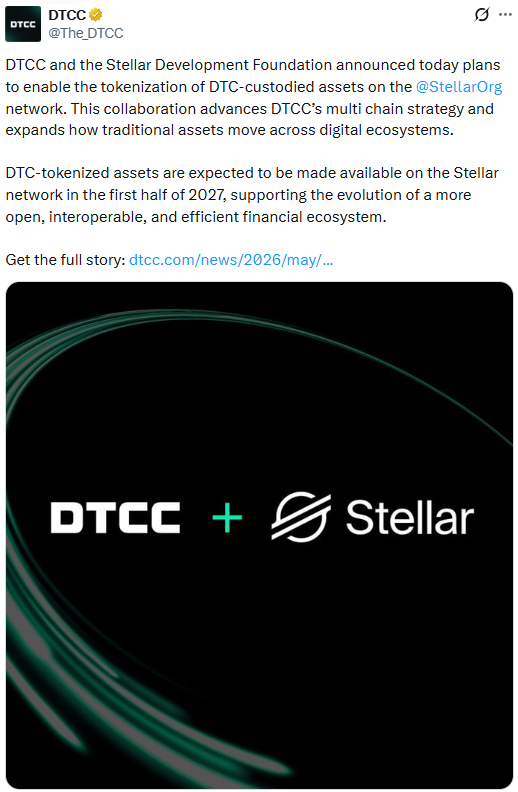
The biggest catalyst behind Stellar’s breakout was the announcement that the Depository Trust & Clearing Corporation (DTCC), one of the most important financial infrastructure providers in the United States, plans to integrate its tokenized securities platform with the Stellar network.
DTCC processes between $10 trillion and $12 trillion in securities transactions daily, making it a cornerstone of global financial markets.
The planned integration would enable tokenized securities issued through DTCC’s platform to leverage Stellar’s blockchain infrastructure for settlement and asset movement.
DTCC and the Stellar Development Foundation announced plans to enable the tokenization of DTC‑custodied assets on the Stellar network. | Credit: DTCC X profile
Unlike many blockchain partnership announcements that focus on future possibilities, the DTCC-Stellar relationship centers on actual financial infrastructure.
The initiative may support tokenized asset issuance, settlement, reporting, and corporate actions, positioning Stellar as a key player in the rapidly growing real-world asset (RWA) sector.
The market responded immediately. Trading volumes reportedly surged more than 900% during the rally, with daily turnover approaching $1 billion as investors rushed to gain exposure to the token.
For institutional investors, Stellar’s appeal lies in its focus on compliance, low transaction costs, and fast settlement times.
These characteristics make it well-suited for regulated financial institutions seeking blockchain solutions without sacrificing operational requirements.
At a time when tokenization is becoming one of the most important narratives in crypto, the DTCC endorsement gives Stellar a level of institutional validation that few blockchain networks can claim.
Short Sellers Were Forced to Fuel the Rally
While the DTCC announcement provided the spark, derivatives markets helped turn it into an explosion.
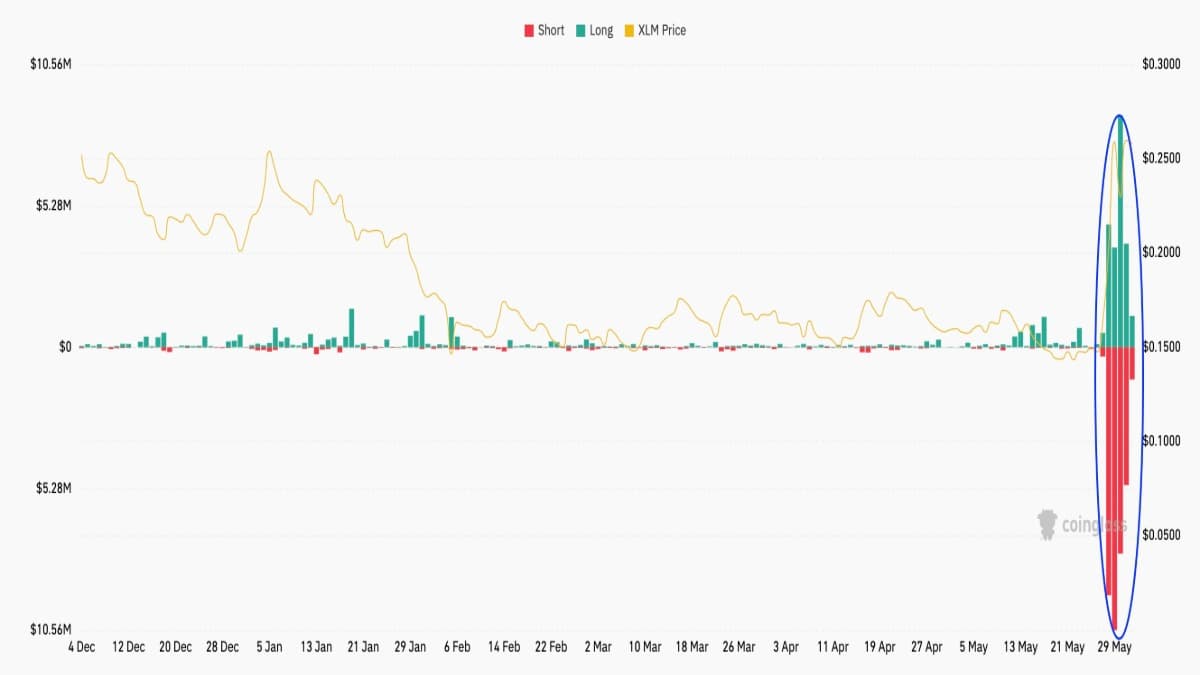
Data shows that approximately $34 million in short positions were liquidated during the rally, significantly exceeding losses suffered by bullish traders.
As XLM’s price moved sharply higher, bearish traders who had bet against the token had to cover their positions, adding further upward pressure.
The scale of the move is evident in futures market activity. Open interest in XLM derivatives nearly tripled to more than $360 million as traders aggressively increased exposure during the rally.
A short squeeze in the derivatives market amplified XLM’s upward momentum. | Credit: CoinGlass
At the same time, funding rates turned deeply negative despite rising prices. Normally, strong rallies are accompanied by positive funding as traders pile into long positions.
Instead, XLM’s funding rate dropped to around-0.027%, suggesting that many traders continued betting against the move even as prices climbed.
This created the ideal conditions for a short squeeze. When heavily leveraged bearish positions remain open during a sharp rally, exchanges force traders to cover losses by buying the underlying asset.
That buying then pushes prices even higher, triggering additional liquidations.
Although short squeezes are often temporary, the presence of a strong fundamental catalyst differentiates XLM’s move from purely speculative pumps.
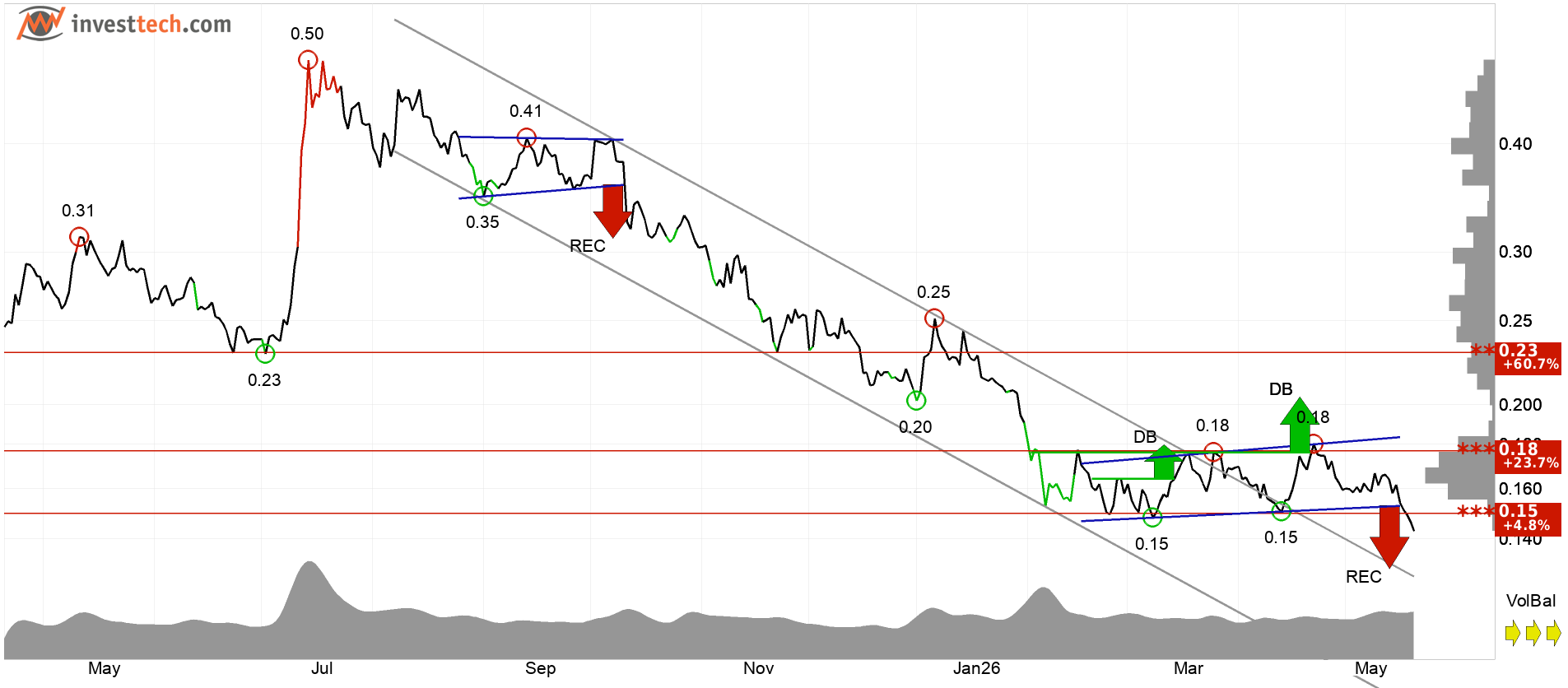
Bullish analysts point to a breakout from a multi-month falling wedge, a traditionally considered reversal formation.
Based on the pattern’s measured move, some forecasts project a longer-term target near $0.55, representing more than 100% upside from current levels.
Momentum indicators also suggest room for additional gains.
Despite the recent surge, XLM has not yet entered extremely overbought territory, leaving space for buyers to remain active if positive sentiment continues.
Stellar has broken the ceiling of the medium-term falling trend. | Credit: InvestTech
However, not all technical indicators support the bullish narrative.
Short- and medium-term trend models continue to generate predominantly bearish signals. Several momentum indicators, including the RSI, MACD, ADX, and rate-of-change metrics, remain in sell territory.
Moving averages also paint a cautious picture, with most short- and medium-term averages still indicating downside pressure.
Additionally, Stellar previously broke below support near $0.15, creating a negative signal from a longer-term rectangle formation.
Some technical models still suggest downside risk toward the $0.13 region despite the recent rebound.
This creates a fascinating conflict between fundamentals and technicals. Institutional adoption, growing tokenization demand, and strong market positioning favor the bulls. Yet many traditional indicators remain cautious following months of weakness.
For now, Stellar’s rally appears to be supported by more than hype alone.
Whether XLM can build on its 80% surge and challenge the $0.55 target will likely depend on whether institutional adoption translates into sustained network activity—and whether buyers can overcome the bearish technical signals that still linger beneath the surface.
Giuseppe Ciccomascolo began his career as an investigative journalist in Italy, where he contributed to both local and national newspapers, focusing on various financial sectors.
Upon relocating to London, he worked as an analyst for Fitch's CapitalStructure and later as a Senior Reporter for Alliance News. In 2017, Giuseppe transitioned to covering cryptocurrency-related news, producing documentaries and articles on Bitcoin and other emerging digital currencies. He also played a pivotal role in establishing the academy for a cryptocurrency exchange website. Crypto remained his primary area of interest throughout his tenure as a writer for ThirdFloor.