Home / News / Crypto / Are Crypto Traders Betting on US-Iran Strike Breaking The Law? Lawmakers Call For War Prediction Ban After ‘Insider Trading’ Claims $1.5M
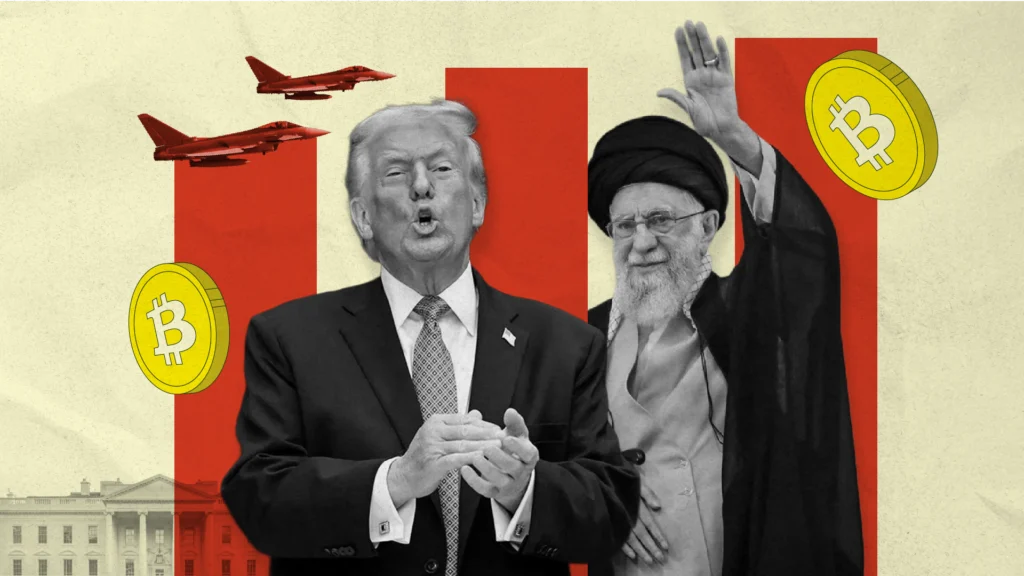
The rise of prediction markets has bled into global military action — and the legal debate is intensifying. | Source: CCN
Share
Key Takeaways
Suspicious profits from US-Iran prediction markets have raised integrity concerns.
Prediction markets face backlash over “death” contracts.
Legal and political debate intensifies.
At least seven accounts on the Polymarket prediction market appear to have collectively made more than $1.5 million in bets that the United States would strike Iran this past weekend, drawing fresh allegations of insider trading and renewed scrutiny of the rapidly expanding online betting market sector.
The allegations have prompted calls for regulatory scrutiny, with figureheads and lawmakers arguing that it represents “a huge integrity issue.”
But some industry leaders have argued that it’s already illegal, so are traders betting on the viral polls breaking the law?
Try Our Recommended Crypto Exchanges
Sponsored
Disclosure
We sometimes use affiliate links in our content, when clicking on those we might receive a commission at no extra cost to you. By using this website you agree to our terms and conditions and privacy policy.
On Saturday, blockchain analytics platform Bubblemaps said at least six “suspected insiders” made $1.2 million betting on prediction polls related to a U.S. strike on Iran, adding that most of the wallets were funded within the previous 24 hours.
On Sunday, the Guardian reported that the number had risen to seven accounts, with at least collectively $1.5 million being collected.
“Five of these accounts are new accounts that have made no other bets; one more appears to have also bet only on strikes last weekend,” the publication reported.
It added that an account which went by “Magamyman” had previously made several bets on U.S. and Israeli strikes against Iran.
The allegations have prompted calls for regulatory scrutiny.
Entrepreneur and X influencer Martin Varsavsky wrote that if the claims are accurate, they represent “a huge integrity issue,” urging regulators to request full audit trails, funding sources and timing data.
“Prediction markets only work when the public trusts they are not being gamed during a crisis,” Varsavsky wrote.
Kalshi, Polymarket Under Microscope
The controversy has also drawn attention to other geopolitical contracts, including Kalshi markets tied to whether Iran’s Supreme Leader Ali Khamenei would remain in office.
Kalshi wrote on X that the odds Khamenei would be “out” as Supreme Leader had surged to 68%, while emphasizing that the company “does not offer markets that settle on death.”
The company said that if Khamenei were to die, the market would resolve based on the last traded price prior to the confirmed reporting of death.
BREAKING: The odds Ali Khamenei is out as Supreme Leader have surged to 68%
Reminder: Kalshi does not offer markets that settle on death.
If Ali Khamenei dies, the market will resolve based on the last traded price prior to confirmed reporting of death. pic.twitter.com/geL2CgdRwI
One X user highlighted how Kalshi’s product contract contains a section explaining how death would affect payout and how unfair outcomes would be remedied, arguing that the company’s public statements conflict with its written terms.
Crypto influencer Jesus Martinez criticized Kalshi, writing that the company advertises when a possible “death” has occurred and changes rules “on the fly.”
“The ONLY way a Supreme Leader in Iran has EVER left office is by death,” Martinez wrote.
Adding: “For a company that doesn’t do ‘death markets,’ they sure know how to milk the fees on them.”
U.S.-Iran Predictions Intensify Legal Scrutiny
The developments have fueled a broader debate over whether such markets are legal.
U.S. Senator Chris Murphy wrote on X that “it’s insane this is legal” and said he would introduce legislation to ban the practice, alleging that people “around Trump are profiting off war and death.”
It’s insane this is legal. People around Trump are profiting off war and death. I’m introducing legislation ASAP to ban this. https://t.co/iC0uPpaWC5
Independent journalist Adam Cochran responded that such activity is already illegal under existing law.
He wrote that Commodity Futures Trading Commission-regulated markets in the U.S. cannot offer war markets and must screen for insider trading, and that offshore markets with U.S. exposure violate U.S. law.
“The CFTC’s enforcement division has been gutted and that’s the failure here,” Cochran wrote, arguin g that lawmakers should instead ensure the agency’s enforcement arm has guaranteed funding.
The issue carries added political sensitivity because Donald Trump Jr., the President’s son, serves as an adviser to the board of Polymarket.
Trump Targets Insider Trading, Critics Skeptical
The controversy over prediction markets has unfolded as President Donald Trump sought to cast himself as an opponent of insider trading in Washington.
In his State of the Union address, Trump urged lawmakers to “ensure that members of Congress cannot corruptly profit from using insider information,” calling on them to pass what he described as the Stop Insider Trading Act.
Republicans repeatedly rose to applaud during the speech, with Democrats also standing during the passage on insider trading.
But not everyone is convinced the proposal represents meaningful reform.
In an opinion piece for USA Today, columnist Chris Brennan wrote that Trump is “an unlikely messenger” on congressional self-dealing, arguing that the President “has used his second term as president to enrich himself and his family.”
Brennan wrote that the Stop Insider Trading Act “deserves scrutiny,” calling it “at best, reform-light and, at worst, just more self-dealing disguised as reform.”
Other legal scholars have also examined whether Trump’s trade policies and related market swings could raise securities law concerns.
In August, Paul Oudin, a professor of law at Oxford University, wrote that while “there is no indication that President Trump or his team engaged in securities fraud,” the legal theories circulating online warranted closer scrutiny.
Oudin argued that a market manipulation case under U.S. law would likely struggle to succeed.
However, he said a more plausible — though still hypothetical — legal theory could involve insider trading.
Is It Legal?
Whether the trading activity tied to the U.S.–Iran strike predictions was unlawful remains unclear.
Under U.S. law, insider trading generally requires proof that someone traded securities or derivatives based on material, nonpublic information in breach of a legal duty.
Prediction markets regulated by the CFTC are also required to monitor for market manipulation and insider activity.
Critics argue that if traders had advance knowledge of military action and placed bets accordingly, that could raise serious legal concerns.
However, proving such claims would require evidence that the individuals involved possessed nonpublic government information and traded on it.
Others contend that existing laws already prohibit such conduct.
Cochran, for example, argued that CFTC-regulated markets “cannot have war markets” and must screen for insider trading.
At this stage, there is no public enforcement action against individual traders tied to the U.S.–Iran strike bets.
Whether crypto traders are breaking the law will depend on whether regulators can establish that they traded on confidential information.
Kurt Robson is a London-based reporter at CCN, specialising in the fast-moving worlds of crypto and emerging technology. He began his career covering local news in Cornwall after graduating from Falmouth University with First Class Honours in Journalism. There, he cut his teeth on everything from council meetings to missing swans.
He quickly rose through the ranks to become a frontline journalist at several of the UK’s leading national newspapers. Over the years, he has interviewed musicians and celebrities, reported from courtrooms and crime scenes, and secured multiple front-page exclusives.
Following the upheaval of the COVID-19 pandemic, Kurt shifted his focus to technology journalism—just ahead of the AI boom. With a natural curiosity and a trained eye for emerging trends, he has found a new rhythm in reporting on innovation.
At CCN, Kurt's work focuses on the cutting edge of crypto, blockchain, AI, and the evolving digital world. Drawing on his background in people-first reporting and his deep interest in disruptive tech, Kurt delivers stories that are insightful, entertaining, and human-centric.