Fidelity says Bitcoin's next bull run could be fueled by the halving, Fed cuts, CLARITY, institutional demand, and new crypto use cases. | Credit: CCN.com
Share
Key Takeaways
Fidelity says Bitcoin’s next bull market could be driven by the halving cycle, Fed rate cuts, the CLARITY Act, and other factors.
Passage of the CLARITY Act could provide a clearer legal framework for digital assets and encourage broader participation from businesses and investors.
Adoption by companies and investment products has remained resilient throughout the current downturn.
Bitcoin remains deep below its October 2025 all-time high of more than $126,000, and investor sentiment has weakened significantly throughout 2026. While the current downturn has not matched the severity of previous crypto bear markets, many market participants describe the environment as another “crypto winter.”
According to a new analysis from Fidelity Digital Assets, history suggests several catalysts could eventually trigger the next bull market.
The asset manager identifies five developments that have repeatedly coincided with previous recoveries: Bitcoin’s four-year halving cycle, supportive regulation, looser monetary policy, a breakthrough crypto use case, and growing institutional adoption.
However, Fidelity stresses that none of these factors guarantees higher prices. Markets evolve, historical patterns can break down, and even a combination of favorable developments may fail to produce another sustained rally.
Try Our Recommended Crypto Exchanges
Sponsored
Disclosure
We sometimes use affiliate links in our content, when clicking on those we might receive a commission at no extra cost to you. By using this website you agree to our terms and conditions and privacy policy.
Since 2011, Bitcoin has experienced four major bear markets, with bottoms and subsequent recoveries often occurring roughly four years apart.
The cycle has largely been driven by Bitcoin’s halving mechanism, which reduces mining rewards every four years and slows the rate at which new coins enter circulation.
If the historical pattern continues, Fidelity suggests the current bear market could bottom around late 2026, approximately four years after the November 2022 low.
Still, the firm cautions that investors should view the cycle as a long-term framework rather than a precise market-timing tool, as previous cycles have varied in length.
Fidelity notes that major regulatory developments have historically restored confidence during periods of market weakness. The introduction of New York’s BitLicense framework in 2015 helped rebuild trust after the collapse of Mt. Gox, while the US Securities and Exchange Commission (SEC)’s approval of spot Bitcoin exchange-traded products in January 2024 contributed to Bitcoin’s eventual rally to record highs.
Attention now turns to the proposed CLARITY Act, which would establish a comprehensive legal framework for digital asset markets in the US. The legislation remains under debate in Congress, but Fidelity believes regulatory clarity could encourage greater participation from both crypto businesses and institutional investors.
Monetary policy could also play a decisive role.
Historically, Bitcoin and other cryptocurrencies have tended to benefit when the Federal Reserve lowers interest rates, as cheaper borrowing costs generally increase investor appetite for risk assets. Conversely, expectations of higher rates have often pressured crypto prices.
While inflation remains a key uncertainty, Fidelity says an unexpected shift toward rate cuts could provide meaningful support for digital assets, although markets often price in monetary easing well before official policy changes occur.
The Next Breakthrough Use Case May Not Yet Exist
Beyond macroeconomic and regulatory developments, Fidelity argues that innovation has repeatedly fueled crypto’s strongest bull markets.
The 2020-2021 cycle saw NFTs, decentralized finance, and memecoins capture mainstream attention and attract millions of new participants to digital assets.
Today’s leading narratives look very different.
Fidelity is basically saying what we’ve been mapping for months.
The calendar alone does not end crypto bear markets.
Liquidity and buyers do.
Yes, the 4-year cycle matters.
Maybe it points to a bottom window later this year.
Real-world asset tokenization continues gaining momentum as financial institutions explore blockchain-based ownership of private credit, real estate, and other traditional assets.
Stablecoins have also become one of crypto’s fastest-growing sectors, supported by increasing regulatory acceptance following the GENIUS Act.
Artificial intelligence is another emerging theme, with blockchain projects building infrastructure for AI agents, decentralized computing networks, and machine-learning applications.
Still, Fidelity notes that the next major adoption wave could come from an entirely unexpected innovation, just as NFTs and decentralized finance surprised markets during previous cycles.
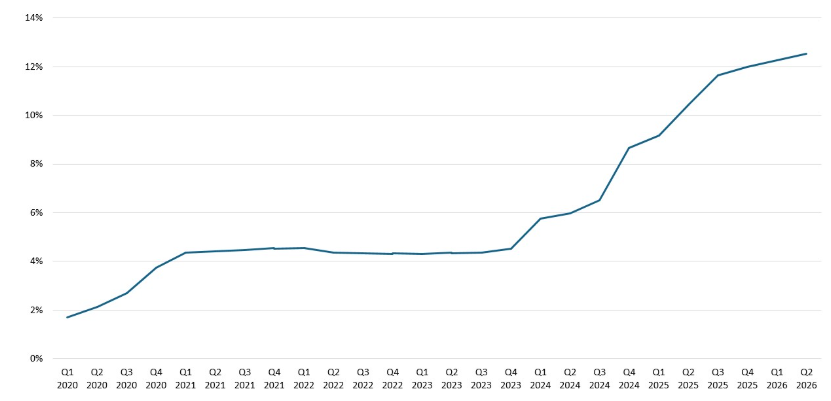
Corporate treasury purchases helped fuel Bitcoin’s 2020 rally, while the approval of spot crypto ETFs and the announcement of a US Strategic Crypto Reserve contributed to the market’s advance toward new all-time highs in 2025.
Unlike previous cycles, however, institutional participation has continued expanding throughout the current downturn without immediately translating into higher prices.
Percentage of Bitcoin’s ciruclating supply held by ETPs and public companies. | Credit: Fidelity Digital Assets
Fidelity argues this reflects the market’s growing maturity. Institutional involvement is no longer a new narrative capable of driving speculative enthusiasm on its own.
Nevertheless, the firm believes another major catalyst could emerge if a globally recognized company, such as one of the “Magnificent Seven” technology firms, announced a significant Bitcoin allocation, or if broader macroeconomic developments prompted institutions to increasingly view digital assets as portfolio hedges.
For now, Fidelity concludes that the crypto winter remains difficult to predict. While historical trends offer reasons for cautious optimism, investors should recognize that markets rarely repeat exactly, and no single catalyst, or even all five combined, can guarantee that Bitcoin’s next bull market has arrived.
Giuseppe Ciccomascolo began his career as an investigative journalist in Italy, where he contributed to both local and national newspapers, focusing on various financial sectors.
Upon relocating to London, he worked as an analyst for Fitch's CapitalStructure and later as a Senior Reporter for Alliance News. In 2017, Giuseppe transitioned to covering cryptocurrency-related news, producing documentaries and articles on Bitcoin and other emerging digital currencies. He also played a pivotal role in establishing the academy for a cryptocurrency exchange website. Crypto remained his primary area of interest throughout his tenure as a writer for ThirdFloor.