Fidelity International launched its first tokenized liquidity fund on Chainlink, signaling Wall Street’s accelerating push into tokenized finance. | Credit: CCN.
Share
Key Takeaways
Fidelity International launched FILQ, its first tokenized US dollar liquidity fund built with Chainlink infrastructure.
The fund uses Chainlink oracles to deliver real-time NAV data, 24/7 access and on-chain settlements.
The launch highlights how quickly Wall Street is moving from crypto experiments to full-scale tokenized finance products.
Fidelity International has officially launched its first tokenized fund, bringing one of the world’s largest asset managers deeper into blockchain-based finance as traditional institutions rush to modernize how money moves.
The new product, called the Fidelity USD Digital Liquidity Fund (FILQ), was announced on May 13 and uses Chainlink’s oracle infrastructure to deliver real-time on-chain fund data and settlements.
Try Our Recommended Crypto Exchanges
Sponsored
Disclosure
We sometimes use affiliate links in our content, when clicking on those we might receive a commission at no extra cost to you. By using this website you agree to our terms and conditions and privacy policy.
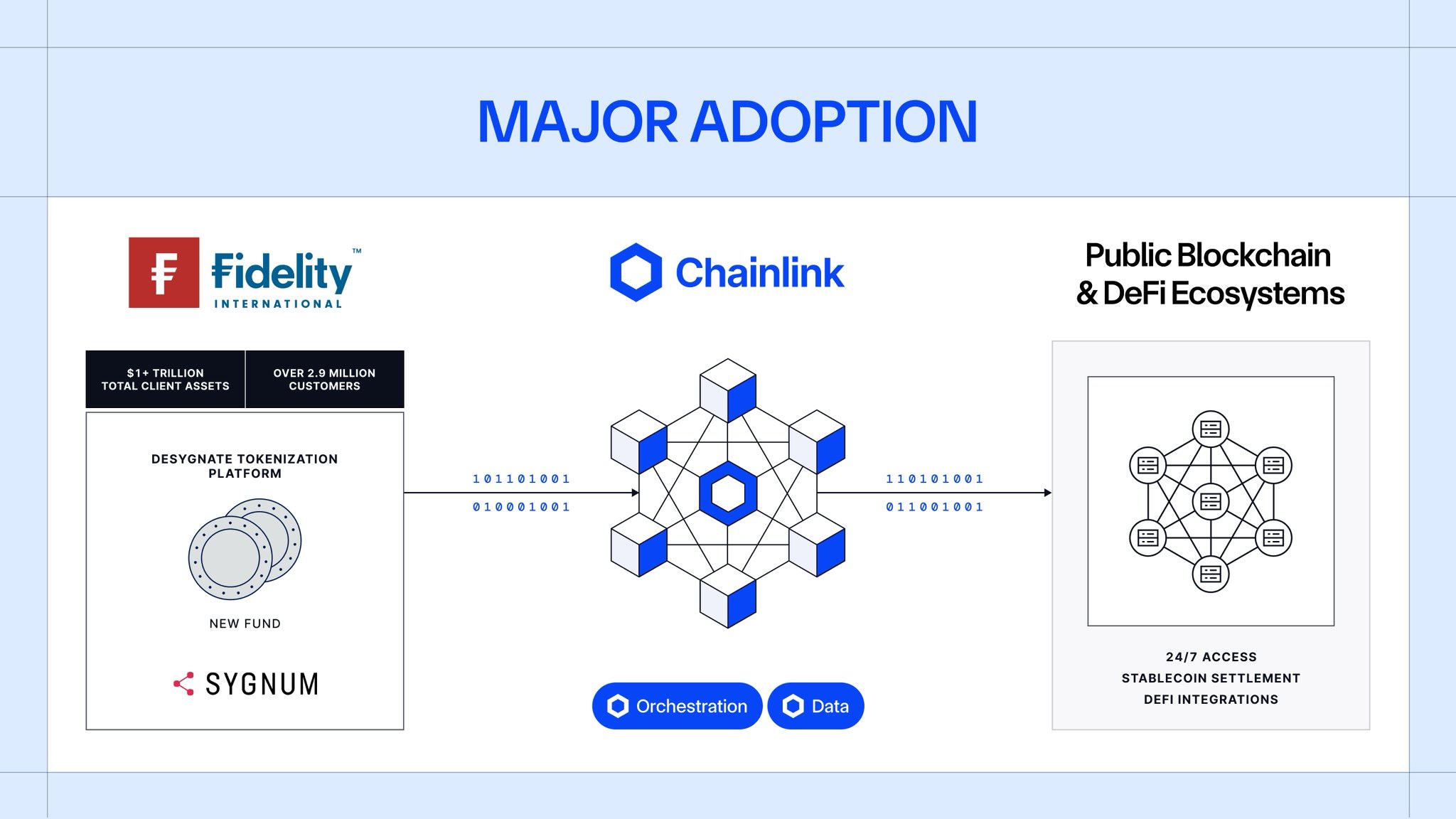
Fidelity International, which manages more than $1 trillion in client assets globally, partnered with Sygnum Bank and Chainlink to build the infrastructure behind FILQ.
The setup combines:
Sygnum’s tokenization framework.
Chainlink’s decentralized oracle network.
and institutional-grade NAV reporting backed by JPMorgan.
The fund itself is designed as a regulated, yield-bearing liquidity product similar to traditional money market funds backed by government securities.
It also received a Moody’s AAA-mf rating, signaling high credit quality and liquidity standards typically associated with institutional cash-management products.
What makes FILQ stand out is not just the fund structure — it is how the data moves.
Fidelity launches tokenized funds on Chainlink. Credit: Chainlink.
Instead of relying on delayed reporting cycles common in traditional finance, Chainlink’s oracle network pushes fund NAV and distribution data directly on-chain in near real time.
That allows investors to interact with the product continuously rather than waiting for standard market-hour settlement windows.
In practical terms, the fund supports:
24/7 subscriptions and redemptions.
Blockchain-based settlement flows.
Stablecoin integrations.
and real-time transparency into fund value and payouts.
That is a major shift from the slower operational infrastructure traditional funds still rely on today.
Why Wall Street Is Racing Toward Tokenization
Fidelity’s launch comes during a broader explosion in tokenized real-world assets, often referred to as RWAs.
What started as a niche crypto concept has rapidly evolved into one of the fastest-growing segments of digital finance.
Tokenized Treasuries,money market funds, credit products and private assets have all expanded sharply over the past two years as major institutions search for faster settlement systems and more efficient capital markets infrastructure.
The appeal is straightforward.
Traditional financial systems still operate with:
Limited market hours.
Slower settlement cycles.
Fragmented global access.
and higher administrative costs.
Blockchain infrastructure changes that.
Tokenized assets can theoretically settle instantly, trade around the clock, integrate directly with digital wallets and become programmable inside broader financial ecosystems.
That opens the door to fractional ownership, real-time collateral usage, automated yield distribution, and seamless integration with DeFi infrastructure
The market is still small relative to traditional finance, but growth has accelerated quickly.
Tokenized US Treasury products alone have surged in recent years, while forecasts from major financial firms increasingly project trillions of dollars in tokenized assets over the coming decade.
For Wall Street firms, the question is no longer whether tokenization matters.
It is how quickly they can build infrastructure around it.
Chainlink Is Quietly Becoming Core Infrastructure
Fidelity’s decision to use Chainlink is also huge.
One of the biggest challenges in tokenized finance is connecting reliable off-chain financial data to blockchain networks securely and consistently.
The company already powers large parts of the DeFi ecosystem through decentralized oracle services. Now, it is becoming more deeply embedded in institutional finance as tokenization grows.
The Fidelity launch builds on earlier collaborations between Chainlink, Sygnum and Fidelity-linked liquidity products dating back to 2024.
Industry participants increasingly view reliable on-chain financial data as essential infrastructure if tokenized markets are going to scale safely.
Fidelity Joins a Growing List of Wall Street Giants
Fidelity is far from alone.
Nearly every major financial institution is now actively exploring tokenized assets in some form.
BlackRock
The world’s largest asset manager pioneered with its BUIDL tokenized Treasury fund, now exceeding $2–3 billion in assets and available across multiple chains, including Ethereum, Solana, and Polygon.
BlackRock CEO Larry Fink has called tokenization “the next generation for markets.”
Franklin Templeton
One of the earliest movers with its on-chain US Government Money Fund (FOBXX) and BENJI tokenized fund on public blockchains like Stellar and Aptos.
The firm has expanded distribution through regulated platforms and partnerships, making short-term yield products blockchain-native.
JPMorgan
Through its Kinexys (formerly Onyx) platform, the bank has processed over $1.5 trillion in tokenized payments and launched tokenized private equity funds.
JPMorgan is also advancing tokenized money market funds and credit products, positioning itself as the most advanced institutional player.
Morgan Stanley
In 2026, the firm elevated RWA tokenization to a top global priority, with plans to launch an institutional digital wallet in the second half of the year.
Fidelity (Investments and International)
Beyond FILQ, the US arm launched the Fidelity Digital Interest Token (FDIT) on Ethereum, while continuing to file for on-chain share classes of Treasury funds.
Other notables include Apollo Global Management (tokenized credit and funds), Goldman Sachs (exploring tokenized equities and infrastructure), Nasdaq (filings for tokenized equities), and NYSE (dedicated 24/7 tokenized securities venue).
The Industry Is Moving From Pilots To Production
Perhaps the biggest takeaway from FILQ is that the tokenization story is no longer theoretical.
Prashant Jha is a seasoned crypto journalist based in Delhi, India, with a Bachelor’s Degree in Computer Science Engineering. Passionate about the evolving world of blockchain and cryptocurrencies, he has been a dedicated voice in the industry since 2018. Prashant’s expertise lies in regulatory reporting, where he unravels complex legal and financial developments with clarity and precision. Before joining CCN in 2024, he honed his craft at Cointelegraph, establishing himself as a trusted name in crypto journalism.
His coverage spans major industry events, including the high-profile collapses of FTX, Three Arrows Capital (3AC), and LUNA, offering readers insightful analyses of their regulatory and market implications. Prashant’s technical background enables him to bridge the gap between intricate blockchain technology and its real-world applications, making his work accessible to novices and experts.
Beyond his professional pursuits, Prashant is an avid music enthusiast, often exploring diverse genres to unwind. A sports lover, he has a particular passion for cricket and frequently engages in discussions about the game. His multifaceted interests and sharp journalistic instincts make him a valuable contributor to CCN, where he continues shaping the crypto landscape's narrative.