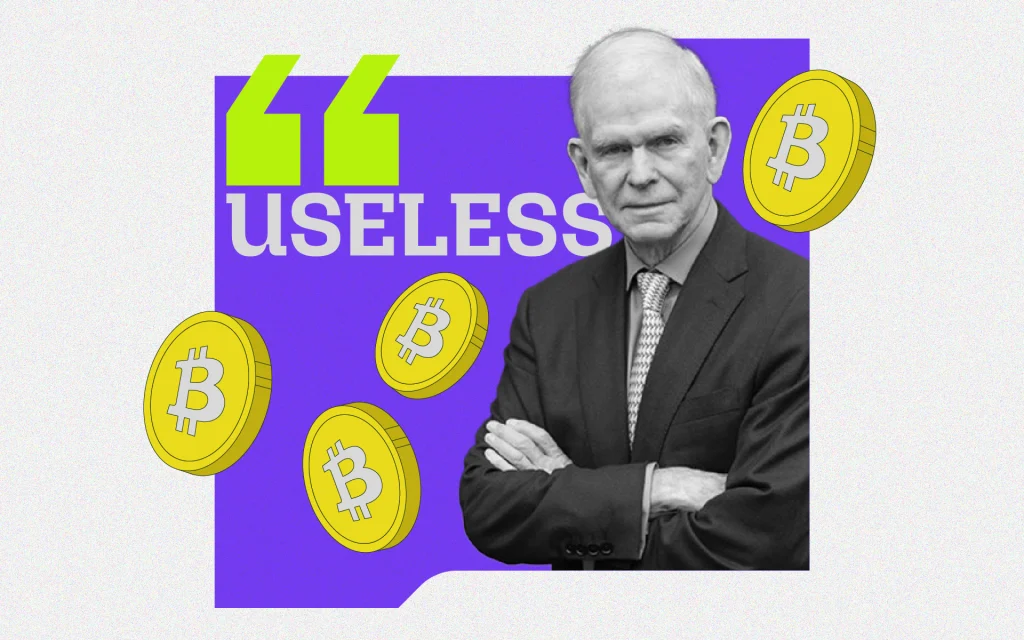
Famed Bubble Caller Jeremy Grantham Calls Bitcoin 'Useless' as CNBC Host Pushes Back
Share
Key Takeaways
Jeremy Grantham called Bitcoin “useless” and predicted it will gradually fade, citing its 52% drawdown from its 2025 peak.
CNBC host Joe Kernen challenged Grantham’s long-running bearish track record, sparking a widely debated on-air exchange.
The clash split market commentators, with Eric Balchunas backing Kernen while Albert Edwards defended Grantham’s warnings.
Bitcoin supporters, including Lark Davis and Ricardo Salinas Pliego, argued BTC’s fixed supply and decentralization remain its core value proposition.
Jeremy Grantham walked onto CNBC’s Squawk Box on June 26 and delivered a verdict on Bitcoin that he has delivered before, only this time it landed on a day Bitcoin was trading below $60,000, down more than 52% from its October 2025 all-time high. The timing gave his argument more ammunition than usual. It also produced one of the more memorable on-air confrontations financial television has generated in years.
The co-founder of investment firm GMO and one of Wall Street’s most prominent bubble callers said Bitcoin is a “useless, speculative” asset without intrinsic value, predicting it will “dwindle away, I suspect, not with a bang, but a whimper.”
He said he has never owned Bitcoin (BTC) and believes it will fall to zero, not through a sudden crash but through a gradual erosion of interest over years and decades.
He compared Bitcoin to shells on an island, arguing that proof of unnecessary work should not be worth a bucket of warm spit.
Grantham pointed to Bitcoin’s recent drawdown as the clearest evidence against its status as a store of value. The coin had fallen 52% from its all-time high of $126,080 set in October 2025, despite what he described as a strong economic backdrop and gold delivering sizable gains over the same period.
“You can’t depend on it in that way,” he said. “People don’t use it to make serious trades, they don’t use it to buy their dinner and pay at the supermarket.”
He did concede that blockchain technology could play a transformative role in the future, but made clear his dismissal was directed at Bitcoin and crypto assets specifically, not the underlying infrastructure.
Joe Kernen Pushes Back Hard
Squawk Box anchor Joe Kernen was not prepared to let the argument pass unchallenged. The exchange that followed drew as much attention online as Grantham’s Bitcoin comments themselves.
Kernen pressed Grantham on his track record, pointing out that he had been warning of market collapses for years while equities kept climbing, and that investors who followed his guidance had significantly underperformed the broader market as a result.
The implication was direct: Grantham’s long-running bearish stance on equities has come at the cost of missing much of the market’s rally. Kernen questioned why investors should be more confident in his bearish call on Bitcoin.
Market Commentators Split Over CNBC’s Bitcoin Clash
Bloomberg ETF analyst Eric Balchunas weighed in with measured support for Kernen’s line of questioning.
“This is great TV,” he wrote on X. “If Grantham is gonna come on and skewer Bitcoin then it’s fair game to bring up that he’s been wrong for a decade plus and listening to him would’ve caused severe underperformance, so why is he so certain about BTC? It’s a fair point.”
Balchunas added that Kernen crossed a line by mentioning that another host had booked Grantham, describing that detail as bad form.
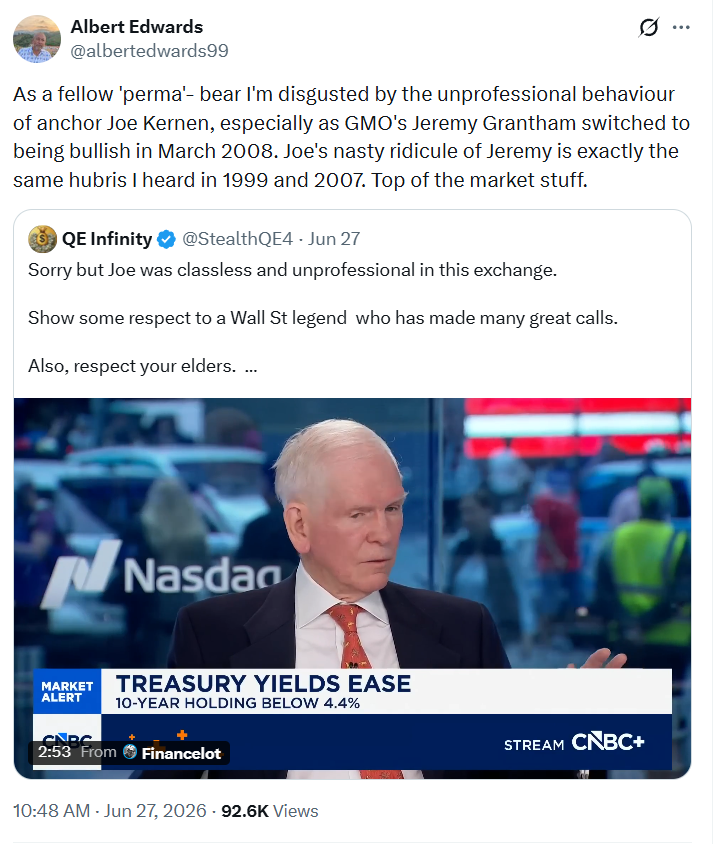
Fellow permabear Albert Edwards of Societe Generale took the opposite view, coming to Grantham’s defense in terms that carried their own market signal. “As a fellow permabear I’m disgusted by the unprofessional behaviour of anchor Joe Kernen,” Edwards wrote on X.
“Joe’s nasty ridicule of Jeremy is exactly the same hubris I heard in 1999 and 2007. Top of the market stuff.” Edwards also noted that Grantham had actually turned bullish in March 2008, before Lehman collapsed, a detail that complicates the simple permabear label his critics have attached to him.
“The only person who came out of that interview with any credibility was Joe Kernen,” he wrote. “We need more hosts willing to grill people who come on television chasing publicity. Jeremy Grantham has built his fortune from markets rising, then gets attention by repeatedly predicting their collapse. Pessimism sells. Accountability matters.”
Track Record Question Behind Grantham’s Bitcoin Call
The argument beneath the television drama is substantive. Grantham has flagged US equities as dangerously overvalued since the S&P 500 traded around 2,300 in April 2021. He correctly called the Japanese asset bubble, the dot-com collapse and the excesses preceding the 2008 financial crisis.
His family foundation outperformed major endowments including Harvard and Yale on a 10-year basis until roughly five years ago, when green energy investments faced headwinds from political and regulatory shifts.
In January 2026, GMO published a research note titled Valuing AI: Extreme Bubble, New Golden Era, or Both, arguing the AI boom meets every condition of prior innovation bubbles, with Big Tech capital expenditure alone reaching nearly $300 billion in 2025 across Amazon, Alphabet, Meta and Microsoft. On Squawk Box, Grantham flagged euphoria around SpaceX, whose addressable market claims reach a quarter of global GDP, as a further sign of late-cycle frothiness.
Bitcoin’s defenders responded quickly.
Crypto investor Lark Davis argued that Bitcoin’s value comes precisely from operating outside the control of any government or central authority, writing that it is the first currency in history with a fixed supply that no central bank can manipulate. “That’s not speculation. That’s the point,” he wrote.
Mexican billionaire Ricardo Salinas Pliego separately reaffirmed that he has allocated 70% of his investment portfolio to Bitcoin, describing it as better protection than cash or gold because no government can seize it.
Mexico’s Seventh-Richest Billionaire Says Around 70% of His Portfolio Is Allocated to Bitcoin
Mexican billionaire Ricardo Salinas Pliego, ranked seventh among Mexico’s richest, said around 70% of his investment portfolio is allocated to Bitcoin, arguing that fiat currencies will… pic.twitter.com/TSV6ErzTyZ
Grantham’s argument has the advantage of a 52% drawdown to point at. Bitcoin closed Friday at $59,948, down 19% for June alone.
Whether that drawdown marks the beginning of the slow fade Grantham has predicted for years, or another reset inside a longer bull cycle, is the question that separates his view from almost everyone else in the room.
Edwards’ comparison to 1999 and 2007 cuts both ways. The permabears were eventually right. The cost of being early was a decade of underperformance, and the people calling the top were still wrong for longer than most of them expected.
Disclaimer:
The information provided in this article is for informational purposes only. It is not intended to be, nor should it be construed as, financial advice. We do not make any warranties regarding the completeness, reliability, or accuracy of this information. All investments involve risk, and past performance does not guarantee future results. We recommend consulting a financial advisor before making any investment decisions.
Dr. Guneet Kaur is a senior editor at CCN.com and a Science Fellow at Exponential Science. She is a fintech and blockchain expert with extensive experience in digital finance education, blockchain ecosystems, and cryptocurrency markets. She has worked with global media such as Cointelegraph, as well as education and blockchain platforms, to design and lead strategic content and learning initiatives. As an educator and assessor for top-tier executive programs, she bridges real-world fintech trends with academic insight.
Dr. Kaur is also a published researcher and peer reviewer across fintech and data science journals, including Financial Innovation Journal and International Journal of Big Data Intelligence and Applications. Her work spans data-driven analysis, Web3 innovation, and technical content development. With a strong foundation in both industry and academia, she translates complex financial technologies into practical applications, empowering learners, professionals, and institutions across the rapidly evolving digital finance landscape.