Key Takeaways
- The GENIUS Act changed how stablecoins operate in the U.S. It defines which tokens banks and institutions can legally use.
- USDC fits the framework because it was built inside the U.S. system. Its reserves, disclosures, and partnerships align with federal rules.
- USA₮ fits the framework through a bank-issued model. Anchorage Digital Bank controls issuance and compliance under U.S. law.
- USDT remains the global liquidity leader. Its offshore structure keeps it outside the U.S. regulatory perimeter.
With the GENIUS Act now in force, stablecoin compliance has become the dividing line between tokens built for U.S. adoption and those left operating outside the regulatory perimeter.
Stablecoins have moved from a niche crypto tool to core financial infrastructure. In 2025, stablecoins processed trillions of dollars in on-chain transactions, overtaking major card networks in settlement volume.
As of early 2026, stablecoins dominate crypto trading liquidity, cross-border payments, decentralized finance, and tokenized asset settlement.
This growth pushed U.S. lawmakers to act. The Guiding and Establishing National Innovation for U.S. Stablecoins Act, known as the GENIUS Act, became law in July 2025, marking the first comprehensive federal framework for dollar-backed stablecoins.
The law reshaped which stablecoin institutions can safely use inside the U.S. financial system.
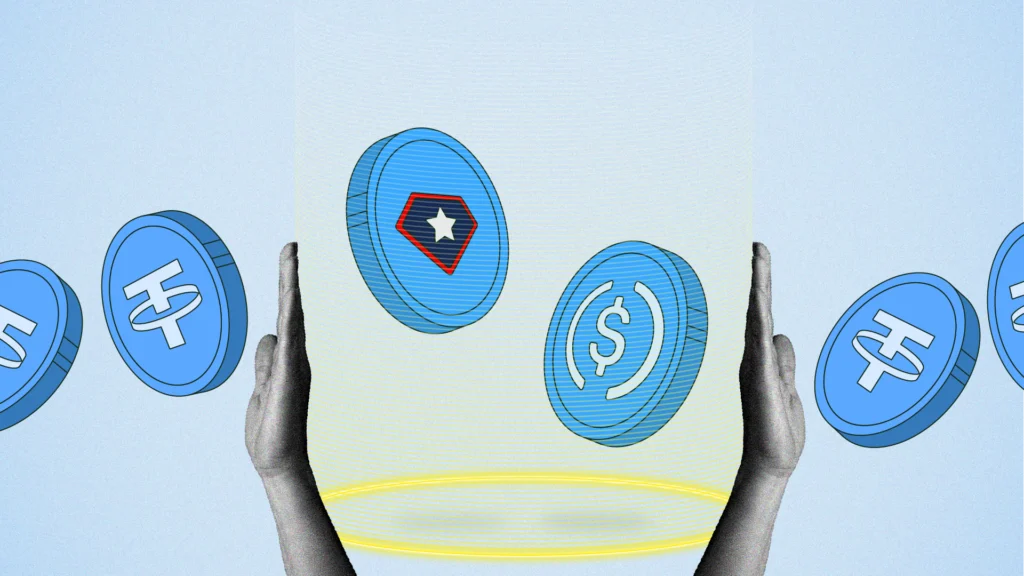
Three tokens now define that divide: USDC, issued by Circle; USA₮, Tether’s newly launched, bank-issued response to federal law; and USDT, the global liquidity engine that now sits outside the U.S. regulatory perimeter.
This article explains how the GENIUS Act defines stablecoin compliance in the U.S., why USDC and USA₮ meet those standards, and why USDT remains outside the U.S. regulatory framework. It also examines how these differences shape adoption, liquidity, and institutional use as stablecoins become a core part of the crypto market.
The GENIUS Act: Background and What “Compliant” Means
The GENIUS Act establishes federal rules for “payment stablecoins,” focusing on safety, transparency, and supervision.
Lawmakers framed the law as a response to stablecoins becoming systemically relevant, a point repeatedly emphasized during Senate Banking Committee hearings.
The law centers on four core requirements:
- Full reserve backing: Stablecoins must maintain 1:1 backing with cash or high-quality liquid assets such as U.S. Treasury bills.
- Regular disclosures: Issuers must publish recurring reserve reports with clear asset breakdowns.
- Regulated issuers: Stablecoins must be issued by federally supervised entities or approved state-level equivalents.
- No yield for holding: Payment stablecoins cannot pay interest simply for being held.
The yield restriction carries an important nuance. While the GENIUS Act prohibits paying yield for holding payment stablecoins, institutions often earn returns by moving compliant stablecoins into tokenized Treasury funds or regulated reserve vehicles, such as BlackRock’s BUIDL fund or Circle’s reserve fund structures.
These products operate outside the payment stablecoin definition, allowing yield generation without violating the Act.
These rules aim to keep stablecoin payment-focused rather than shadow banking products.
With that framework in place, differences between USDT, USDC, and USA₮ become clearer.
The following sections detail their differences.
USDC: Built for Regulation From the Start
Circle, a U.S.-based firm, issues USDC and designed the stablecoin around regulatory access rather than speed.
That strategy paid off after 2023, when banks, payment networks, and regulators began demanding clearer safeguards.
Circle has stated that USDC reserves are held in cash and short-term U.S. Treasuries through the Circle Reserve Fund, a structure designed to mirror the safety profile of top-tier government money market funds operating within the U.S. financial system.
Why USDC Fits the GENIUS Act?
USDC aligns with the GENIUS Act in several ways:
- Reserve structure: Circle states that USDC reserves consist of cash and short-term U.S. Treasuries held at regulated institutions, with custody at BNY Mellon.
- Disclosure practices: Circle publishes monthly reserve reports and is subject to U.S. regulatory oversight.
- Institutional adoption: Visa, PayPal, Stripe pilot programs, and U.S. bank settlement trials increasingly rely on USDC. For example, Visa has achieved more than $3.5 billion in annualized stablecoin transaction volume as banks experiment with on-chain settlement, reflecting growing institutional reliance on USDC.
This positioning makes USDC suitable for regulated payments, tokenized funds, and corporate settlements. The stablecoin trades some global reach for compliance certainty. That contrast sets the stage for USA₮.
USA₮: Tether’s U.S.-Specific Expansion
USA₮ represents a structural shift rather than a rebrand. Introduced on Jan. 27, 2026, USA₮ is a nationally chartered U.S. bank regulated by the Office of the Comptroller of the Currency. Tether acts as the branding and technology partner, not the issuer.
This distinction matters under the GENIUS Act.
Why USA₮ Fits the Framework
USA₮ exists to meet U.S. legal requirements that USDT cannot:
- U.S. issuer: Anchorage Digital Bank holds a national trust bank charter.
- Federal supervision: Anchorage operates under direct federal oversight.
- Domestic compliance: USA₮ is designed specifically for U.S. institutions, exchanges, and payment platforms.
As Paolo Ardoino, CEO of Tether, stated in official communications:
“USA₮ offers institutions an additional option: a dollar-backed token made in America,” said Paolo Ardoino, CEO of Tether.
Ardoino said that USD₮ has already shown how digital dollars can function reliably at a global scale, and that USA₮ builds on that experience by offering a version designed specifically to meet U.S. regulatory requirements.
This structure allows Tether to preserve USDT’s global role while offering a compliant alternative for U.S. markets.
Additionally, interoperability remains a key design feature. Tether and Anchorage are developing 1:1, fee-less swap mechanisms between USA₮ and USDT, allowing liquidity to move seamlessly between U.S.-regulated and global markets without breaking parity.
This approach aims to preserve USDT’s global liquidity while enabling compliant access for U.S. institutions.
It is important to note that while USA₮ was launched in partnership with Tether, the legal and operational roles remain clearly separated.
Anchorage Digital Bank, N.A. controls issuance and redemption, ensuring compliance with Office of the Comptroller of the Currency (OCC) requirements for federally chartered banks.
Cantor Fitzgerald, a U.S.-based global financial services firm, serves as the primary custodian for USA₮’s U.S. Treasury reserves, creating a custody structure distinct from the offshore reserve arrangements supporting USDT.
The firm publicly framed USA₮’s launch as a milestone for the U.S. digital asset market, describing it as the result of years of collaboration with Tether on stablecoin infrastructure and U.S. Treasury-backed custody.
In its announcement, Cantor highlighted Tether’s scale, noting that more than $180 billion in issued tokens support global payments, savings, and cross-border transfers.
It also emphasized USA₮ as a U.S.-first, GENIUS Act-compliant stablecoin designed to bring those capabilities into the American financial system through regulated payment rails. Global vs. National Rails: Why Structure Matters
Stablecoins now operate on two parallel tracks.
- USDT dominates global crypto liquidity across offshore exchanges and emerging markets.
- USDC dominates regulated payment experiments and institutional settlement.
- USA₮ targets U.S. institutions that require a federally issued stablecoin.
Major platforms already reflect this split:
- USDT: Binance, OKX, Bybit, KuCoin.
- USDC: Coinbase, Visa pilots, PayPal integrations.
- USA₮: Early-stage U.S. institutional and banking use cases.
This division reflects regulatory reality rather than competition alone.
USA₮ vs. USDC: Similar Goals, Different Origins
Both USA₮ and USDC meet GENIUS Act expectations, but their paths differ.
- USDC grew inside the U.S. system from inception.
- USA₮ adapts an existing global stablecoin brand to U.S. law.
That difference may shape adoption speed, but not legality.
Stablecoin Comparison Table
The following comparison shows structural differences between stablecoins and it also reveals how U.S. regulation is reshaping market behavior.
| Feature |
USDT |
USDC |
USA₮ |
| Issuer jurisdiction |
Offshore |
United States |
United States |
| Federal supervision |
No |
Yes |
Yes |
| GENIUS Act fit |
Limited |
Yes |
Yes |
| Global liquidity |
Very high |
Medium |
Emerging |
| Institutional access |
Restricted |
Strong |
Strong |
Since the GENIUS Act took effect, compliance has begun to influence where liquidity moves, which tokens institutions select, and how payment and settlement products get built.
In practice, the law is starting to function as a filter, directing regulated activity toward stablecoins that can operate inside the U.S. financial system without legal uncertainty.
This shift sets the stage for the next phase of stablecoin adoption.
What Comes Next for U.S.-Compliant Stablecoins
Under the GENIUS Act, compliance no longer functions as a secondary feature. It now determines which tokens can integrate with U.S. banks, payment networks, and regulated financial products.
USDC is positioned to remain central to regulated payments and settlement. Its early integration with Visa, PayPal, and U.S. banking pilots places it close to traditional financial infrastructure, especially as tokenized treasuries, corporate payments, and on-chain settlement continue to expand.
USA₮ introduces a parallel path for institutions familiar with Tether’s liquidity model. By issuing the token through a nationally chartered bank, Tether created a compliant entry point for U.S. institutions that want exposure to its stablecoin ecosystem without regulatory uncertainty.
USDT is likely to retain its global role outside the U.S. system. Its dominance across offshore exchanges and emerging markets remains intact, but U.S. law now draws a clear boundary between global liquidity and domestic compliance.
Together, these models signal the next phase of stablecoins. The market is no longer moving toward a single dominant token. Instead, it is fragmenting by jurisdiction, use case, and regulatory access, with GENIUS Act compliance acting as the gatekeeper for U.S. adoption.
FAQs
No. USA₮ is not legal tender (it is not issued by the U.S. Treasury or Federal Reserve). It is a regulated payment stablecoin issued by a private entity (Anchorage Digital Bank, N.A.) under the GENIUS Act framework.
No. It prohibits ‘Digital Asset Service Providers’ (U.S. exchanges or custodians) from offering non-compliant tokens to U.S. persons. USDT remains legal to hold, but U.S. institutions are effectively mandated to use PPSI-compliant tokens like USDC or USA₮ for commercial settlement.
No. While USDC (and USA₮) are designed for payments and settlement, the GENIUS Act explicitly distinguishes payment stablecoins from bank deposits. They are not FDIC-insured and represent a claim on a reserve of assets, not a traditional deposit.
Because the GENIUS Act requires U.S. market stablecoins to be issued by U.S.-domiciled, federally or state-qualified entities with specific reserve and audit standards. USDT’s global offshore structure is optimized for international scale, whereas USA₮ is “Made in America” to meet domestic banking and compliance requirements.
The information provided in this article is for informational purposes only. It is not intended to be, nor should it be construed as, financial advice. We do not make any warranties regarding the completeness, reliability, or accuracy of this information. All investments involve risk, and past performance does not guarantee future results. We recommend consulting a financial advisor before making any investment decisions.

Dr. Lorena Nessi is an award-winning journalist and media technology expert with 15 years of experience in digital culture and communication. Based in Oxfordshire, UK, she combines academic insight with hands-on media practice.
She holds a PhD in Communication, Sociology, and Digital Cultures, and an MA in Globalization, Identity, and Technology.
Lorena has taught at Fairleigh Dickinson University, Nottingham Trent University, and the University of Oxford. She is a former producer for the BBC in London, with additional experience creating television content in Mexico and Japan.
Her research focuses on digital cultures, social media, technology, capitalism, and the societal impact of blockchain innovation.
She has written extensively on digital media and emerging technologies, with her work featured in both academic and media platforms. Her Web3 expertise explores how blockchain technologies shape culture, economics, and decentralized systems.
Outside of work, Lorena enjoys reading science fiction, playing strategic board games, traveling, and chasing adventures that get her heart racing. A perfect day ends with a relaxing spa and a good family meal.


 Easy
Easy