Key Takeaways
- Mysten Labs co-founder Adeniyi Abiodun said the company built Sui to continue ambitions first explored during Meta’s Libra initiative.
- The company announced plans for fee-free stablecoin transfers on Sui, monetizing instead through stablecoin treasury yield and complex smart contract activity.
- Abiodun argued that crypto should improve ownership, payments, and virtual economies inside games.
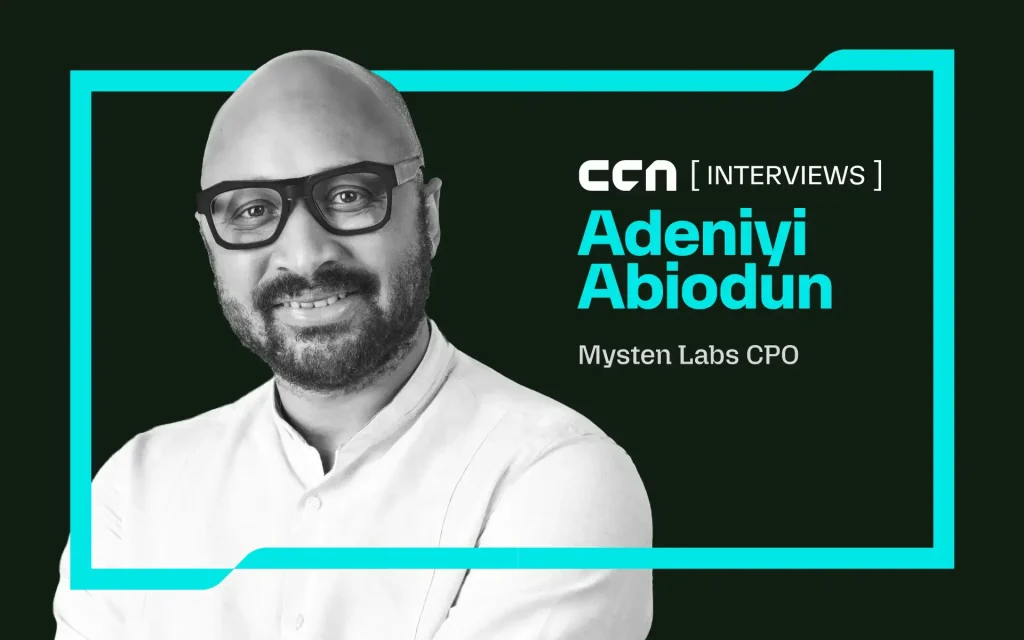
Mysten Labs co-founder and Chief Product Officer Adeniyi Abiodun said the company built the Sui blockchain to continue ambitions first explored during Meta’s failed Libra stablecoin initiative.
Founded in 2021 after leaving Meta, the firm built the high-performance Layer 1 network using the Move programming language originally developed during Libra’s creation.
Abiodun said the firm is looking to position Sui as infrastructure for global payments, gaming, and AI applications.
Sui Built For Internet-Scale Payments
Speaking to CCN at Consensus 2026, Abiodun said the experience of designing systems intended for billions of users heavily influenced Sui’s architecture.
“The reason the language was built is because Facebook has three-and-a-half billion users,” he said. “We held a higher bar for code quality and security.”
He criticized existing blockchain infrastructure based on the Ethereum Virtual Machine, arguing that account-based systems struggle to scale efficiently for mainstream financial applications.
“We couldn’t build a safe identity system on the EVM primitive,” he said. “We were able to find multiple bugs, not in people’s smart contracts, but in the actual virtual machine itself.”
Sui uses an object-based execution model rather than the account-based architecture used by Ethereum and many other blockchains.
According to Abiodun, this allows transactions to process independently and in parallel.
“Transactions happening on this object have nothing to do with transactions happening here,” he said. “My transactions do not affect yours.”
That structure, he argued, enables the network to scale horizontally by adding computing resources rather than bottlenecks caused by shared state.
“An account model can only scale to the size of a CPU,” Abiodun said. “An object model scales to as many CPUs as you can have.”
Zero-Fee Stablecoin Transfers
Mysten Labs also used Consensus to announce plans for fee-free stablecoin transfers on Sui, positioning the network as infrastructure for internet-native payments and fintech applications.
“We’ve computationally figured out a way to make the movement of money very, very low cost,” Abiodun said.
The company plans to monetize the network through stablecoin treasury yield and fees on more complex smart contract activity rather than peer-to-peer payments.
“I don’t think moving money is a value-added service,” he said. “It’s a prerequisite.”
Abiodun said the economics become viable because stablecoin reserves generate yield through US Treasuries and related financial products.
“That yield goes back to the network validators and also to partners who use the network,” he said.
Mysten Labs also announced a partnership with Nigerian fintech company Paga, which plans to use Sui infrastructure for cross-border payments and treasury management.
“They don’t have to build an entire system,” Abiodun said. “Sui can be that ledger.”
Simplifying Crypto Onboarding
A major focus for Mysten Labs is reducing complexity for mainstream users interacting with blockchain applications.
Abiodun said Sui supports integrations with existing internet login systems, allowing users to access blockchain applications using accounts from Google, Apple, or Facebook rather than managing traditional crypto wallets.
“We created a way by which you could use the existing session on the internet as a wallet,” he said.
The company is also emphasizing username-based payments rather than long wallet addresses.
“The idea of showing this long character string makes no sense,” Abiodun said. “Most users will never use it.”
He argued that future adoption would depend on abstracting away crypto infrastructure from end users.
Sui Gaming and Digital Economies
Mysten Labs has also expanded into gaming infrastructure through Sui partnerships, including projects tied to CCP Games’ EVE Frontier ecosystem.
Abiodun said blockchain should primarily serve as infrastructure for online economies rather than as speculative gaming mechanics.
“A game sucks, but you try to make it fun by adding money,” he said. “Crypto is not going to solve that problem.”
Instead, he described blockchain systems as tools that enable persistent asset ownership and programmable marketplaces within games.
“I’ve seen people build bounty systems,” he said. “Someone destroyed my ship. I’ll pay you X amount to go and destroy them.”
According to Abiodun, developers building on EVE Frontier have experimented with transport systems, programmable ownership rules, and player-created economic infrastructure.
Abiodun said the broader goal is not to force crypto speculation into games, but to modernize the underlying financial infrastructure powering virtual economies.
“It’s less that crypto makes the game more fun,” he said. “Crypto actually makes the game more efficient and gives a better user experience.”
He added that Mysten Labs believes blockchain-based infrastructure could reduce the need for game studios to repeatedly build internal marketplaces.
“It’s an infrastructure to liberate game developers from building the same infrastructure over and over again,” he said.
Libra Reflection
Abiodun reflected on his time at Meta, where he worked on the company’s Libra project — later renamed Diem.
The project aimed to create a programmable digital payments network integrated across Meta’s platforms, but ran into regulatory resistance.
“We were well aware of the regulatory climate,” Abiodun said.
“The project was close to being launched multiple times, and last minute we’d get some letter that prevents the launch.”
Abiodun said the repeated setbacks eventually convinced parts of the team that the broader vision around frictionless internet-native payments would need to continue outside Meta.
“So while that was happening, we decided, let’s go out of the company and continue the mission outside,” he said.
Meta’s Libra project, unveiled in 2019, is one of the most infamous and high-profile attempts by a major technology company to enter the digital finance space.
The initiative sought to create a global payments and stablecoin network backed by a consortium of corporate partners, but faced intense scrutiny from regulators and lawmakers concerned about financial stability.
The project was ultimately shut down in 2022.
AI Memory and Decentralized Infrastructure
Beyond payments and gaming, Mysten Labs is also building decentralized AI infrastructure through Walrus, its storage layer.
As well as MemWal, a system designed to let users port AI interaction history across different models and applications.
“You’re not going to want to give all your historical memory to a single company,” Abiodun said.
The system is designed to let users selectively share information between services such as ChatGPT, Claude, and Gemini while maintaining ownership and privacy controls over stored data.
“You own it, you control it, you decide where it’s been given,” he said.
Abiodun framed Mysten Labs’ broader vision as building decentralized alternatives to centralized internet infrastructure providers.
“We’re building the decentralized version of Google that’s fully programmable and fully transparent,” he said.
Top Trending Crypto Articles

Kurt Robson is a London-based reporter at CCN, specialising in the fast-moving worlds of crypto and emerging technology. He began his career covering local news in Cornwall after graduating from Falmouth University with First Class Honours in Journalism. There, he cut his teeth on everything from council meetings to missing swans.
He quickly rose through the ranks to become a frontline journalist at several of the UK’s leading national newspapers. Over the years, he has interviewed musicians and celebrities, reported from courtrooms and crime scenes, and secured multiple front-page exclusives.
Following the upheaval of the COVID-19 pandemic, Kurt shifted his focus to technology journalism—just ahead of the AI boom. With a natural curiosity and a trained eye for emerging trends, he has found a new rhythm in reporting on innovation.
At CCN, Kurt's work focuses on the cutting edge of crypto, blockchain, AI, and the evolving digital world. Drawing on his background in people-first reporting and his deep interest in disruptive tech, Kurt delivers stories that are insightful, entertaining, and human-centric.

Max Moeller is a Chicago‑based writer and video editor passionate about games, tech, and crypto. Whether it’s crafting clear, insightful articles or piecing together engaging video retrospectives, he’s driven by curiosity and takes pride in keeping things human. Since 2017, Max has been published in a variety of notable crypto magazines.
Contact Max: [email protected], reach out on LinkedIn or Youtube.