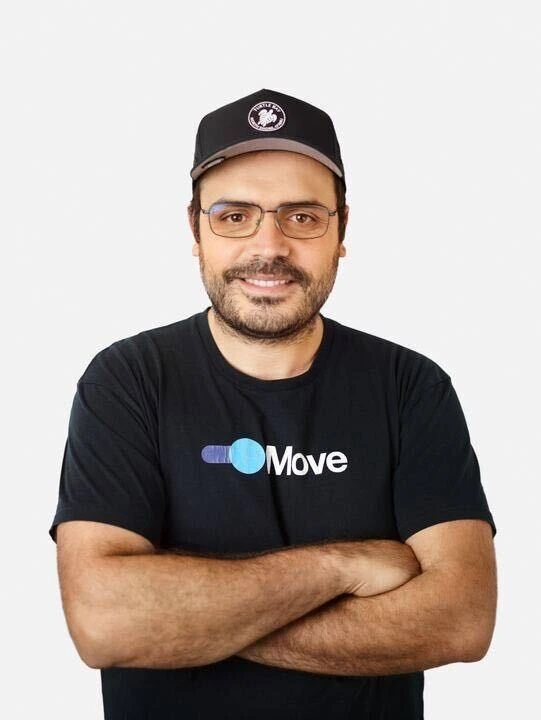
Inside Its Quantum-Ready Design, AI Defense & ZK Tunnels | Credit: Hameem Sarwar /CCN
Share
At Token 2049, one of the most anticipated discussions centered on the future of blockchain security and scalability in a post-quantum world. Insha Zia, News Editor at CCN, sat down with Dr. Kostas “Kryptos” Chalkias, co-founder and chief cryptographer at Mysten Labs, to explore how Sui was designed to meet these challenges from the ground up.
The most striking part of his vision is that Sui delivers 0.4-second finality, supports high-frequency use cases like gaming and trading, and can adopt new authentication methods, including post-quantum cryptography, at the flip of a switch.
“Sui was designed to be quantum-ready from day one,” he said, underscoring that modularity and scalability matter as much as speed.
A rich technical conversation unfolded, and in the sections that follow, you will find how Sui’s architecture delivers on this vision and why it positions itself as quantum-proof.
“There is a bigger threat than quantum: Artificial Intelligence” — Dr. Kostas Chalkias, SUI / Mysten Labs
What Sets Sui Apart From Other Blockchains?
Quantum computing has long been viewed as a distant threat. Yet Dr. Chalkias said it was a priority from Sui’s earliest design stage.
Try Our Recommended Crypto Exchanges
Sponsored
Disclosure
We sometimes use affiliate links in our content, when clicking on those we might receive a commission at no extra cost to you. By using this website you agree to our terms and conditions and privacy policy.
Unlike Bitcoin and Ethereum, which rely on the Elliptic Curve Digital Signature Algorithm (ECDSA), Sui employs the Edwards-curve Digital Signature Algorithm (EdDSA).
“So this is applicable only on Sui, Solana, Near and only on the blockchains that are using not the algorithms that Satoshi picked for Bitcoin, but the new algorithm that is called EdDSA. While Bitcoin is using ECDSA, this difference, this small letter, is actually a different algorithm. But this different algorithm makes our new innovation possible to convert it to post-quantum with a single click of a button,” Dr. Chalkias explained.
He described how Sui can retrofit (meaning upgrade existing accounts without replacing them) into post-quantum safety by layering zero-knowledge proofs (ZKP) on top of existing keys.
In practice, this allows wallets created under older cryptographic schemes to be strengthened so their signatures remain secure against quantum attacks, without users needing to move funds or create new accounts.
How Sui approaches post-quantum readiness according to Dr. Chalkias:
Modular authentication: Users can shift between cryptographic schemes without migrating accounts.
Backward compatibility: Old accounts can be secured against future threats through zero-knowledge upgrades.
Protection of dormant assets: Inactive wallets and “slumbering” accounts can be moved into safe schemes before a quantum attack occurs.
Broader crypto implications: He pointed to 6.2 million dormant Bitcoins as prime targets for a quantum computer, highlighting why Sui’s approach matters.
By designing modularity into the protocol itself, Dr. Chalkias argued, Sui avoids the trap of being “locked” into a vulnerable scheme, a challenge older chains must now confront.
The Blockchain Quadlemma
The blockchain trilemma, balancing decentralization, scalability, and security, has long been seen as the field’s hardest puzzle.
“Everyone knows about the blockchain trilemma, but now it’s not a trilemma, it’s a quadlemma because we have this quantum threat as well,” Dr. Chalkias pointed out.
“In my opinion, Sui is positioned at the best place at the moment to solve this quadlemma,” he said, crediting both technical design choices and the concentration of expertise inside Mysten Labs.
Dr. Chalkias pointed out that Sui combines several factors that work together to keep performance high while supporting complex features:
High execution power: Capable of handling resource-heavy operations like zero-knowledge proofs efficiently.
Parallelization: Transactions can be spread across multiple CPU cores, boosting throughput.
Ultra-fast consensus: A design that ensures sub-second finality without bottlenecks.
Optimized cryptography: Cryptographic systems tailored for speed and future-proof security.
Programming language efficiency: A blockchain-specific language built for performance at scale.
With these elements combined, Dr. Chalkias said, “you can have thousands of transactions operating in a single block of 0.4 second latency, which is huge.”
In his view, these four elements combine to position Sui ahead of its rivals.
Beyond Finance: Sui Blockchain’s Real-World Use Cases in Healthcare
At this point, the conversation shifted away from technology toward real-world applications, focusing on Sui’s partnership with the United Nations Development Programme (UNDP) and what the healthcare pilot reveals about blockchain’s potential beyond finance.
Dr. Chalkias was clear: blockchain must demonstrate its value in areas that touch people’s daily lives.
“This one would be a proof of concept about protecting the medicine being delivered to people that are vulnerable and so on. But you need privacy,” he said.
“What is the problem with blockchains, typically—all of the blockchains? Everything is public. Everyone can see. Everybody can see everything,” he stated.
As a result, the main challenge is ensuring privacy in a system where most blockchains are inherently transparent. To address this, Sui deployed a trio of specialized tools:
Seal: Encryption that allows selective access to sensitive data.
Nautilus: Confidential computation so AI models can analyze information without exposing it.
Walrus:Decentralized storage for gigabytes or even terabytes of medical records.
“We created a system that can protect secrets and can provide privacy with selective access to the content,” Dr. Chalkias said.
For him, the UNDP pilot demonstrated that blockchain can do more than process financial transactions. It can also safeguard vital supply chains where both speed and privacy are essential.
He emphasized that healthcare is only the beginning. Chalkias pointed to a growing list of enterprise partnerships, including Google, as proof that Sui’s infrastructure is being taken seriously beyond crypto-native circles.
“SUI is not just a token at the moment; it’s something bigger than that. It’s a traded asset even on the stock market, even in NASDAQ,” Dr. Chalkias said.
For him, the stablecoin wave further validates Sui’s enterprise appeal. By offering high throughput, composability, and privacy features, Sui positions itself as a natural home for large-scale payment networks like Ethena’s stablecoin, alongside collaborations with traditional finance and technology giants.
As the discussion progressed, it became clear that it would not settle into simplicity. Insha steered it back into the technical side, introducing one of Dr. Chalkias’ favorite topics: ZK Tunnels.
ZK Tunnels: Instant Off-Chain Transactions
Dr. Chalkias’ enthusiasm was strongest when discussing ZK tunnels, which he presented as a more flexible, programmable version of Bitcoin’s Lightning Network.
“We might have situations where you want instant final, literally zero seconds. How do you do that? The only way is you are opening a tunnel with a player that you want to interact with,” he said.
Unlike Lightning, which is limited to payments, Sui’s tunnels can handle any kind of off-chain logic. That means the same mechanism that powers instant transactions can also enable complex interactions between users, devices, or applications, all while keeping them private from the main chain.
Dr. Chalkias outlined several use cases that show the versatility of this design:
Gaming: Real-time moves without even a 0.4-second delay.
Disaster relief: Offline supermarket transactions in areas with no internet.
Robotics and devices: Remote control of hardware such as remote-controlled (RC) cars or drones.
Confidential competitions: Chess or poker games where outcomes are settled off-chain but verified on-chain.
He emphasized that the real breakthrough is privacy. With ZK Tunnels, interactions remain invisible to outsiders, whether they involve gaming, shopping, or competitive play.
As he put it: “Apart from the fact that they cannot see off-chain because it’s anyway between us, they cannot even see on the blockchain that we’re playing chess.”
This naturally extends into robotics and AI, where instant and private interactions are critical.
“All of this data can go on chain, you can control your robot as you do it now, and for the first time in your life, you can monetize from your robot very quickly,” Dr. Chalkias said.
He pointed to Sui’s participation at CoRL, a robotics conference in Korea, where the team showed how blockchain can support scientific robots. Mysten Labs has even built low-cost prototypes to make this real: “
Imagine very small Arduino devices… eventually you can stick this on all of your devices—your TV, in your car, in your air conditioning—and now everything speaks Sui.”
In Dr. Chalkias’s view, Sui could become the backbone that allows everyday devices and robots to interact securely.
Beyond Quantum: AI Threats and Regulation
While quantum dominates headlines as the main risk to blockchain, for Dr. Chalkias there is a bigger threat: artificial intelligence.
“AI in the wrong hands can actually cause problems to all of the open source projects in the world,” he said. “Because everything is public and the AI is now learning from all of humanity’s history across the years.”
Mysten Labs’ response has been to deploy AI proactively and he prefers to dismiss short-term panic.
“Quantum computers are not there yet to break crypto,” Dr. Chalkias said.
“And I can cut my hand that it’s not two, three years. I’m telling you, we’re not there”, he emphasized.”
Instead, his focus is on preparedness. He argued that blockchains cannot remain isolated from regulatory shifts and real-world payment systems.
Stablecoins and broader Web2 integration mean the transition to quantum-safe infrastructure must begin now, regardless of when quantum breakthroughs arrive.
As he put it, regulation is already setting the pace. Quoting U.S. standards, he noted that the National Institute of Standards and Technology (NIST) “says 2030 to 2035 is the last deadline I’m giving you to switch all of your algorithms to quantum.”
Dr. Chalkias emphasized that developers are at the heart of Sui’s adoption.
“We’re going to work on confidential transactions. You’re going to see a lot of privacy on Sui, quantum safety,” he said.
“People have never seen a backwards-compatible quantum solution. So Sui is going to implement all of this stuff.”
At the same time, security remains a priority, with white-hat hackers like himself and Mysten’s Reginaldo building defenses against scams.
His final point underscored his priorities stating the following:
“More startups mean eventually better adoption of your blockchain. In my opinion, this is my biggest bet. I want to win on the developer side of things and then eventually on the markets because more startups mean eventually better adoption of blockchain.”
Disclaimer:
The information provided in this article is for informational purposes only. It is not intended to be, nor should it be construed as, financial advice. We do not make any warranties regarding the completeness, reliability, or accuracy of this information. All investments involve risk, and past performance does not guarantee future results. We recommend consulting a financial advisor before making any investment decisions.
Dr. Lorena Nessi is an award-winning journalist and media technology expert with 15 years of experience in digital culture and communication. Based in Oxfordshire, UK, she combines academic insight with hands-on media practice.
She holds a PhD in Communication, Sociology, and Digital Cultures, and an MA in Globalization, Identity, and Technology.
Lorena has taught at Fairleigh Dickinson University, Nottingham Trent University, and the University of Oxford. She is a former producer for the BBC in London, with additional experience creating television content in Mexico and Japan.
Her research focuses on digital cultures, social media, technology, capitalism, and the societal impact of blockchain innovation.
She has written extensively on digital media and emerging technologies, with her work featured in both academic and media platforms. Her Web3 expertise explores how blockchain technologies shape culture, economics, and decentralized systems.
Outside of work, Lorena enjoys reading science fiction, playing strategic board games, traveling, and chasing adventures that get her heart racing. A perfect day ends with a relaxing spa and a good family meal.
Insha Zia is the News Editor at CCN. Based in Dubai, United Arab Emirates, he ensures the CCN newsroom provides value to readers by educating, informing, and engaging them with accurate and timely coverage.
Before joining CCN, Insha was a Senior Journalist at DailyCoin, where his career in crypto journalism took off. At DailyCoin he garnered ample experience by covering some of the biggest news in the crypto industry, especially in the Cardano ecosystem, and maintain solid relations with KOLs in the industry.
Insha has worked as a ghostwriter and a developer for three years. He has co-authored numerous articles in reputable publications, including Hackernoon, Yahoo Finance, and Nasdaq. He also has experience as a Solidity Developer and a Data Analyst.
Insha’s developer and journalist backgrounds go hand in hand when educating readers on technically complex concepts within the crypto space. He values accuracy, transparency, and delivering valuable insights to his readers.
Insha firmly believes education can propel the mass adoption of the crypto space. He is committed to giving CCN readers a greater understanding of the technology using his technical background.
Insha earned a Bachelor of Science in Computer Systems Engineering at the University of Engineering and Technology, Peshawar, in 2022. His technical foundation includes expertise in quantitative and qualitative research, data analysis, programming languages, and cybersecurity.
His comprehensive skill set enables him to communicate complex concepts to crypto readers with authority and clarity, making his articles both informative and engaging for his audience.
Insha is determined to take CCN to the top of the industry. When he’s not working on his next article or editing, Insha enjoys playing video games, mainly in FPS and MMORPG genres. He also loves playing soccer and has supported Arsenal since he was six.


 Easy
Easy