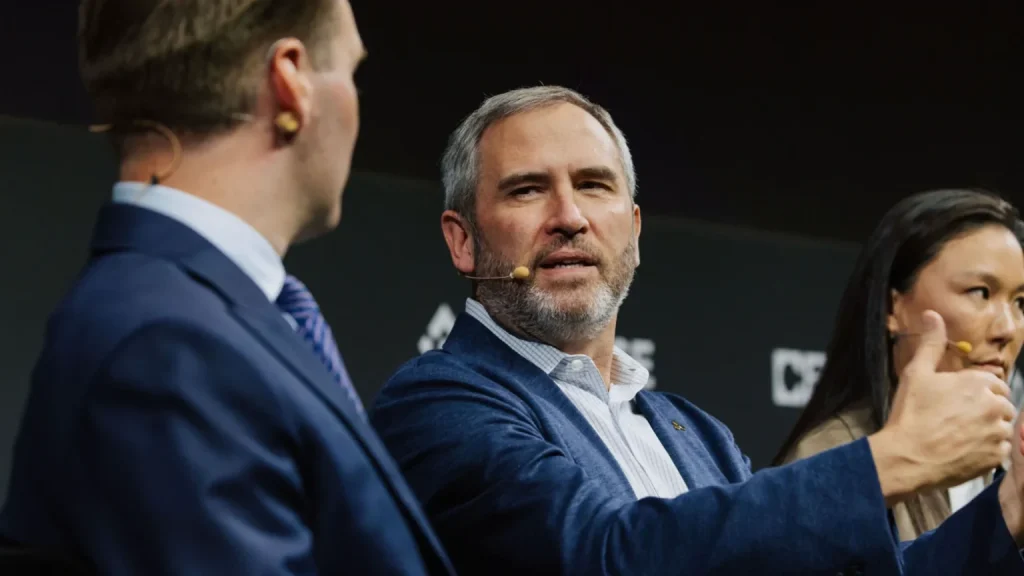
Does crypto need infinite scale? | Source: Kimberly White/Getty Images
Share
Key Takeaways
Solana’s Yakovenko argues that crypto doesn’t need unlimited transaction throughput.
He emphasizes optimizing the “economic tick” and the speed at which a blockchain updates the global state.
Privacy will likely emerge later as a competitive differentiator, he claims.
Solana co-founder Anatoly Yakovenko said the crypto industry may be overestimating how much scale it ultimately needs, arguing that a relatively modest level of throughput could handle the transactions that truly matter in a mature blockchain economy.
Speaking in a fireside chat with Ali Yahya, general partner at a16z crypto, at the Consensus 2026 conference, Yakovenko said the focus should shift away from raw transaction volume toward speed, reliability and economic value.
Try Our Recommended Crypto Exchanges
Sponsored
Disclosure
We sometimes use affiliate links in our content, when clicking on those we might receive a commission at no extra cost to you. By using this website you agree to our terms and conditions and privacy policy.
Solana Co-Founder: Crypto “Transactions That Matter”
Yakovenko pushed back on the idea that blockchains must scale to handle every possible machine-to-machine interaction, even as AI agents increasingly drive activity.
“The nuance to that question is… what is the median fee per transaction?” he said.
“If you start going below half a penny, that means that all the transactions you’re not including are basically financially insignificant.”
He compared blockchain usage to search engines, where only monetizable activity drives meaningful scale.
“Google doesn’t actually handle all of the search in the world… but none of those are financially important searches,” he said.
“The layer that matters is that layer above the median fee.”
Yakovenko said his earlier estimate of roughly 700,000 transactions per second — cited in the discussion as enough to put “the entirety of the world’s finance on chain” — was based on “a back-of-the-envelope estimate for one gigabit.”
“We’re not even near that,” he said, noting that even leading networks are operating well under potential capacity.
Instead of maximizing throughput, Yakovenko said the industry should prioritize what he called the “economic tick” — the speed at which a blockchain updates and synchronizes global state.
“What people actually care [about] right now is, how big is your economic tick? Is it 400 milliseconds? Is it one second? Is it 50 milliseconds?” he said.
Faster synchronization enables higher-value activity to move on-chain, he added.
“That allows people to actually put more expensive transactions on chain and… more important stuff actually goes away from traditional markets into these decentralized ones.”
Privacy’s A “Lagging Feature”
Yakovenko also said privacy in crypto is likely to emerge as a secondary feature rather than a primary driver of adoption, as the industry matures toward institutional-scale usage.
While demand for privacy is universal, the Solana co-founder believes it is unlikely to be the initial catalyst for widespread consumer adoption.
“I think privacy is not a leading feature that will change consumer behavior. It’s a lagging feature,” Yakovenko said.
“Once you establish product-market fit… then you can add privacy… and that becomes a moat.”
He said rising transaction volumes on blockchain networks—currently around $1 trillion per month in stablecoin activity by his estimate—will make privacy a more meaningful competitive differentiator over time.
“As crypto matures… these issues between competitors and between consumers are going to start to become serious differentiators,” he said.
Yakovenko also highlighted regulatory tensions as a key uncertainty.
He noted that the push and pull between the consumer and regulation in this area will be a “critical thing in the next two to five years.”
Neutral Base Layers Are Key
Addressing concerns about growing institutional influence in crypto, Yakovenko argued that large financial players still prefer decentralized infrastructure at the foundational level.
“They actually want to build on a base layer where they know nobody else has control,” he said.
“There’s no way for a third party to interrupt or screw up the financial systems that they’re building on top.”
He described permissionless and trustless systems as “really critical as a foundational building block,” even as institutions require additional controls to meet regulatory obligations.
Rather than embedding centralized controls into the base layer itself, Yakovenko suggested these features should be implemented at higher layers.
“What they don’t want is the ambiguity… where the rules are opaque and hard to enforce,” he added.
He pointed to Solana’s open-source and high-speed design as enabling businesses to scale consumer-facing applications.
“Solana, being open source and permissionless is this really great foundational bedrock, and the fact that it’s cheap and fast is what allows them to build businesses on top that can actually scale to consumers.”
Kurt Robson is a London-based reporter at CCN, specialising in the fast-moving worlds of crypto and emerging technology. He began his career covering local news in Cornwall after graduating from Falmouth University with First Class Honours in Journalism. There, he cut his teeth on everything from council meetings to missing swans.
He quickly rose through the ranks to become a frontline journalist at several of the UK’s leading national newspapers. Over the years, he has interviewed musicians and celebrities, reported from courtrooms and crime scenes, and secured multiple front-page exclusives.
Following the upheaval of the COVID-19 pandemic, Kurt shifted his focus to technology journalism—just ahead of the AI boom. With a natural curiosity and a trained eye for emerging trends, he has found a new rhythm in reporting on innovation.
At CCN, Kurt's work focuses on the cutting edge of crypto, blockchain, AI, and the evolving digital world. Drawing on his background in people-first reporting and his deep interest in disruptive tech, Kurt delivers stories that are insightful, entertaining, and human-centric.