Web3 gaming lost over half its funding in 2025 as play-to-earn collapsed and hype faded. A Delphi report explains what went wrong—and what’s next. | Credit: Getty Images.
Share
Key Takeaways
The Web3 gaming trend has seen a steep decline in 2025 as investor money almost completely dried up.
Funding dropped more than 50% as highly hyped Web3 games failed to deliver on their promises.
The play-to-earn model collapsed as it relied on endless token rewards, turning games into short-lived money schemes.
However, in 2025, the trend has seen a substantial decline, prompting many to question whether it is nearing its end.
A new Delphi Digital report highlights the significant decline in funding for Web3 gaming in 2025, with the most anticipated launches underdelivering, and enthusiasm fading.
Try Our Recommended Crypto Exchanges
Sponsored
Disclosure
We sometimes use affiliate links in our content, when clicking on those we might receive a commission at no extra cost to you. By using this website you agree to our terms and conditions and privacy policy.
Delphi Digital’s latest report paints a stark picture of GameFi’s struggles this year, but the narrative is far more nuanced than one of outright demise.
Native Web3 games eked out six- to seven-figure revenues, but with tiny, bot-infested player pools where “the fun stops once incentives dry up.”
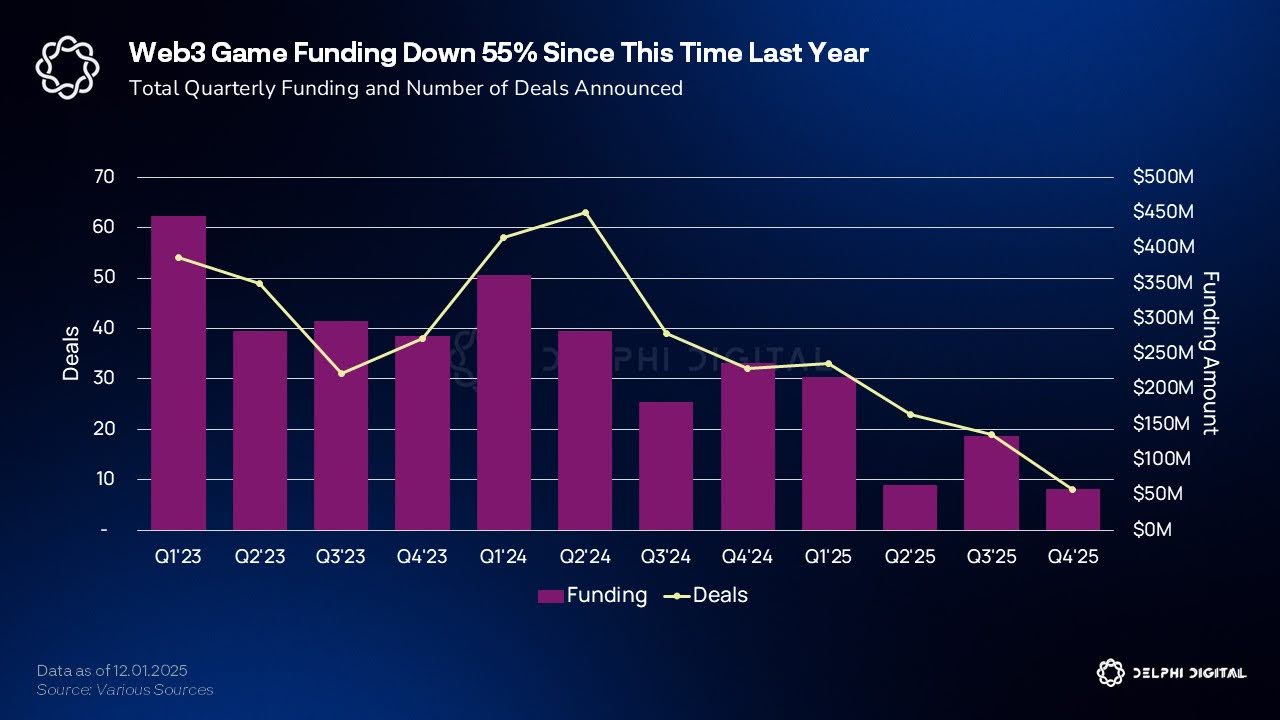
The funding rate has plunged by 55% over the past two years, but a new generation of gaming has risen to compensate for the falling popularity of pure Web3 gaming ecosystems.
The first quarter of 2024 saw over $400 million in funding and 65 deals announced; that number has now slumped to just over $50 million in funding and just two deals in the final quarter of 2025, a steep decline in under two years.
The funding rate for Web3 gaming declines by 55%. Source: Delphi Digital
Even when native Web3 games have seen a decline in adoption, Web2.5 games have emerged as the new flag bearer.
These new generations of games utilize blockchain to a certain extent to attract players, but offer a genuine Web2-level gaming experience.
Studios like Fumb Games, Mythical Games, and Wemade/Wemix continue generating significant revenue while leveraging blockchain in their own unique ways.
The chain improves margins, increases engagement, or introduces new revenue streams.
Key Reasons Behind GameFi’s Downfall
Several factors contributed to the decline and downfall of the Web3 gaming ecosystem, including overhyped projects failing to deliver, a funding drought, and the impending bear market. Here are some of the key reasons behind the decline:
Money from investors almost disappeared: People who give money to game companies have stopped investing. Funding dropped by more than half compared to 2024, resulting in many projects running out of cash.
Over-hyped games failed to keep players: Games that everyone was excited about launched, but most players quit quickly. The games were not fun enough once the free rewards stopped.
The “Play-to-Earn” model broke down: Many games paid players with tokens to play, but this turned into a system where people only played for quick money. When the rewards dried up, everyone left, and token prices crashed.
The games were not good enough compared to regular games: Web3 games often felt clunky, required complicated wallets, and were not as enjoyable as regular mobile or console games that people already love.
Too much focus on making money fast instead of building real games: Many teams built games around tokens and speculation first, rather than creating fun gameplay. When the crypto market cooled down, these projects could not survive.
In short, the sector got cleaned up as the weak, money-focused projects failed, leaving room for better ones to grow.
Prashant Jha is a seasoned crypto journalist based in Delhi, India, with a Bachelor’s Degree in Computer Science Engineering. Passionate about the evolving world of blockchain and cryptocurrencies, he has been a dedicated voice in the industry since 2018. Prashant’s expertise lies in regulatory reporting, where he unravels complex legal and financial developments with clarity and precision. Before joining CCN in 2024, he honed his craft at Cointelegraph, establishing himself as a trusted name in crypto journalism.
His coverage spans major industry events, including the high-profile collapses of FTX, Three Arrows Capital (3AC), and LUNA, offering readers insightful analyses of their regulatory and market implications. Prashant’s technical background enables him to bridge the gap between intricate blockchain technology and its real-world applications, making his work accessible to novices and experts.
Beyond his professional pursuits, Prashant is an avid music enthusiast, often exploring diverse genres to unwind. A sports lover, he has a particular passion for cricket and frequently engages in discussions about the game. His multifaceted interests and sharp journalistic instincts make him a valuable contributor to CCN, where he continues shaping the crypto landscape's narrative.