Ethereum leads tokenization with 61% market share as institutions like BlackRock drive real-world assets on-chain. | Credit: CCN.
Share
Key Takeaways
Ethereum dominates tokenization with 61% market share, $206 billion in settled volume, and 40% annual growth.
Competitors like BNB Chain, Solana, and Avalanche trail far behind with much smaller shares.
BlackRock, Franklin Templeton, and others are accelerating the tokenization trend through major on-chain funds.
Ethereum is increasingly becoming the default infrastructure for tokenized assets, and the gap is widening.
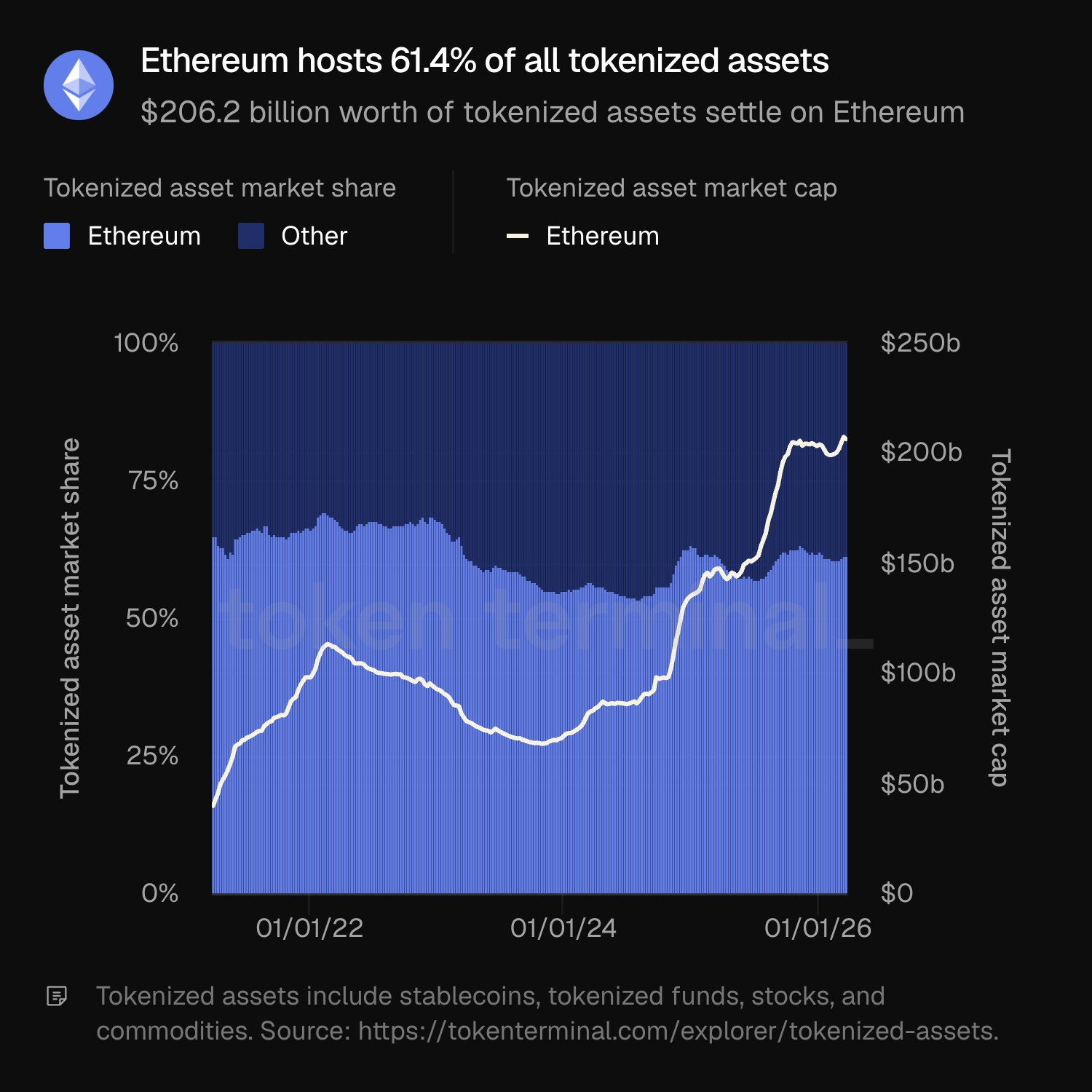
A new analysis from Token Terminal shows the network controlling around 61% of the tokenization market, with $206 billion in settled value over the past year.
That dominance is backed by roughly 40% year-over-year growth, reinforcing Ethereum’s position as the primary settlement layer for both institutional and retail adoption in real-world asset (RWA) tokenization.
Try Our Recommended Crypto Exchanges
Sponsored
Disclosure
We sometimes use affiliate links in our content, when clicking on those we might receive a commission at no extra cost to you. By using this website you agree to our terms and conditions and privacy policy.
As more traditional finance activity moves on-chain, Ethereum continues to attract issuers looking for a reliable and liquid base layer.
Its combination of smart contract flexibility, security track record, and deep developer ecosystem has made it the go-to network for tokenizing assets ranging from U.S. Treasuries to private credit.
The appeal is straightforward. Ethereum enables programmable ownership, near-instant settlement, and global access, without relying on traditional intermediaries.
Ethereum dominates the tokenization ecosystem with 61% share. Credit: Toketerimnal.
Unlike legacy systems burdened by slow clearing times and high costs, Ethereum enables 24/7 trading of tokenized assets.
This is while maintaining regulatory compliance through tools like on-chain identity and permissioned smart contracts.
Data from leading analytics platforms underscore this momentum.
Settled volumes are climbing steadily as more funds and issuers choose the network for its liquidity depth and interoperability.
This 40% annual expansion outpaces broader blockchain growth, positioning Ethereum as the default choice for scaling tokenized markets that could eventually reach trillions in value.
Institutional interest has been a key catalyst.
Major asset managers have deployed funds directly on Ethereum, leveraging its established DeFi primitives to offer yield-bearing products that bridge traditional finance and decentralized protocols.
The network’s upgrades, including lower transaction fees enabled by layer-two solutions, have further accelerated adoption without sacrificing security or decentralization.
As a result, Ethereum not only hosts the majority of tokenized real-world assets but also processes the highest volume of institutional flows, cementing its role as the settlement layer for the next generation of capital markets.
Who Else Is Competing?
Other blockchains are gaining traction, but remain far behind in both scale and institutional adoption.
BNB Chain holds roughly 12–13% of the tokenized asset market, with about $3.4 billion in active value.
Its lower fees and integration with the Binance ecosystem make it attractive for retail-driven applications, though it lacks Ethereum’s depth in institutional use cases.
Solana is another fast-growing contender, with around 6% market share and roughly $1.7 billion in tokenized value.
Its high throughput and low latency have driven growth in areas like tokenized equities and high-frequency strategies.
In some cases, Solana has even surpassed Ethereum in the number of wallets holding tokenized assets.
Still, its total volume and institutional backing remain well below Ethereum’s.
Other networks, including Stellar and Avalanche, each account for roughly 4–5% of the market.
Stellar has focused on cross-border payments and stablecoin-based tokenization, while Avalanche has leaned into enterprise use through customizable subnets.
Even Ethereum’s own layer-two networks, such as Arbitrum, contribute to this expansion—though they ultimately reinforce Ethereum’s position by scaling its underlying infrastructure.
Taken together, all competing chains still control less than 40% of the market, highlighting how concentrated tokenization activity remains.
Wall Street Is Accelerating the Trend
The bigger story is how quickly tokenization itself is scaling.
What started as a niche experiment has grown into a multi-billion-dollar sector, with tokenized real-world assets now exceeding $25 billion in total value locked.
The drivers are clear: faster settlement, fractional ownership, and improved transparency.
Private credit, U.S. Treasuries, and real estate are leading the way, offering programmable yields and broader access to assets that were traditionally difficult to reach.
Large asset managers are now pushing the trend forward.
The fund has scaled to billions in assets and distributes yield directly on-chain, showing how traditional finance can integrate blockchain without overhauling existing systems.
Franklin Templeton has taken a similar approach with its BENJI fund, offering on-chain access to government securities.
Meanwhile, firms like Ondo Finance, Securitize, and Centrifuge are building the infrastructure needed to bring private credit and real estate on-chain in a compliant way.
As these players scale, the tokenization market is shifting from proof-of-concept to production-grade infrastructure.
Ethereum’s leadership ensures it will capture the lion’s share of this growth, yet the competitive landscape keeps innovation sharp.
With settled volumes climbing and new entrants joining daily, tokenization stands poised to redefine global finance, making assets more liquid, accessible, and efficient for investors worldwide.
Prashant Jha is a seasoned crypto journalist based in Delhi, India, with a Bachelor’s Degree in Computer Science Engineering. Passionate about the evolving world of blockchain and cryptocurrencies, he has been a dedicated voice in the industry since 2018. Prashant’s expertise lies in regulatory reporting, where he unravels complex legal and financial developments with clarity and precision. Before joining CCN in 2024, he honed his craft at Cointelegraph, establishing himself as a trusted name in crypto journalism.
His coverage spans major industry events, including the high-profile collapses of FTX, Three Arrows Capital (3AC), and LUNA, offering readers insightful analyses of their regulatory and market implications. Prashant’s technical background enables him to bridge the gap between intricate blockchain technology and its real-world applications, making his work accessible to novices and experts.
Beyond his professional pursuits, Prashant is an avid music enthusiast, often exploring diverse genres to unwind. A sports lover, he has a particular passion for cricket and frequently engages in discussions about the game. His multifaceted interests and sharp journalistic instincts make him a valuable contributor to CCN, where he continues shaping the crypto landscape's narrative.