“If the conversations in London are any indication, the tokenization debate has moved decisively into its implementation phase.”| Image credit: Hameem Sarwar /CCN
Share
Key Takeaways
RWA tokenization is entering an implementation phase in global finance.
Tokenized money market funds and Treasuries are emerging as the first scalable use cases.
Regulation, compliance, and trusted intermediaries remain essential for institutional adoption.
Infrastructure integration with traditional finance will determine how fast tokenization scales.
There was a clear belief among delegates that real-world asset (RWA) tokenization can be the gateway for large-scale institutional adoption of on-chain assets.
But the tone of the discussions also indicated that tokenization is no longer framed as a speculative technology, but as a practical infrastructure upgrade to the global financial system.
What was particularly encouraging was seeing the conversation move beyond tokenized money market funds to encompass other assets and wider use cases.
The RWA & Stablecoins London Summit brought together representatives from BlackRock, State Street, JP Morgan, and Barclays, all grappling with the same fundamental question:
How do we bridge the traditional finance market with blockchain technology?
The Value of RWA Tokenization
The scale of that opportunity is difficult to overstate. Global financial assets now exceed $250 trillion according to Boston Consulting Group (BCG), and even a small portion migrating on-chain would represent a massive structural shift in how financial markets operate.
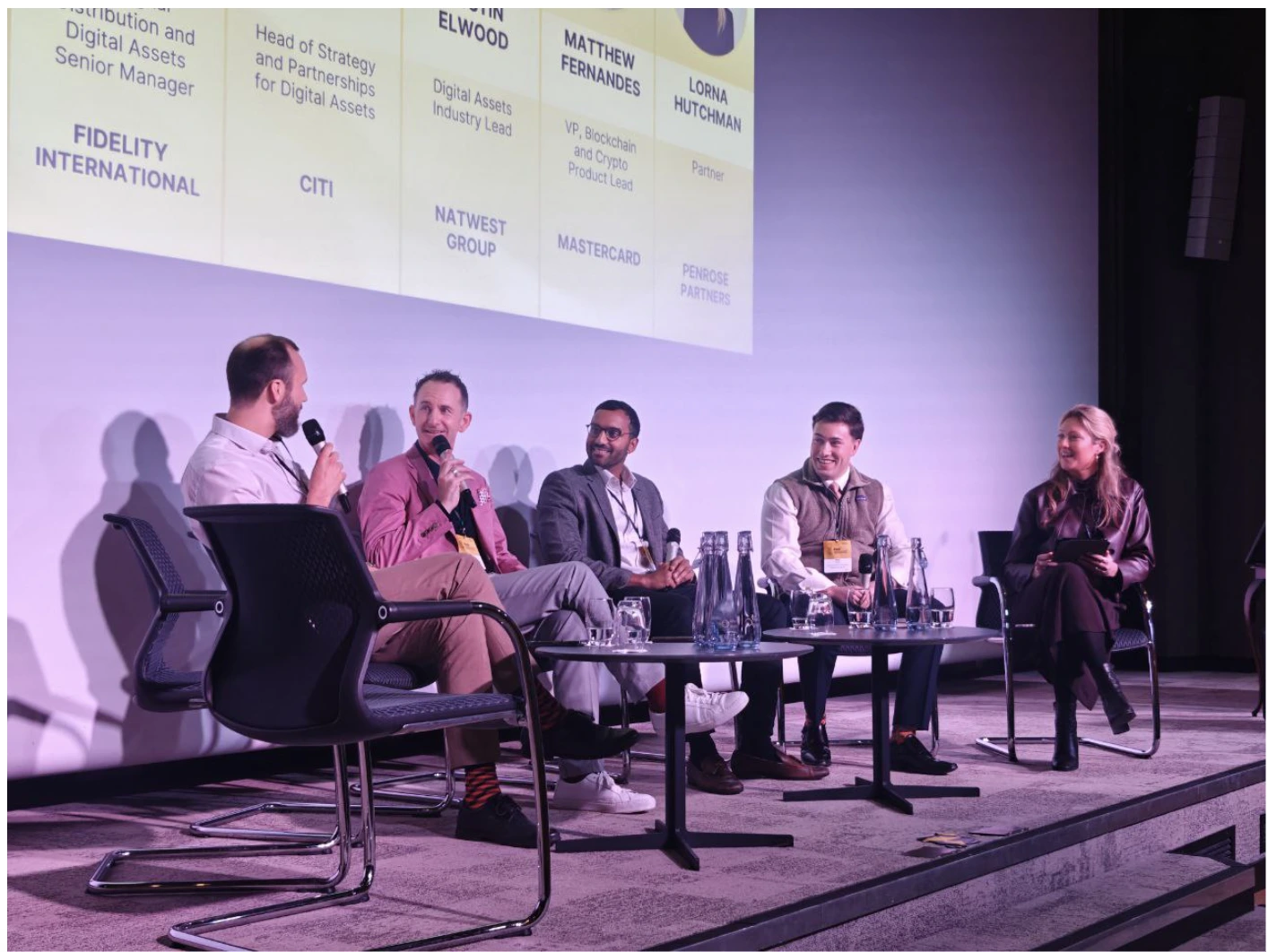
As moderator of the “Digital Gold and Trade: Unlocking Liquidity in Commodity Markets” panel, what struck me most wasn’t the technology discussions, which are largely solved, but the honest acknowledgment of where friction still exists and what’s needed for institutional adoption.
In previous years, conversations around tokenization tended to focus on theoretical efficiency gains.
This time, the discussion felt more operational: how do institutions actually integrate blockchain rails into systems designed decades before the internet existed?
Emilio Anting’s (Franklin Templeton) framing was particularly apt, dividing the world into “Have Wallets” and “Want Wallets.”
In this model, decentralized finance (DeFi) serves the $2.3 trillion crypto market, but the real opportunity lies in bringing DeFi elements into traditional markets to capture the $250 trillion in assets that are still sidelined.
Why Money Market Funds Are Leading the RWA Adoption Curve
Discussion about what scales first yielded a surprising consensus: tokenized money market funds, not exotic use cases.
With $7.8 trillion already in that market, the path of least resistance wins.
As Nikhil Sharma noted, the more standardized and scalable the product, the more optimized the expense ratios, though there’s always a trade-off between price and utility until commoditization drives compression.
Tokenized U.S. Treasury products alone surpassed $1 billion in on-chain value during 2024, led by offerings from the likes of BlackRock and Franklin Templeton.
What began as experimentation is quietly becoming a new distribution channel for one of the most conservative asset classes in global finance.
Tokenization Does Not Automatically Create Liquidity
The efficiency question prompted useful candor.
Several panelists pushed back on overhyped timelines; efficiency gains will take time, and liquidity creation for illiquid assets doesn’t happen automatically through tokenization, Nikhil Sharma added.
The prediction: 2026 will be the year of digital money, with FCA and GENIUS Act clarity enabling broader adoption. | Source: Ben Elvidge
From my work on uranium tokenization, this rings true. We’ve reduced entry barriers from $9 million to a few dollars per ounce, but creating genuine liquidity requires education, regulatory clarity, and time.
The regulatory discussions were pragmatic.
Regulated markets will need centralized platforms because regulators require control, know-your-customer (KYC), and jurisdictional connections remain non-negotiable.
Trusted intermediaries won’t disappear; institutions need someone to blame when things go wrong.
The Infrastructure Shift Driving Tokenization
What gave me genuine optimism was the discussion around infrastructure players.
As Christoph Kletzer noted, when DTCC and NASDAQ are actively tokenizing collateral and planning on-chain settlement with stablecoins, the question shifts from “if” to “when”.
DTCC alone processes over $3 quadrillion in securities transactions annually, illustrating how even incremental blockchain integration within existing market infrastructure could have profound systemic implications.
Retail remains slow, with a speaker in the “Architecting Risk, Regulation and Infrastructure for Digital Assets” panel mentioning that only 3% use crypto for payments because fiat and credit cards work everywhere.
Real traction is in B2B, where SWIFT’s two-to-three-day settlement feels painfully slow in the modern context.
The prediction: 2026 will be the year of digital money, with the Financial Conduct Authority (FCA) and GENIUS Act clarity enabling broader adoption.
“The remaining challenge is integrating that technology into the complex institutional structures that underpin global finance”. | Source: Ben Elvidge
From Institutional Adoption to a Generational Shift
The generational shift was noted multiple times.
Lisa Cameron, a Former Member of Parliament of the United Kingdom, recounted a meeting with the Children’s Parliament initiative, where the young representatives understood what Web3 meant while MPs looked confused, a sign of something important.
In 15 years, the digital-native generation will be transacting, and blockchain will simply be infrastructure.
The commodity panel I moderated reinforced these themes.
The common thread across gold, uranium, and other commodities was bridging physical custody with digital representation to create genuine utility.
And utility comes in various guises; for instance, tokenizing physical assets isn’t just about accessibility, but about creating pricing transparency in historically opaque markets.
Why 2026 Could Mark a Turning Point for Digital Assets
2026 represents an inflection point. We have the technology, institutional interest, regulatory momentum, and infrastructure connections for scale. The challenge isn’t technical, then, but operational, educational, and cultural.
As Ed Goh (B2C2) noted, we need to make RWAs feel like the iPod: users don’t need to understand what’s underneath, they just experience something that works.
Emma Lovett’s (J.P. Morgan) opinion was that 2026 is going to be the year of digital money, but that without adequate knowledge and certainty around the digital payment side, nothing else can really flow easily.
If the conversations in London are any indication, the tokenization debate has moved decisively into its implementation phase.
The technology question is largely settled.
The remaining challenge is now integrating that technology into the complex institutional structures that underpin global finance.
That process may take longer than the industry initially hoped, but the direction of travel is indisputable. It’s only a matter of time.
Disclaimer:
We occasionally work with brands we trust to bring you deeply researched content. This article was developed in collaboration with a trusted partner.
Disclaimer:
The views, thoughts, and opinions expressed in the article belong solely to the author, and not necessarily to CCN, its management, employees, or affiliates. This content is for informational purposes only and should not be considered professional advice.
About the Author
Jay Leonard
With over half a decade of experience commentating on the cryptocurrency market and even more as a trader and investor, Jay has developed a robust knowledge base that enables him to dive deep into the inner workings of crypto platforms and the broader market to deliver unique, user-focused insight.
Jay's work has spanned public relations firms, crypto projects, affiliate sites, and news outlets.