Home / News / Crypto / Regulation & Policy / CLARITY Act Faces Brutal Timing Crunch as House Prepares to Leave Washington — Is Bitcoin’s $81K Rally Now at Risk?
Crypto Faces a Make-or-Break Week With 60-Vote CLARITY Test, Fed Decision and BOJ Meeting Ahead
Share
Key Takeaways
The House is now expected to have just one voting week in Washington in September, returning Sept. 14 before lawmakers head back to their districts ahead of the midterms.
The Senate’s first CLARITY Act floor test is not until Sept. 15 at 2:15 p.m. ET, leaving almost no realistic pre-election window for the House to consider any Senate-amended version.
The bill is not dead if Congress misses the September deadline. Lawmakers could still act during a post-election lame-duck session, but failure to finish before the current Congress ends would force the process to start again.
The CLARITY Act already faced a difficult 60-vote test in the Senate. Now it has another problem: the congressional calendar may be running out faster than votes can be held.
House Republican leaders have canceled votes for the final two weeks of September, leaving lawmakers with what is expected to be only one week in Washington before the November midterm elections.
The House will return for votes on the evening of Monday, Sept. 14. It is then expected to leave Washington after that week’s session as lawmakers return to their districts to campaign.
The shortened calendar follows President Donald Trump‘s signing of a stopgap spending measure that keeps the government funded through Dec. 11, reducing pressure for lawmakers to remain in Washington later in September.
That creates an unusually tight problem for crypto’s biggest remaining legislative push.
Galaxy Digital Head of Firmwide Research Alex Thorn warned Thursday that the revised schedule makes it “extremely unlikely” that the CLARITY Act can become law before the midterms.
🚨 HOUSE SEPT SESSION ONLY 1 WEEK
House republican leadership has canceled votes for the weeks of sept 21 and sept. 28. the house will return sept 14 for 4 days, then leave washington until after the midterms
*this makes it extremely unlikely CLARITY can pass before midterms*
The reason is not simply that the House is leaving. It is when the Senate starts.
Try Our Recommended Crypto Exchanges
Sponsored
Disclosure
We sometimes use affiliate links in our content, when clicking on those we might receive a commission at no extra cost to you. By using this website you agree to our terms and conditions and privacy policy.
Senate CLARITY Vote Comes as House Clock Is Almost Expired
The Senate returns to regular business on Sept. 14.
At 2:15 p.m. ET on Sept. 15, senators are scheduled to vote on cloture on the motion to proceed to H.R. 3633, the Digital Asset Market Clarity Act, according to the Senate Press Gallery.
That is only the procedural gateway.
CLARITY needs 60 votes to invoke cloture and move toward debate. A successful Sept. 15 vote would not pass the legislation or send it to Trump.
If the Senate clears the first hurdle, lawmakers would still have to debate the measure, consider amendments, and ultimately vote on passage.
Meanwhile, the House could be preparing to leave Washington within days.
“The Senate has approx 3 weeks of session from 9/15 until the first week of Oct,” Thorn wrote. But he noted that even if the Senate passes CLARITY, the House would need to approve the Senate’s version before it could reach the president.
That latter point needs one qualification.
The House already passed H.R. 3633 by a vote of 294-134 in July 2025, with support from 78 Democrats.
If the Senate somehow passed the exact House text unchanged, another House vote would not be necessary. But that is not where the process currently stands.
The Senate has spent months rewriting the legislation. Its latest text combines work from the Banking and Agriculture committees and adds or revises provisions involving ethics, non-custodial software developers, illicit finance, and stablecoin interest and yield. Senate Banking advanced its version 15-9 in May.
If that amended Senate package passes, the House must agree to the changes before Trump can sign it.
That is the timing crunch Thorn is pointing to.
National Sheriffs’ Association Drops CLARITY Act Opposition
Separately, the National Sheriffs’ Association has dropped its opposition to the CLARITY Act, removing one of the law-enforcement concerns that had complicated the bill’s path through the Senate.
The group had previously raised concerns over crypto-related crime and enforcement, so its change in position could make it easier for lawmakers to build the bipartisan support needed for the bill to advance.
BREAKING: 🇺🇸 National Sheriffs’ Association drops its opposition to the CLARITY Act.
Its crypto crime concerns had been one of the obstacles holding the bill back in the Senate.
CLARITY Could Clear the Senate and Still Miss the House
Now consider the calendar.
The House returns Sept. 14.
The Senate’s first procedural vote comes Sept. 15.
Even an immediate victory would only begin Senate consideration, while the House’s remaining September floor time could be measured in days.
The Senate, by contrast, is currently scheduled to remain in legislative session through Oct. 2.
That means a scenario in which senators spend late September finishing CLARITY but have no House in Washington to accept the revised bill is increasingly plausible.
It also makes every delay more expensive.
Negotiators still have politically difficult issues to manage. Senate Democrats have challenged the bill’s ethics provisions, particularly rules governing elected officials’ crypto interests.
Republicans have also had to negotiate language covering stablecoin rewards, anti-money-laundering rules and protections for software developers.
The latest Senate text includes an ethics framework and a safe harbor clarifying that certain non-custodial developers are not money transmitters.
Those disagreements matter because the Sept. 15 vote itself requires bipartisan support before the bill even reaches final passage.
Could the CLARITY Delay Hit Bitcoin Price?
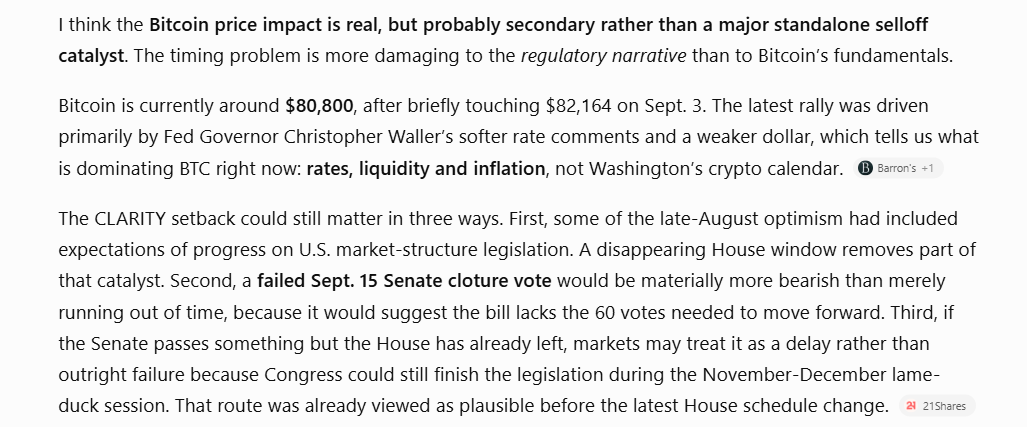
According to ChatGPT, Bitcoin may feel the political setback, but the immediate price impact could be smaller than usually anticipated.
BTC traded near $81,000 on Sept. 4, after jumping more than 5% a day earlier as softer Federal Reserve rhetoric revived expectations that policymakers could leave rates unchanged this month.
That reaction suggests monetary policy remains the stronger short-term driver of Bitcoin.
ChatGPT on Bitcoin price impact if CLARITY Act Fails. | Source: ChatGPT
The CLARITY Act is potentially more consequential for altcoins, DeFi platforms, exchanges and other crypto businesses whose regulatory treatment remains less settled. Bitcoin already occupies a comparatively established position in US markets through spot ETFs and existing regulatory treatment.
Still, the House calendar removes one bullish catalyst investors had been watching. A successful Sept. 15 procedural vote, followed by congressional delay, could elicit only a limited reaction because lawmakers would retain a lame-duck route after the elections. A failure to reach the Senate’s 60-vote threshold, however, would send a stronger signal that comprehensive crypto legislation may not arrive in 2026.
For Bitcoin, the worst combination would therefore be CLARITY failing in the Senate just as inflation reaccelerates and the Fed turns hawkish on Sept. 16. In that scenario, regulatory disappointment would arrive alongside tighter liquidity — the factor to which Bitcoin has recently shown far more sensitivity.
Missing September Would Not Kill CLARITY — Yet
The calendar change does not mean CLARITY automatically dies if it is unfinished before the midterms.
Congress can return after the election for a lame-duck session, giving the House another opportunity to take up whatever the Senate passes.
But that would introduce a different political environment.
Lawmakers will know which party controls the next Congress. Members who lost reelection may still be voting. Leadership priorities can change, while year-end government funding and other must-pass legislation compete for limited floor time.
There is also a harder deadline waiting beyond the election: the end of the 119th Congress.
If CLARITY is not enacted before the current Congress expires in January 2027, unfinished legislation does not simply carry over into the next Congress. Lawmakers would need to introduce and move legislation again.
That makes September far more consequential than a normal scheduling headache.
CLARITY Act survived more than a year after its 294-134 House victory and has finally reached the doorstep of the Senate floor.
Now, even if supporters find the 60 votes they need on Sept. 15, they may discover that winning the Senate vote and finding enough days on the congressional calendar have become two separate battles.
Disclaimer:
The information provided in this article is for informational purposes only. It is not intended to be, nor should it be construed as, financial advice. We do not make any warranties regarding the completeness, reliability, or accuracy of this information. All investments involve risk, and past performance does not guarantee future results. We recommend consulting a financial advisor before making any investment decisions.
Dr. Guneet Kaur is a senior editor at CCN.com and a Science Fellow at Exponential Science. She is a fintech and blockchain expert with extensive experience in digital finance education, blockchain ecosystems, and cryptocurrency markets. She has worked with global media such as Cointelegraph, as well as education and blockchain platforms, to design and lead strategic content and learning initiatives. As an educator and assessor for top-tier executive programs, she bridges real-world fintech trends with academic insight.
Dr. Kaur is also a published researcher and peer reviewer across fintech and data science journals, including Financial Innovation Journal and International Journal of Big Data Intelligence and Applications. Her work spans data-driven analysis, Web3 innovation, and technical content development. With a strong foundation in both industry and academia, she translates complex financial technologies into practical applications, empowering learners, professionals, and institutions across the rapidly evolving digital finance landscape.