Home / Analysis / Crypto / Technical Analysis / CLARITY Act Heads to Vote Today as Bitcoin Wobbles Around $79K — Here’s Why $550M in BTC Shorts Could Pay the Price
Will BTC hit $88,000 if CLARITY Act vote gets greenlight? | Credit: Hameem Sarwar
Share
Key Takeaways
Bitcoin is holding above the key $79,000 level ahead of the Senate’s vote on the CLARITY Act.
More than $550 million in short positions could be liquidated if BTC rises toward $88,000.
A successful vote may strengthen institutional confidence, while failure could send BTC back to $75,616.
Bitcoin (BTC) is trading near the critical $79,000 level as traders brace for one of the most important regulatory events in crypto history.
Today, May 14, 2026, the US Senate Banking Committee will officially advance the long-awaited Digital Asset Market Clarity Act, commonly known as the CLARITY Act, toward a major markup vote.
While Bitcoin’s price has remained relatively stable, indicators suggest the market may underestimate the legislation’s short-term implications.
At current levels, more than $550 million in leveraged Bitcoin short positions are sitting dangerously exposed if bullish momentum accelerates following the vote.
The bill aims to replace the industry’s long-standing “regulation by enforcement” environment with a formal legal framework for digital assets.
Get These Top Crypto Casino Offers Now!
Sponsored
Disclosure
We sometimes use affiliate links in our content, when clicking on those we might receive a commission at no extra cost to you. By using this website you agree to our terms and conditions and privacy policy.
Under the proposed structure, crypto assets would be divided into three major categories:
Securities regulated by the SEC
Digital commodities regulated by the CFTC
Stablecoins operating under shared oversight frameworks
The legislation also establishes clearer rules surrounding token issuance, exchange registration, custody services, decentralized finance infrastructure, and stablecoin operations.
For institutional investors, the biggest advantage is clarity. Beyond that, the outcome of today’s vote could affect Bitcoin’s price and traders alike.
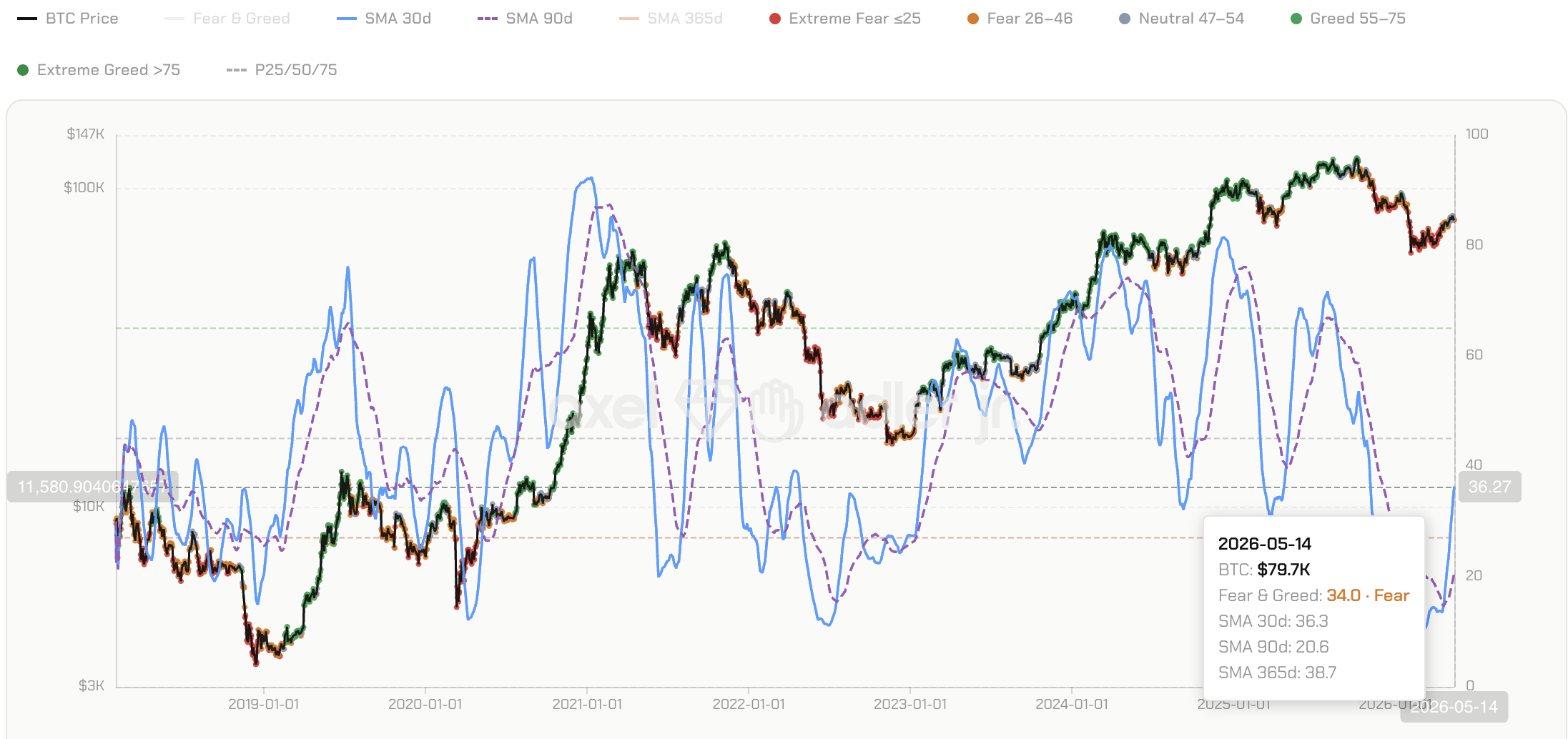
Ahead of the CLARITY Act vote, the broader market sentiment remains in the “fear” zone, with a Fear & Greed Index reading around 34.
Historically, this type of divergence is important because major market tops usually form during extreme greed, not fear.
The 30-day and 90-day moving averages of the Fear & Greed Index are also near cyclical lows. For context, this suggests sentiment has cooled even as prices remain relatively strong.
Notably, this occurs during consolidation phases within larger bull markets, when weak hands exit before another rally begins.
Looking back at previous cycles, deep fear readings during uptrends have frequently created strong buying opportunities.
So, if the current setup remains the same, Bitcoin’s price could increase.
Approval Means Problems for Bears
Interestingly, data from Coinglass shows an equal number of longs and shorts at the time of writing.
However, it seems shorts are most at risk given the enthusiasm around the event.
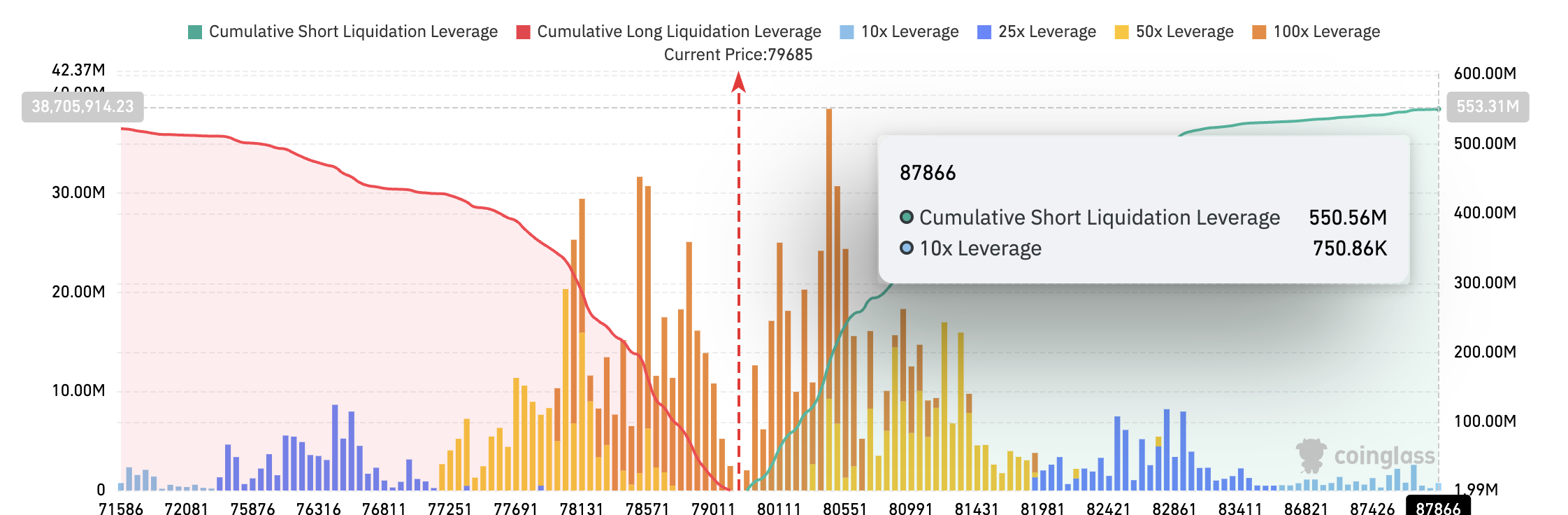
Looking at the Bitcoin Liquidation Map on Binance, Bitcoin may still have strong upside liquidity targets above the current price of around $79,600.
The chart shows cumulative short liquidation leverage rising from roughly $80,000 to $88,000, with over $550 million in potential short liquidations near $87,800.
As such, this has created a short squeeze setup. If BTC continues to push higher, shorts positioned in that range could be forcefully liquidated, adding further buy pressure and accelerating the rally.
In addition, the concentration of high-leverage positions, especially 50x and 100x, increases the probability of violent price action.
Meanwhile, most long liquidation clusters below the current Bitcoin price appear relatively small and already partially cleared.
This implies that downside liquidity is weaker than the large pool of liquidity resting above the price.
Amid this setup, analyst Michaël van de Poppe said the greenlight for the act could kick off another bull run.
“Big day today with the Clarity Act vote. Might be a historical day for everyone involved in #Crypto and could, very-well, signal the start of a stronger cycle,” van de Poppe posted on X.
Higher Odds Again
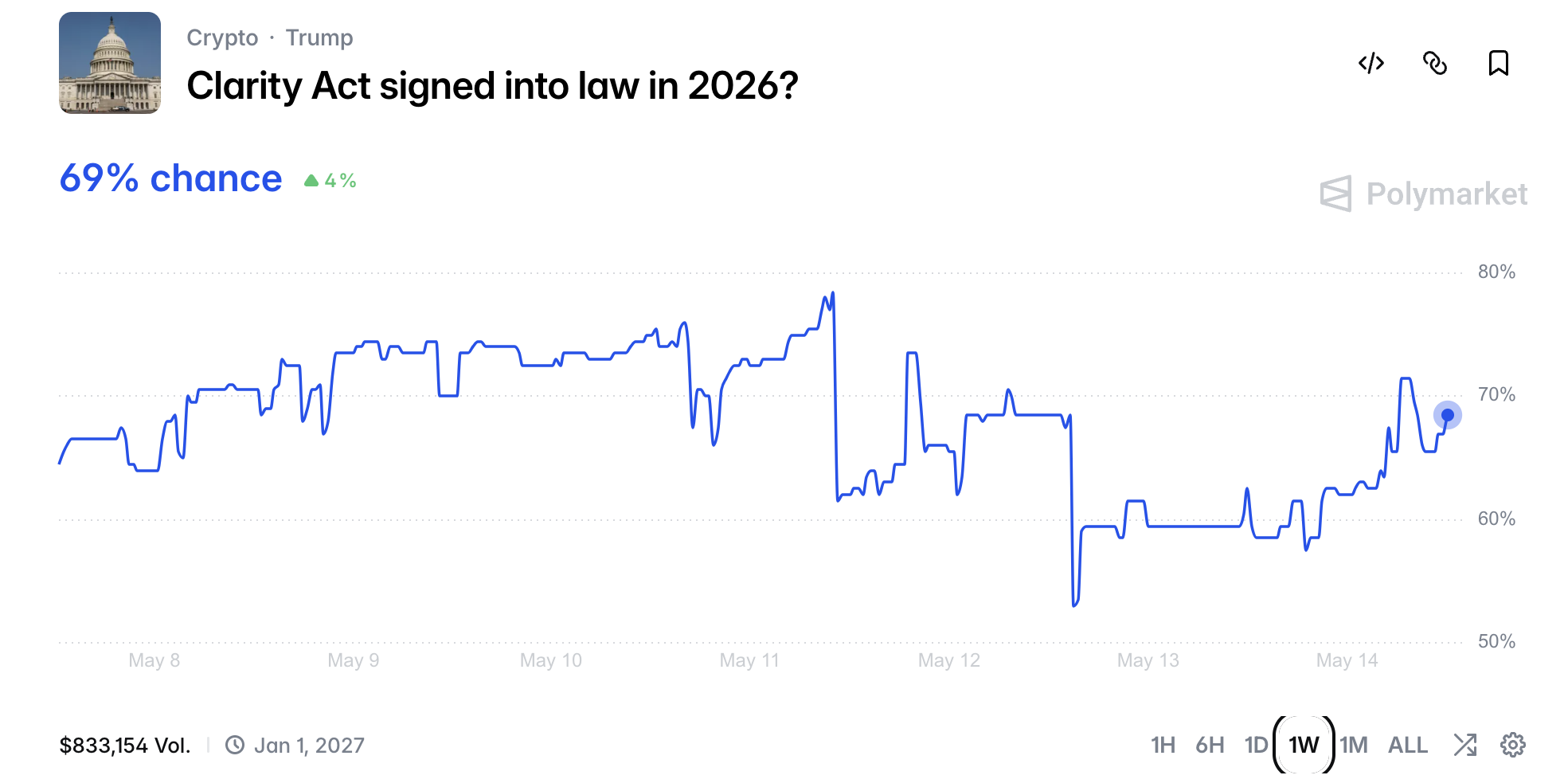
In the meantime, Polymarket shows that traders have assigned a 69% probability that the Clarity Act will be signed into law in 2026.
This signifies growing confidence in meaningful crypto regulation.
Over the past week, sentiment has steadily trended upward despite some volatility. Notably, the odds have recovered after briefly falling near 53%.
For the crypto market, this is potentially very significant. The CLARITY Act vote could provide clearer rules on token classifications, exchange operations, and institutional participation, reducing one of the biggest uncertainties weighing on the US crypto market.
If passed, sectors such as DeFi, Layer 1s, Layer 2s, and real-world asset protocols could benefit the most.
The rising probability on prediction markets also helps explain why many Bitcoin and other altcoins have recently begun to show stronger breakout structures.
BTC Price Prediction: Setup Bullish
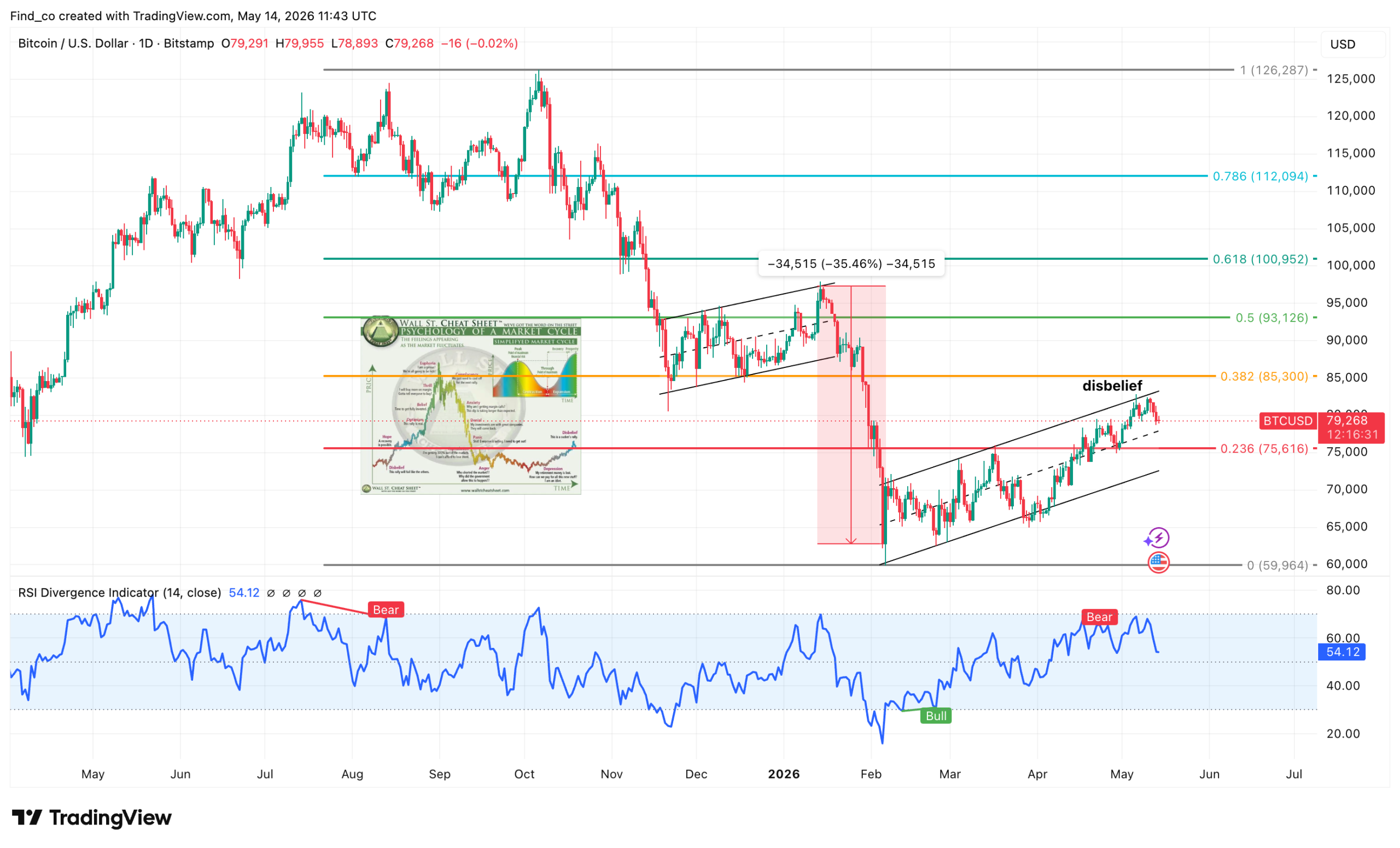
On the daily chart, Bitcoin’s price appears to be following the popular market psychology cycle almost perfectly.
After the 35% correction from the local top near $96,000 in January, sentiment shifted bearish. However, Bitcoin’s price has since recovered and reclaimed key support above the $75,000.
The current move resembles the “disbelief” phase of a bull market, where price trends higher while many participants still expect another major collapse.
This is reinforced by the rising channel structure from the February lows and by BTC’s continued printing of higher lows despite recent bearish RSI divergences.
From a technical perspective, the $75,616 level remains a critical support zone.
As long as Bitcoin holds above it, the broader bullish structure remains intact. The next major resistance sits around the 0.382 Fibonacci level near $85,300, followed by the psychological $93,126.
The chart also suggests that the February capitulation may have acted as the cycle reset rather than the start of a prolonged bear market.
Similar mid-cycle corrections occurred in previous bull markets before continuation toward new highs.
A period of consolidation between $75,000 and $85,000 would be healthy before any potential continuation toward the $100,000 region later in the cycle.
On the other hand, if the CLARITY Act vote fails to get the expected approval, BTC might decline to $75,616.
What Else to Watch
Beyond Bitcoin, the CLARITY Act vote could have enormous implications for some tokenized finance platforms and cross-chain interoperability protocols.
Projects such as Injective (INJ), Chainlink (LINK), and Ondo Finance (ONDO) have already seen growing institutional interest as markets anticipate a transition toward a more regulated crypto economy.
Analysts say the legislation could effectively mark the beginning of crypto’s “Institutional Era.”
At the same time, incoming Federal Reserve Chair Kevin Warsh, who has previously referred to Bitcoin as “new gold for the under-40s,” is expected to oversee a major transition period in U.S. monetary and financial policy.
Disclaimer:
The information provided in this article is for informational purposes only. It is not intended to be, nor should it be construed as, financial advice. We do not make any warranties regarding the completeness, reliability, or accuracy of this information. All investments involve risk, and past performance does not guarantee future results. We recommend consulting a financial advisor before making any investment decisions.
Victor Olanrewaju is a crypto analyst and reporter at CCN with deep roots in on-chain research and technical analysis. His crypto journey began in 2017, but it was the 2020 Uniswap airdrop that sparked a full-time pivot into the space.
With a foundation in copywriting, Victor honed his craft creating high-converting content for leading crypto brokers — most notably an XRP price prediction that ranked #1 on Google during the 2021 bull run.
He later joined AMBCrypto in 2022, where he combined storytelling with technical and on-chain analysis to cover key market narratives.
In 2024, he expanded his expertise at BeInCrypto, collaborating with analysts and using tools like Glassnode, Santiment, and IntoTheBlock to break down Bitcoin and altcoin trends.
At CCN, Victor covers the top cryptocurrencies, memecoins, macro shifts, blending real-time insights with deep-dive metrics.
He holds a Bachelor’s degree in Physics from the University of Ibadan, equipping him to simplify complex data for a wide audience. Follow his work or connect on LinkedIn or X.