Key Takeaways
- Former US lawmakers Tim Ryan and David McIntosh say the Sept. 15 CLARITY Act vote could improve institutional confidence in DeFi, but regulatory implementation will still determine how quickly capital moves onchain.
- McIntosh expects tokenized Treasuries to move first, with private credit and other real-world assets offering a larger long-term opportunity as institutions become more comfortable with onchain infrastructure.
- Ryan warns that continued US regulatory uncertainty could push developers, capital, and financial infrastructure overseas, while other jurisdictions move ahead with clearer digital-asset frameworks.
Institutional finance is already moving onchain before Washington has finished writing the rulebook.
On Aug. 27, Virtu Financial, M1X Global, and Tradeweb completed a fully onchain repo using a sovereign digital bond as collateral, with the securities delivery, cash leg, and return settling atomically on the Canton Network. Meanwhile, distributed tokenized real-world assets stand at roughly $38.7 billion, showing how quickly traditional assets are beginning to move onto blockchain infrastructure.
The question now is whether US regulation can catch up.
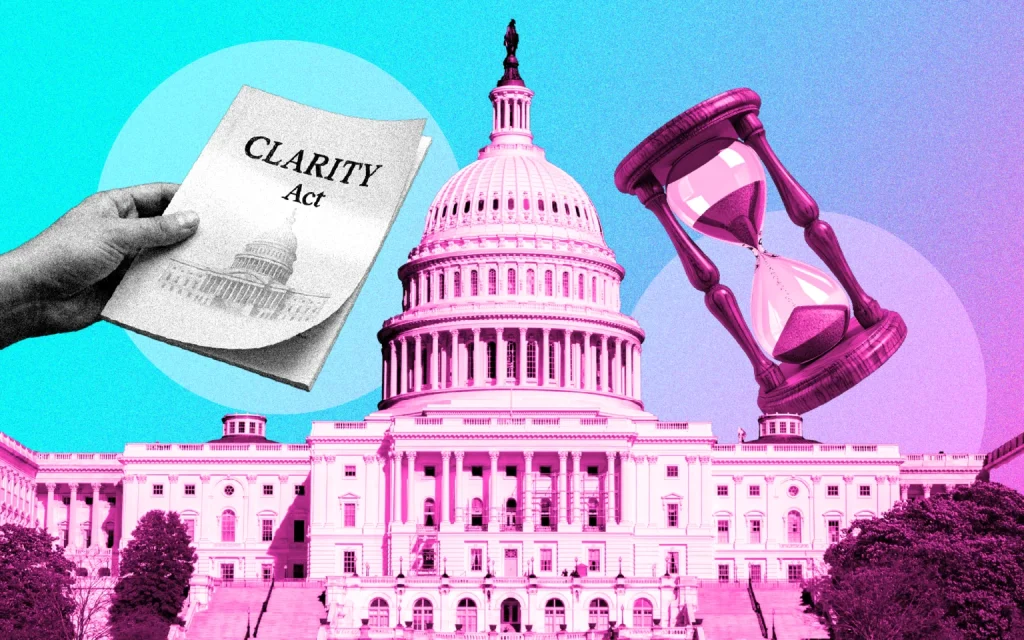
On Sept. 15 at 2:15 p.m., the Senate is scheduled to take up cloture on the motion to proceed to H.R. 3633, the Digital Asset Market Clarity Act. It is a procedural vote rather than final passage, but it will test whether supporters can secure the 60 votes needed to advance the legislation.
Sept. 15 Could Turn DeFi Interest Into Capital
Former US Congressman Tim Ryan, Lumia Bipartisan Policy Officer and Shyft Policy Board Member, told CCN that the first effect of progress on CLARITY would likely be greater institutional confidence.
“The first thing that changes is confidence, since institutions are not going to commit meaningful capital if they cannot tell which regulator has authority or what the rules will be next year. A successful vote on September 15 would bring a wave of money into DeFi, and it would show that Congress is serious about creating a durable framework. That is when interest can begin turning into action,” said Ryan.
But congressional approval would only establish the legal foundation.
Former US Congressman David McIntosh, Lumia Bipartisan Policy Officer and Shyft Policy Board Member, said institutions would still need regulators to translate the legislation into rules they can actually follow.
“Markets can price risk, but they can’t price a rulebook that is unsettled across agencies or changes with each administration. Even if CLARITY moves forward, institutions will still need clear implementation. The legislation would provide the statutory foundation, but regulators must turn it into a consistent and workable path to compliance. That is what converts legal progress into deployable capital. I have confidence that the current leaders at SEC, CTFC, and Treasury are very capable and ready to implement the pro-growth regulatory decisions when Congress gives them the green light by passing the Clarity Act,” said McIntosh.
Tokenized Treasuries Could Move First
The institutional DeFi market is already expanding beyond crypto-native assets.
In August, Securitize proposed onboarding HINC, a tokenized high-yield fund sub-advised by Neuberger Berman, as collateral on Aave Horizon. Qualified investors could potentially borrow assets, including USDC, GHO, and RLUSD, against the fund.
McIntosh expects familiar financial instruments to lead adoption.
“Private tokenized treasuries seem likely to move first because the underlying frameworks are already familiar to institutions. The larger long-term opportunity may be private credit and other real-world assets. Onchain infrastructure can make those markets more transparent, efficient and accessible.”
For large financial institutions, the attraction is increasingly less about buying crypto tokens and more about gaining access to faster financial infrastructure.
“DeFi needs clear, fair rules. Faster settlement, greater transparency and round-the-clock markets are certainly advantages, but institutions won’t use them at scale if regulations aren’t fully in place. As that happens, the line between DeFi and traditional finance will matter less because institutions will adopt the infrastructure that works,” McIntosh said.
What the US Risks if the CLARITY Act Stalls
The competition is moving regardless of what happens in Congress.
Traditional financial firms are developing stablecoins, tokenized deposits, blockchain settlement systems, and onchain collateral markets, while jurisdictions outside the US continue building regulatory frameworks for digital assets.
Ryan said prolonged uncertainty could cost the US more than trading volume.
“The United States would lose far more than just market share. We would risk losing developers, engineers, compliance professionals, and the investment behind new financial infrastructure. We would also give other jurisdictions greater influence over the standards that determine how capital moves. Regulatory uncertainty will not stop blockchain from developing. It will simply send the investment and expertise somewhere else.”
The Sept. 15 vote will not decide the future of institutional DeFi on its own. Even if CLARITY advances, implementation by the SEC, CFTC, and Treasury will determine how quickly financial firms can put meaningful capital to work.
But for institutions waiting for a clearer division of regulatory responsibility, Sept. 15 could determine whether another year of watching DeFi from the sidelines starts turning into actual deployment.
Top Trending Crypto Articles
The information provided in this article is for informational purposes only. It is not intended to be, nor should it be construed as, financial advice. We do not make any warranties regarding the completeness, reliability, or accuracy of this information. All investments involve risk, and past performance does not guarantee future results. We recommend consulting a financial advisor before making any investment decisions.

Dr. Guneet Kaur is a senior editor at CCN.com and a Science Fellow at Exponential Science. She is a fintech and blockchain expert with extensive experience in digital finance education, blockchain ecosystems, and cryptocurrency markets. She has worked with global media such as Cointelegraph, as well as education and blockchain platforms, to design and lead strategic content and learning initiatives. As an educator and assessor for top-tier executive programs, she bridges real-world fintech trends with academic insight.
Dr. Kaur is also a published researcher and peer reviewer across fintech and data science journals, including Financial Innovation Journal and International Journal of Big Data Intelligence and Applications. Her work spans data-driven analysis, Web3 innovation, and technical content development. With a strong foundation in both industry and academia, she translates complex financial technologies into practical applications, empowering learners, professionals, and institutions across the rapidly evolving digital finance landscape.