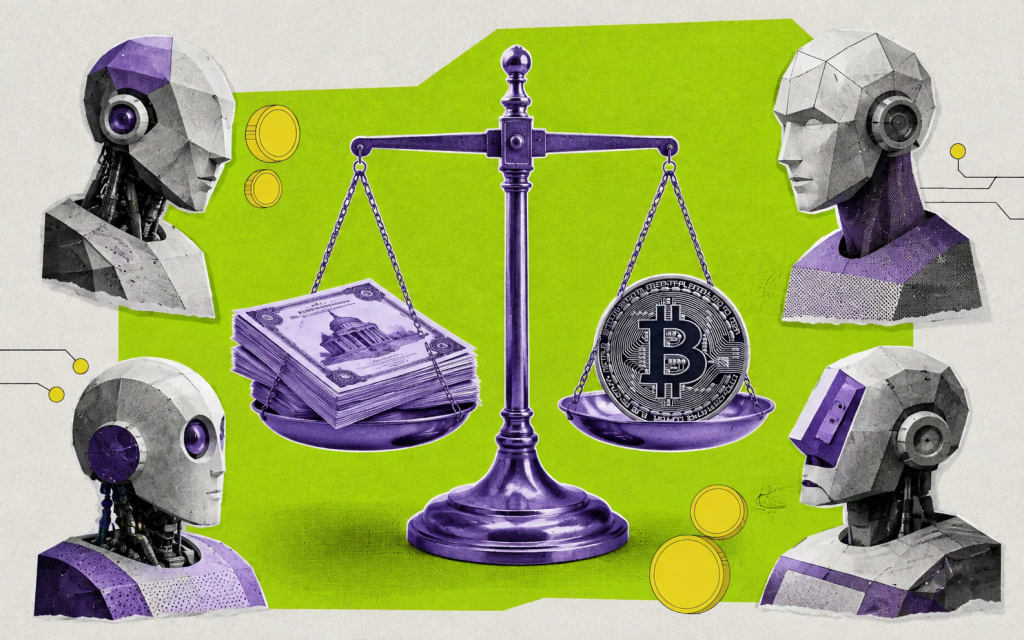
We asked ChatGPT, Gemini, Claude and Grok whether investors should buy Bitcoin or US Treasuries. Here’s which asset they favored. | Credit: CCN.com
Share
Key Takeaways
ChatGPT and Grok favored short-term or intermediate US Treasuries for dependable income and lower volatility.
Gemini viewed bonds as the defensive choice and Bitcoin as the higher-risk option with greater potential upside.
Claude declined to name a winner, arguing that bonds provide income while Bitcoin offers speculative growth.
Should investors lock in some of the highest US Treasury yields in nearly two decades or bet that improving liquidity will send Bitcoin higher?
We asked ChatGPT, Gemini, Claude and Grok to compare the two assets after the 30-year Treasury yield reached a 19-year high and the US Treasury doubled its long-term bond buybacks. Their answers differed, but none recommended making an aggressive, all-or-nothing bet.
The broad verdict favored bonds for security and income, while Bitcoin remained the higher-risk choice for investors seeking greater long-term upside.
Our Top Crypto Sports Betting Partners:
Sponsored
Disclosure
We sometimes use affiliate links in our content, when clicking on those we might receive a commission at no extra cost to you. By using this website you agree to our terms and conditions and privacy policy.
ChatGPT gave the clearest answer. If forced to buy one asset, it would choose short-term Treasury bills rather than Bitcoin or long-duration bonds.
It proposed holding 60% to 75% of new capital in three-to-12-month Treasury bills, allocating 15% to 25% to Bitcoin gradually and placing the remainder in intermediate-term Treasuries or Treasury Inflation-Protected Securities.
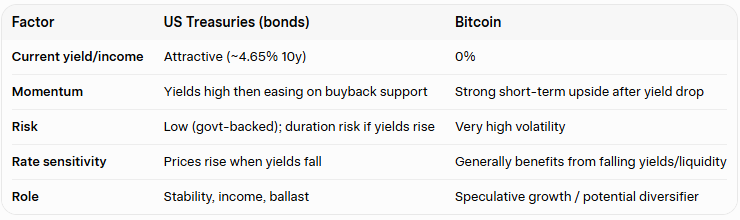
Direct comparison and suggestion based on Treasury momentum. | Credit: Grok
ChatGPT argued that elevated inflation, substantial government issuance and uncertainty over interest rates make 20-to-30-year bonds unattractive. Long-duration bond prices could suffer significant losses if yields continue climbing.
Grok reached a similar conclusion. It described Treasuries as the better option for investors seeking reliable income and stability, given yields of more than 4.6% on 10-year debt.
However, Grok still saw a role for Bitcoin as a small “satellite” position. It suggested that a 1% to 5% allocation could suit investors with a long time horizon and a high tolerance for volatility.
Both models therefore preferred a bond-heavy portfolio without dismissing Bitcoin entirely.
Gemini Saw a Choice Between Safety and Upside
Gemini offered a more conditional verdict. It framed Treasuries as the choice for capital preservation and Bitcoin as the option for asymmetric growth.
Investors who expect economic weakness and falling interest rates could benefit from bonds. Lower yields increase the market value of existing fixed-rate securities, while current yields provide a comparatively attractive income stream.
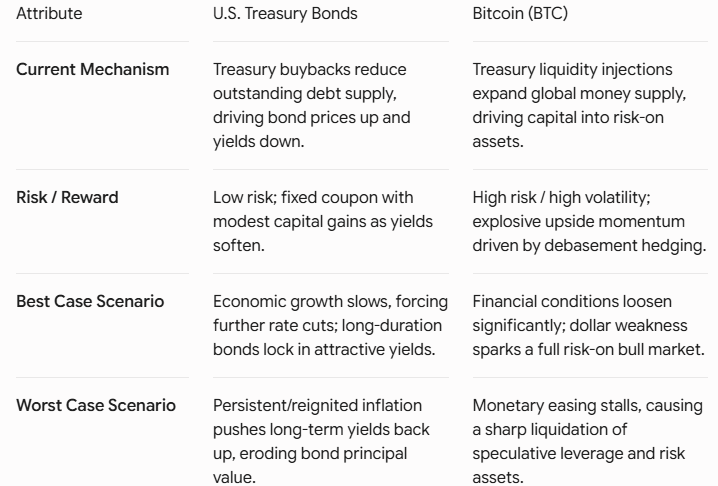
Key macro takeaways. | Credit: Gemini
Bitcoin could outperform if Treasury buybacks help loosen financial conditions, weaken the dollar and encourage investors to take more risk. It could also attract buyers who interpret rising public debt and liquidity support as evidence of long-term currency debasement.
The trade-off remains volatility. Treasuries provide contractual cash flows and government backing, while Bitcoin generates no income and can experience steep drawdowns.
Gemini stopped short of identifying one universal winner, arguing that the decision depends on whether an investor prioritizes stability or growth.
Claude Refused to Pick a Clear Winner
Claude delivered the most cautious response. It argued that bonds and Bitcoin serve fundamentally different purposes and should not function as direct substitutes.
Bonds allow investors to lend money to the government for a defined return. Bitcoin offers speculative exposure to liquidity, adoption and scarcity narratives without guaranteed cash flows.
Claude also found weaknesses in both markets. Long-term Treasuries remain vulnerable to inflation, fiscal deficits and additional debt issuance. Bitcoin, meanwhile, has faced technical resistance and remains highly sensitive to changes in yields and broader risk appetite.
Bitcoin is surging hard on the news that the U.S. Treasury is going to buy back $4B of debt to "increase liquidity support by at least double"
Across the four answers, one consensus emerged: none favored a large position in long-term Treasury bonds. ChatGPT and Grok preferred shorter or intermediate maturities, Gemini divided the choice by risk appetite, and Claude declined to select a winner.
For conservative investors, the models leaned toward Treasuries. For those seeking higher upside and willing to accept substantial losses, they viewed Bitcoin as the more compelling, but much riskier, alternative.
Disclaimer:
The information provided in this article is for informational purposes only. It is not intended to be, nor should it be construed as, financial advice. We do not make any warranties regarding the completeness, reliability, or accuracy of this information. All investments involve risk, and past performance does not guarantee future results. We recommend consulting a financial advisor before making any investment decisions.
Giuseppe Ciccomascolo began his career as an investigative journalist in Italy, where he contributed to both local and national newspapers, focusing on various financial sectors.
Upon relocating to London, he worked as an analyst for Fitch's CapitalStructure and later as a Senior Reporter for Alliance News. In 2017, Giuseppe transitioned to covering cryptocurrency-related news, producing documentaries and articles on Bitcoin and other emerging digital currencies. He also played a pivotal role in establishing the academy for a cryptocurrency exchange website. Crypto remained his primary area of interest throughout his tenure as a writer for ThirdFloor.