The next few months will decide if Pi’s upgrades translate into real adoption and ecosystem growth.
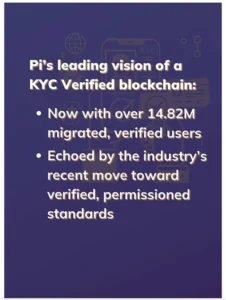
Pi Network claims it has reached over 14.82 million migrated, verified users, underscoring its push to become a know-your-customer (KYC) verified blockchain.
The latest upgrade focuses on scaling that vision with two significant updates.
The first is the long-awaited Linux Node support (allowing nodes to run on Linux servers and devices, not just Windows or macOS), which makes running a Pi node easier and more accessible across platforms.
Second, the move to Protocol v23, customized from Stellar’s latest version, introduces on-chainKYC authority and improved node consistency, setting the stage for a more decentralized and community-driven ecosystem.
This article explains what Linux Node support means for Pi Network, what’s new in Protocol v23, and how these updates aim to unlock its potential.
New Trending Crypto Wallet Offers
Sponsored
Disclosure
We sometimes use affiliate links in our content, when clicking on those we might receive a commission at no extra cost to you. By using this website you agree to our terms and conditions and privacy policy.
Pi Network’s latest upgrade brings two major changes aimed at improving stability, scalability, and developer experience. Here is how both work:
1) Linux Node
Pi Network’s node software will now be supported on Linux in addition to the existing platforms. Previously, nodes were primarily supported on Windows and macOS, which limited participation to desktop users with those operating systems (OS).
The new Linux support allows developers and community members to run Pi nodes on servers, Raspberry Pi devices, and cloud infrastructure.
What Does This Mean for Pi Network?
Linux compatibility brings better scalability and flexibility to Pi’s node network. Linux systems are widely used in server environments, making it easier to deploy Pi nodes in data centers, on Virtual Private Servers (VPS), or other hosted setups.
This step encourages more technically skilled contributors to join and maintain nodes, helping decentralize and strengthen the network.
Benefits of Linux Node
This move to Linux creates a stronger base for Pi’s infrastructure and gives node operators a more dependable way to run the network. Its value becomes clear in the benefits it brings to stability and participation.
Standardization: Linux support helps create a consistent environment across nodes, reducing bugs caused by OS–specific differences.
Easier maintenance: Linux servers can run continuously with less downtime and fewer manual interventions, improving uptime for the network.
Auto-updates: Linux’s package management systems can automate software updates, helping nodes stay current with security patches and protocol changes.
Accessibility for developers: Linux is a platform that many developers use, making it easier to contribute, test, and build tooling around Pi’s ecosystem.
2) Protocol v23
Pi Network’s consensus and transaction processing layer is built on a fork of the Stellar Consensus Protocol (SCP, a blockchain protocol designed for fast, low-cost transactions). Protocol v23 brings Pi up to date with Stellar’s Protocol 23 while including Pi-specific customizations that reflect its unique approach to KYC, mining, and ecosystem governance.
Key New Features
On-chain KYC authority: The KYC process will now be embedded in the protocol itself rather than handled as an external service. This allows for the potential decentralization of KYC verification in the future, enabling multiple verifiers and reducing central bottlenecks.
Better node consistency: The upgrade introduces improvements in how nodes communicate and agree on network state, reducing edge-case desynchronization and giving more predictable outcomes.
Developer support: Improved application programming interfaces (APIs, tools that let software communicate with Pi) and better debugging tools make it easier for developers to build apps and integrate with Pi.
Phased Rollout
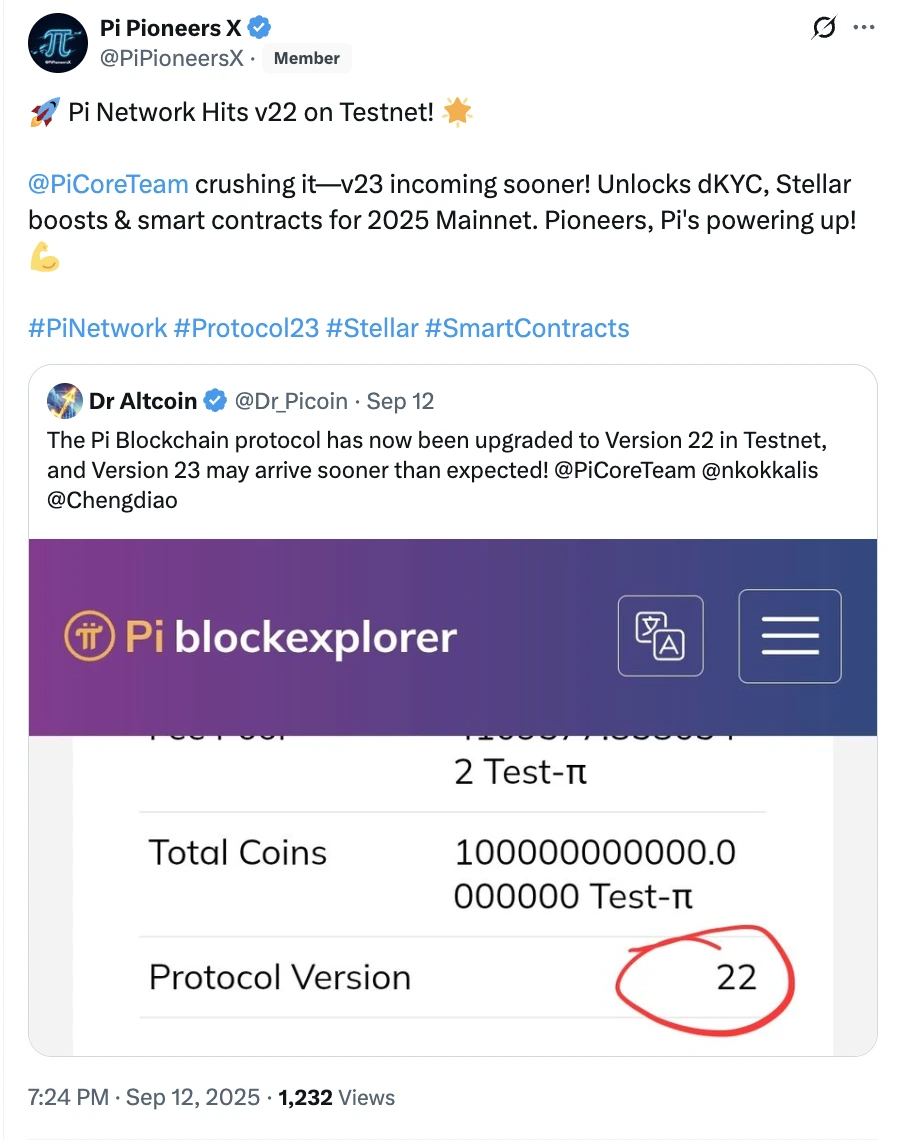
As of September 15, 2025, the rollout of Protocol v23, built on Stellar’s architecture with Pi-specific customizations like on-chain know your customer (KYC) and support for smart contracts, has already begun. The process started in late August 2025 and is moving forward in stages.
Testnet 1: Upgrades began around August 30 and reached full v23 implementation by September 13.
Testnet 2: The next stage will expand testing to more community nodes and apps to ensure stability before mainnet deployment.
Mainnet: Final deployment will follow once the network proves stable under testnet conditions.
Note: Pi Network has pointed out that temporary outages may occur during these transitions as nodes upgrade and synchronize with the new protocol.
Benefits of Protocol v23
Protocol v23 focuses on refining how the network operates at its core. It improves coordination between nodes, strengthens reliability during consensus, and creates a more predictable environment for applications and validators.
More control: Core team and validators have more fine-grained tools to manage upgrades.
Better consistency: Nodes stay synchronized more reliably, reducing downtime.
Improved developer experience: More predictable and standardized environment for building Pi apps and services.
Why the Pi Network Linux Node & v23 Upgrade Could Unlock Its Potential
The release of the Linux Node and the move from Protocol v19 to v23 mark the most ambitious phase of Pi Network’s development. If executed well, these updates could finally prepare the ecosystem for mainstream adoption.
Improved infrastructure and network stability: A strong technical base is vital for Pi’s long-term vision. Linux node + standardized builds reduce fragmentation, reduce configuration errors, improve uptime and reliability.
Better compliance and exchange integrations: Regulatory readiness is becoming essential for blockchain projects. On-chain KYC embedded could make Pi more acceptable to regulators, exchanges and institutions. This could open up more real-use cases.
Developer and ecosystem growth: The network thrives when developers can easily participate. Easier node operation could attract more technically capable users, devs building tools or decentralized applications (DApps).
Scalability and advanced feature enablement: Scaling is key to handling millions of transactions in the future. Protocol v23 likely includes performance upgrades (drawn from Stellar’s improvements), enabling more transactions, lower latency, perhaps smart contract capacity or similar. As a result, it could support more ambitious use cases.
Risks, Caveats and Unknowns of the Pi Network Upgrade
While the recent updates strengthen Pi Network’s infrastructure, several risks and uncertainties remain that could affect its impact and adoption:
Technical complexity: The phased rollout introduces the possibility of temporary instability and downtime as nodes upgrade and synchronize with the new protocol.
Regulatory challenges: Moving KYC on-chain creates new risks. The success of a decentralized KYC authority depends on trust in verifiers and safeguards against misuse.
Market response: Infrastructure upgrades alone may not boost adoption. If real-world usage and utility remain limited, token price may not reflect the technical progress.
Unclear incentives: Rewards for node operators and tokenomics adjustments have yet to be clarified, meaning the Linux node release does not immediately change earnings for participants.
Competition from similar projects: Pi Network’s large user base is an advantage, but it competes with other mobile-mining projects such as Bee Network and Omega Network, as well as established layer-1 blockchains like Solana, Ethereum, and Avalanche. These rivals are already attracting developers and building real-world use cases, and some are further ahead in adoption.
Institutional interest, including the launch of a Pi Crypto exchange-traded products (ETP) on Sweden’s Spotlight Stock Market and the project’s presence at Token2049, is helping sustain optimism as the network moves closer to the full rollout of Protocol v23.
Hopeful but cautious; waiting to see if v23 fulfills promises
External visibility
Token2049 appearance, exchange listing speculation, institutional interest (e.g., Swedish ETP)
This snapshot highlights Pi’s strong KYC migration progress but shows that price recovery is still lagging. Market confidence appears tied to the successful completion of the Mainnet v23 rollout and the ability to deliver more real-world use cases.
With Testnet1 live and Mainnet migration pending, September 2025 is a decisive moment for Pi Network. The coming months will show whether the Linux Node and Protocol v23 upgrade can turn its large user base into a fully functional ecosystem or whether skepticism will continue to weigh on adoption and price momentum.
Pi Network’s Linux Node support and the v23 protocol upgrade represent its boldest step toward becoming a functional, decentralized ecosystem. These improvements target infrastructure, node consistency, and developer experience, preparing the network for greater scalability and adoption.
The rollout is not without challenges. The phased migration could lead to downtime, and on-chain KYC introduces regulatory and privacy considerations. Market confidence remains tied to real-world use cases and exchange participation, making the next few months critical for Pi’s trajectory.
If Pi Network successfully completes its Mainnet transition and attracts developers to build apps on its improved infrastructure, it could finally shift from promise to delivery.
Pi’s community, investors, and the wider crypto industry are watching closely to see if this is the upgrade that unlocks its true potential. Many have waited for a long time.
Community speculation suggests listings may follow the Mainnet launch, but no official date is confirmed.
What risks does on-chain KYC carry?
It raises questions about user privacy and trust in delegated verifiers managing identity checks.
Disclaimer:
The information provided in this article is for informational purposes only. It is not intended to be, nor should it be construed as, financial advice. We do not make any warranties regarding the completeness, reliability, or accuracy of this information. All investments involve risk, and past performance does not guarantee future results. We recommend consulting a financial advisor before making any investment decisions.
Dr. Lorena Nessi is an award-winning journalist and media technology expert with 15 years of experience in digital culture and communication. Based in Oxfordshire, UK, she combines academic insight with hands-on media practice.
She holds a PhD in Communication, Sociology, and Digital Cultures, and an MA in Globalization, Identity, and Technology.
Lorena has taught at Fairleigh Dickinson University, Nottingham Trent University, and the University of Oxford. She is a former producer for the BBC in London, with additional experience creating television content in Mexico and Japan.
Her research focuses on digital cultures, social media, technology, capitalism, and the societal impact of blockchain innovation.
She has written extensively on digital media and emerging technologies, with her work featured in both academic and media platforms. Her Web3 expertise explores how blockchain technologies shape culture, economics, and decentralized systems.
Outside of work, Lorena enjoys reading science fiction, playing strategic board games, traveling, and chasing adventures that get her heart racing. A perfect day ends with a relaxing spa and a good family meal.


 Easy
Easy