XRPL just crossed $2B in tokenized assets. As real-world finance moves on-chain, could this milestone set up XRP price for a new all-time high? | Credit: CCN.com
Share
Key Takeaways
The adoption of XRP through Ripple’s ODL aims to reduce working capital drag in cross-border payments and elevate XRP’s role as an institutional liquidity asset.
RLUSD stablecoin could be the biggest catalyst for XRP demand in 2026–2027.
The November 2025 U.S. spot XRP ETF debut marks a significant milestone in institutional access.
Short-term volatility, competing platforms, regulatory fragmentation and execution risks could derail the XRP’s role in the global liquidity narrative.
XRP sits at the center of one of the most significant shifts in global finance. Banks, payment providers and fintech firms continue to search for faster and cheaper ways to move money across borders, especially as traditional systems still rely on slow settlement processes and locked capital.
The XRP Ledger offers a different model by enabling instant transfers, low costs and real-time liquidity across key remittance and treasury routes.
Growing regulatory clarity in 2025, along with the arrival of the first U.S. spot XRP Exchange Trading-Funds (ETFs), has pushed XRP further into the institutional spotlight.
At the same time the XRPL ecosystem is expanding toward tokenized assets, decentralized finance (DeFi) products and CBDC integrations that strengthen its long-term utility.
This article explains how XRP supports global liquidity today and what investors must know in 2025 and beyond.
A growing number of financial institutions want faster settlement and lower costs when they send money across borders. XRP aligns with this shift and connects it to why banks should pay attention to its liquidity model.
Traditional cross-border systems require banks to keep large sums locked in nostro and vostro accounts. These accounts restrict the liquidity that banks could use elsewhere. As a result, it creates working capital pressure for institutions that operate in multiple regions.
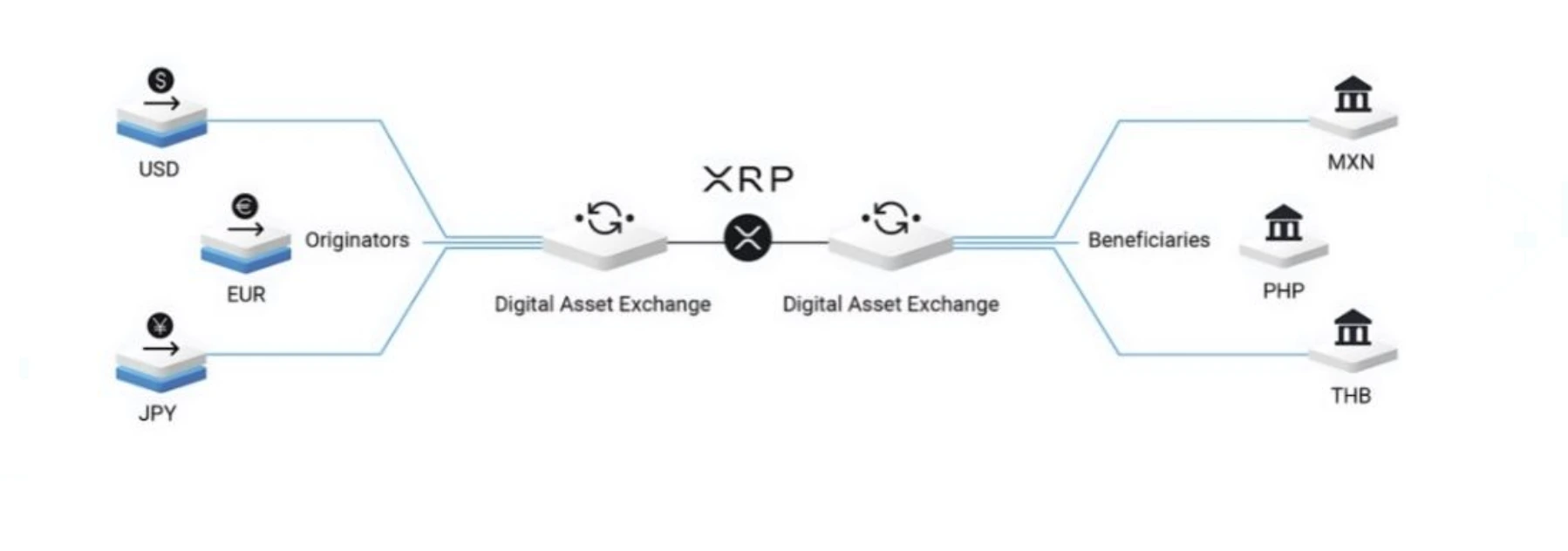
Ripple Labs, introduced its On-Demand Liquidity (ODL) product, aiming to solve this issue. The model converts fiat currency into XRP, transfers it through the XRP Ledger, and converts the XRP back into local currency on the receiving end.
Payments’ process | Source: Kensoninvestments
This process frees up capital that banks would otherwise keep idle and supports real-time settlement across jurisdictions.
These reductions reinforce the notion that XRP can serve as an institutional liquidity asset.
APAC growth: APAC shows the strongest concentration of ODL activity in 2025. 93 institutions use or test ODL, with Tranglo in Malaysia operating more than twenty corridors and SBI Remit in Japan supporting RLUSD-based remittances. On-chain value received in the region exceeds $185 billion each month through mid-2025, and Japan reports 120% year-over-year growth.
MENA expansion: MENA continues to build momentum. Zand Bank and Mamo in the United Arab Emirates (UAE) run live Ripple Payments flows, while Pyypl enables instant transfers across regional routes. Saudi Arabia, Qatar and Morocco plan to scale blockchain infrastructure for tokenized assets by the end of the year.
LATAM deployment: Travelex Bank in Brazil leads with live ODL usage. Santander also operates in Brazil, supported by new Portugal to Brazil through Unicâmbio. Intermex strengthens its activity across the United States to Mexico remittances.
Global volume impact: Ripple’s ODL network processed $1.3 trillion in the second quarter of 2025, and these regions account for more than 60% of total growth.
The expansion across APAC, MENA and LATAM sets the stage for the next set of catalysts that shape XRP’s trajectory. Growth in utility only matters when institutions can operate within clear legal frameworks. This leads directly to the next focus area.
XRP and Global Liquidity: Could It Matter More Than an ETF?
XRP plays a unique role in global liquidity by enabling near-instant, low-cost cross-border settlements without the need for traditional intermediaries. Unlike an ETF, which primarily offers investors exposure to price movements, XRP’s utility lies in facilitating real-time value transfer between currencies and financial systems.
Through RippleNet and On-Demand Liquidity (ODL), XRP can help institutions access liquidity on demand, reducing the need for pre-funded accounts. While an ETF may boost market visibility and investor confidence, XRP’s real-world function in improving liquidity efficiency arguably has a deeper impact on financial infrastructure, especially if adoption continues to grow among banks and payment providers seeking faster, cheaper global transfers.
Regulatory Clarity and Institutional Access: XRP’s 2025 Liquidity Turning Point
Regulatory clarity and institutional investment access emerge as major turning points for XRP in global liquidity markets.
Lawsuit end: The Securities and Exchange Commission (SEC) ended its lawsuit against Ripple Labs, Inc. on August 8, 2025, with Ripple to pay a $125 million fine and restrictions remaining in place for institutional XRP sales.
Spot XRP ETF launch: The first U.S. spot XRP exchange-traded fund (ETF), ticker XRPC from Canary Capital Group LLC, debuted on the Nasdaq with approximately $58 million in day-one trading volume. The ETF launch institutionalizes exposure to XRP and could shift supply and demand dynamics in favor of XRP.
Strategic funding and valuation: Ripple’s estimated $40 billion valuation in 2025 shows the scale of the company behind the XRP ecosystem. A clearer regulatory environment and the introduction of regulated investment products place XRP within payment and liquidity systems used by institutions.
XRPC day one trading volume | Source: @EricBalchunas
This context also shapes how XRP fits into new financial use cases beyond payments, which introduces the next area of development on the XRPL, involving DeFi and smart contract functionality.
XRPL Expands Toward DeFi and Tokenized Assets with the Multi-Purpose Token Standard
The introduction of the Multi-Purpose Token standard establishes a unified method for issuing regulated digital assets. It embeds compliance tools such as Know Your Customer (KYC) and anti-money laundering (AML) checks, and issuer controls directly on the ledger rather than relying on external smart contracts.
This structure provides institutions with a more predictable framework for issuing or managing tokenized assets.
Development work across the ecosystem also points toward native lending protocols and Ethereum Virtual Machine (EVM)-compatible side chains that support interaction with Ethereum-based applications.
These components suggest that XRPL aims to participate in a broader DeFi environment by late 2025.
For investors, the takeaway is that the network may evolve from payment utility into areas such as token issuance, lending and cross-chain value movement.
This expansion into DeFi is directly connected to the next area of development, where institutions focus on real-world asset tokenization (RWA) as part of XRPL’s broader infrastructure.
XRPL Targets Real-World Asset Tokenization as the Next Institutional Growth Frontier
The XRPL is positioning itself as a key platform for tokenizing RWAs, such as bonds, treasury bills, or commercial paper. The documentation on XRPL emphasises institutional-grade capabilities, including on-chain escrow, issuer control, and metadata management.
For example, the launch of tokenized treasuries and digital commercial paper on XRPL has been reported.
Ripple’s own tokenization platform emphasizes that the market value of tokenized assets could reach approximately $19 trillion by the early 2030s.
In this context, XRP may gain utility as the liquidity bridge inside token networks. When a bond token is issued and later transferred in secondary markets, the XRPL’s design for efficient value movement through XRP becomes relevant.
CBDC Interoperability and Ripple’s XRPL
Central banks continue to test digital settlement systems, and this trend shapes how the XRPL may interact with public digital currencies. For example, on November 13, 2025, the Monetary Authority of Singapore (MAS) announced trials for tokenized MAS bills, which are short-term debt instruments issued by Singapore’s central bank.
These developments demonstrate how public institutions are moving closer to digital settlement. The XRPL already supports fast transfers, built-in controls and predictable finality, which places it within ongoing discussions about digital-asset infrastructure.
If CBDC systems need a neutral settlement path across networks, XRP may serve that role. The relevance increases when institutions transfer tokenized assets such as bills or bonds in secondary markets. These transfers need a reliable channel for value movement, and the XRPL provides that through native XRP liquidity.
This direction connects public-sector digital currency programs with private-sector settlement tools, giving XRP a more precise position in institutional payment and asset transfer activities.
The Future: XRPL as a Global Financial Infrastructure Layer
The trajectory of the XRPL shows a clear direction. Regulatory clarity improves, the U.S. spot ETF creates a regulated entry point, and the network expands into DeFi, real-world assets and early CBDC pilots. Together, these developments position XRP for a more prominent role within digital financial infrastructure.
In this direction, XRP’s relevance moves beyond remittance speed. The asset serves as a bridge within a system that handles tokenized value at scale. Institutions use XRP for atomic settlement when they trade tokenized treasuries or corporate bonds.
Central banks that issue digital currencies need a neutral layer for cross-border exchange, and the XRPL provides that function. Liquidity providers utilize ODL to settle large trade flows, thereby reinforcing XRP’s role in institutional payment activity.
This shift changes how the market evaluates XRP. The asset becomes tied to measurable utility rather than short-term trading cycles. For long-term investors, the attention moves to the volume and velocity of value settled across the XRPL. These indicators reflect how XRP supports the infrastructure of a digital financial system.
What is the difference between using XRP for payments and owning it as an investment?
Owning XRP entitles the holder to potential price appreciation but no direct claim on Ripple’s revenues. Using XRP for payments (e.g., via ODL) is about utility and network use rather than speculation.
Does the existence of a spot XRP ETF mean XRP is approved by regulators?
Not fully. While the ETF opens regulated exposure, the broader regulatory environment (especially for secondary-market token classifications in different jurisdictions) remains evolving.
What should investors monitor as they enter 2026?
Key metrics include the adoption of ODL corridors by major banks, institutional flows into XRP products, tokenization activity on the XRPL, regulatory updates in key jurisdictions, the velocity of XRP on-chain, and developments on competing platforms.
What are the most significant XRP catalysts to watch in 2026?
The most significant catalysts include bank adoption of ODL, growth of the RLUSD stablecoin, increasing institutional ETF inflows, rising real-world asset tokenization volume on XRPL, more precise regulation in the UK and EU, and on-chain activity.
Disclaimer:
The information provided in this article is for informational purposes only. It is not intended to be, nor should it be construed as, financial advice. We do not make any warranties regarding the completeness, reliability, or accuracy of this information. All investments involve risk, and past performance does not guarantee future results. We recommend consulting a financial advisor before making any investment decisions.
Dr. Lorena Nessi is an award-winning journalist and media technology expert with 15 years of experience in digital culture and communication. Based in Oxfordshire, UK, she combines academic insight with hands-on media practice.
She holds a PhD in Communication, Sociology, and Digital Cultures, and an MA in Globalization, Identity, and Technology.
Lorena has taught at Fairleigh Dickinson University, Nottingham Trent University, and the University of Oxford. She is a former producer for the BBC in London, with additional experience creating television content in Mexico and Japan.
Her research focuses on digital cultures, social media, technology, capitalism, and the societal impact of blockchain innovation.
She has written extensively on digital media and emerging technologies, with her work featured in both academic and media platforms. Her Web3 expertise explores how blockchain technologies shape culture, economics, and decentralized systems.
Outside of work, Lorena enjoys reading science fiction, playing strategic board games, traveling, and chasing adventures that get her heart racing. A perfect day ends with a relaxing spa and a good family meal.


 Easy
Easy