XRP is holding above key support as the XRP Ledger adds $2.6 billion in tokenized assets, expands RLUSD infrastructure and surpasses 1.4 million AI-driven transactions. | Credit: CCN.com
Share
Key Takeaways
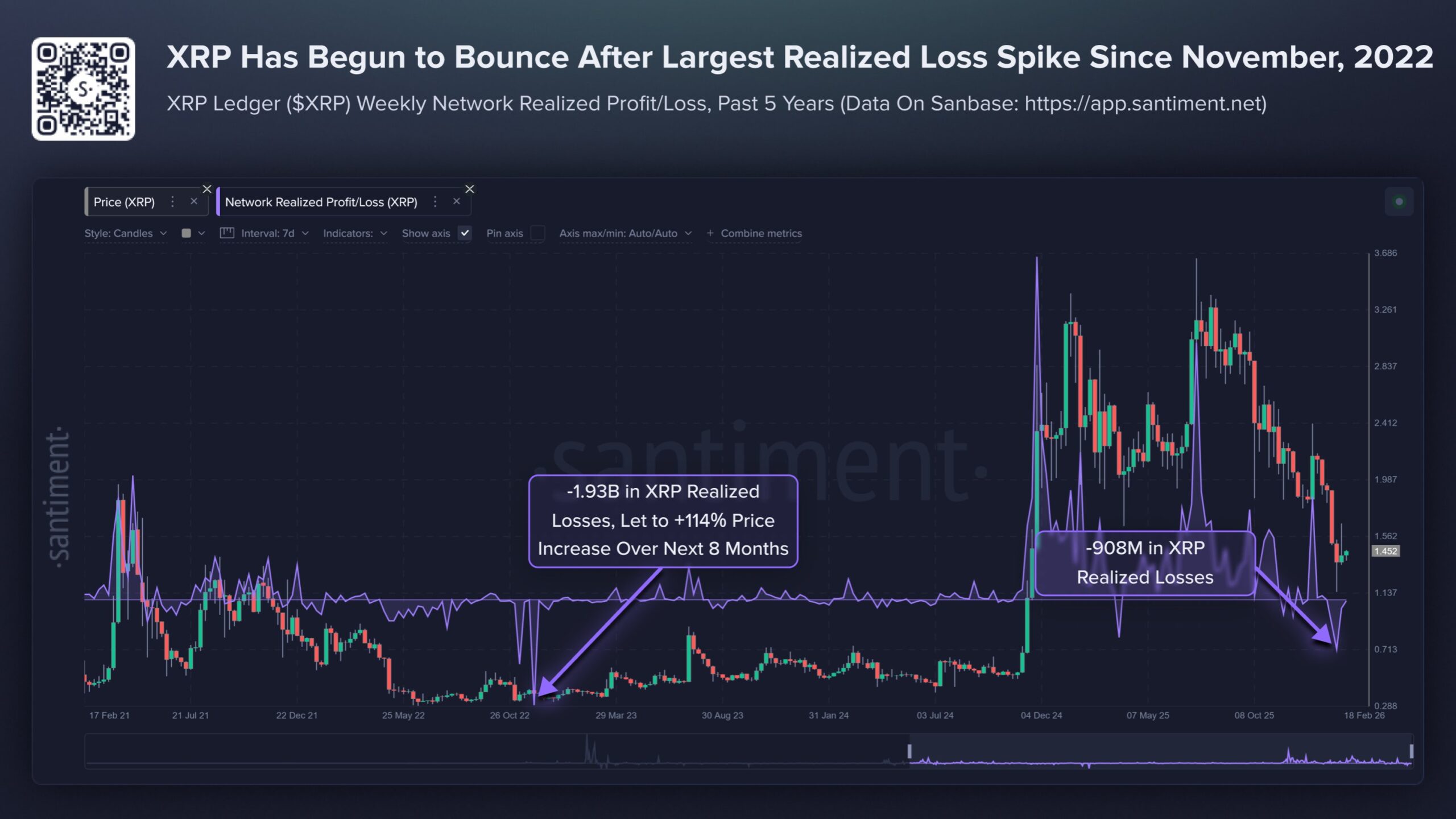
XRP just recorded its largest realized loss spike since 2022, hitting approximately $1.93 billion in weekly realized losses.
The last time this happened, XRP surged 114% over the following eight months.
Realized losses increase when investors panic-sell, often signaling peak fear in the market.
Historically, major loss spikes appear near market bottoms as selling pressure exhausts.
XRP has just recorded its largest on-chain realized loss spike since 2022, a moment that historically coincided with a major market bottom.
Investors who held through earlier declines finally give up. Fear takes over. Instead of waiting for a recovery, they “capitulate”, locking in losses to avoid further downside.
While this feels extremely negative in the moment, it can actually be a powerful market signal.
Because once weak hands sell, there may be fewer sellers left to push the XRP price lower.
Why Major Realized Loss Events Often Signal an XRP Bottom
Markets move in cycles driven by emotion. During bull markets, greed dominates. During bear markets, fear dominates.
Realized loss spikes often mark the peak of fear.
Historically, extreme realized losses tend to appear:
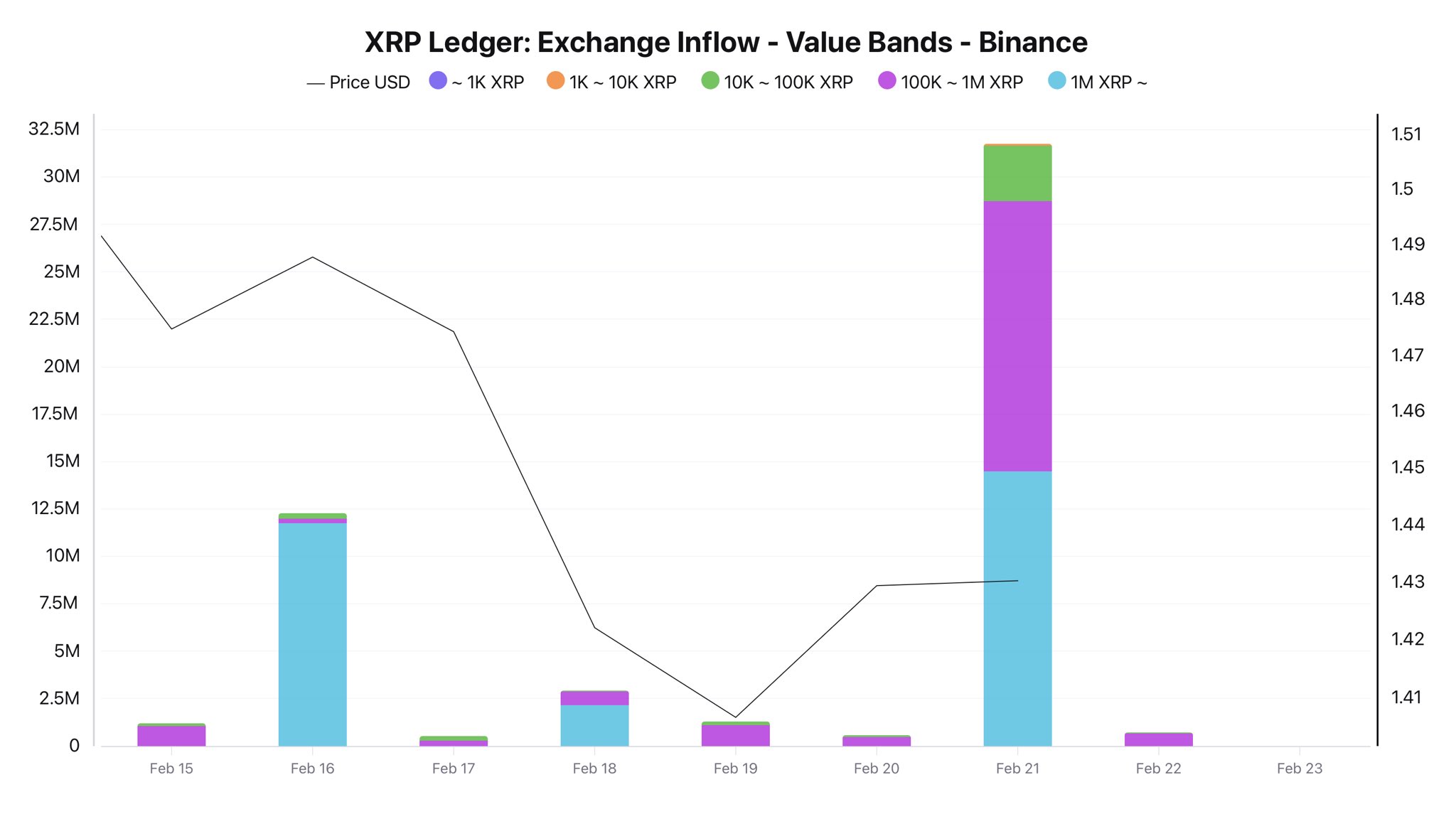
One of the most notable developments is a surge in inflows from exchanges. In a single day, large holders transferred more than 31 million XRP to Binance, representing roughly $45 million in potential selling pressure.
On-chain data shows that most of these transfers came from major holders:
Wallets holding over 1 million XRP moved 14.49 million XRP.
Wallets with 100,000 to 1 million XRP transferred 14.2 million XRP.
Smaller holders contributed about 2.9 million XRP.
XRPL exchange inflow. | Credit: FXEmpire
Large transfers to exchanges often spark concern because tokens moved to centralized platforms can be sold quickly.
However, it’s important to note that exchange inflows do not necessarily lead to immediate liquidation. Tokens can remain idle, be used as collateral, or be part of internal rebalancing.
Still, the concentration of inflows among whales increases short-term volatility risk.
XRP Below Realized Price: A Key Structural Level
Adding to the tension, XRP is currently struggling to reclaim and hold above its Realized Price, one of the most important on-chain metrics.
The Realized Price represents the average price at which the circulating supply was sold. When an asset trades below this level, it means that, on average, holders are sitting on unrealized losses.
🚨 XRP in a critical zone
XRP is struggling to reclaim and hold above its Realized Price.
The Realized Price is one of the most important onchain levels, as it represents the aggregated average price paid for the circulating supply.
Historically, cryptocurrencies that remain below their Realized Price for extended periods tend to show structural weakness. The level often acts as a dividing line between expansion and contraction phases.
If XRP fails to reclaim this threshold, it could signal continued cycle pressure. However, a sustained move back above it would suggest improving market health.
XRP Price Outlook: Opportunity or More Downside?
XRP’s latest $1.93 billion realized loss spike is statistically rare and historically meaningful. The last time this happened, the market eventually rewarded patient investors with a triple-digit percentage gain.
That does not guarantee a repeat performance.
But it does highlight a powerful pattern: major realized losses often spike near market bottoms because fear tends to peak before prices do.
If selling pressure is truly becoming exhausted, XRP may be closer to opportunity than most believe.
Whether this becomes another 114% post-panic surge remains uncertain, but on-chain data suggests something important may be developing beneath the surface.
A realized loss happens when an investor sells XRP (or any crypto) for less than what they originally paid. The loss becomes “real” because the position is closed.
Why does a spike in realized losses matter for XRP price?
A large spike means many investors are panic-selling at a loss. Historically, this often happens near market bottoms because most weak holders have already sold.
Does a realized loss spike guarantee an XRP rally?
No. It increases the probability of a rebound, but it does not guarantee one. Price still depends on broader market conditions, Bitcoin’s trend, and macro factors.
Is XRP definitely at a bottom now?
It’s impossible to confirm a bottom in real time. Capitulation signals suggest downside risk may be decreasing, but prices can still move sideways or retest lows.
Disclaimer:
The information provided in this article is for informational purposes only. It is not intended to be, nor should it be construed as, financial advice. We do not make any warranties regarding the completeness, reliability, or accuracy of this information. All investments involve risk, and past performance does not guarantee future results. We recommend consulting a financial advisor before making any investment decisions.
Giuseppe Ciccomascolo began his career as an investigative journalist in Italy, where he contributed to both local and national newspapers, focusing on various financial sectors.
Upon relocating to London, he worked as an analyst for Fitch's CapitalStructure and later as a Senior Reporter for Alliance News. In 2017, Giuseppe transitioned to covering cryptocurrency-related news, producing documentaries and articles on Bitcoin and other emerging digital currencies. He also played a pivotal role in establishing the academy for a cryptocurrency exchange website. Crypto remained his primary area of interest throughout his tenure as a writer for ThirdFloor.


 Easy
Easy