XRPL just crossed $2B in tokenized assets. As real-world finance moves on-chain, could this milestone set up XRP price for a new all-time high? | Credit: CCN.com
Share
Key Takeaways
XRPL has surpassed $2 billion in tokenized real-world assets, doubling from $1B in just one month and signaling accelerating institutional adoption.
Growth is driven by regulated, capital-markets products, including Ripple’s RLUSD stablecoin and tokenized U.S. Treasuries and funds.
XRPL is shifting from a speculative narrative to financial infrastructure, positioning itself as a settlement layer for on-chain capital markets.
Tokenization strengthens XRP’s long-term utility, even if it does not immediately translate into price appreciation.
The XRP Ledger (XRPL) has reached a milestone that is reshaping how the network is perceived within the broader crypto and financial ecosystem. Tokenized assets on XRPL have now surpassed $2 billion in total on-chain value, doubling from roughly $1 billion in just one month.
The rapid growth underscores a strategic shift underway on the network, away from speculative narratives and toward real-world financial infrastructure.
For years, XRPL has been primarily associated with cross-border payments and, at times, legal uncertainty surrounding Ripple. Today, the conversation is changing. Stablecoins, tokenized U.S. Treasuries, and on-chain funds are becoming central to XRPL’s activity, aligning the network with one of the fastest-growing themes in crypto: real-world asset (RWA) tokenization.
As capital markets increasingly experiment with blockchain-based settlement and issuance, XRPL’s progress raises a critical question for investors and observers alike: Does growing real-world usage on XRPL set the stage for XRP to reach a new all-time high?
What Does $2B in Tokenized Assets on XRPL Actually Mean?
Tokenized assets are real-world financial instruments, such as fiat-backed stablecoins, government bonds, money market funds, or commodities, that are represented and settled on a blockchain.
Instead of existing solely in traditional financial systems, these assets move on-chain, enabling faster settlement, greater transparency, and programmability.
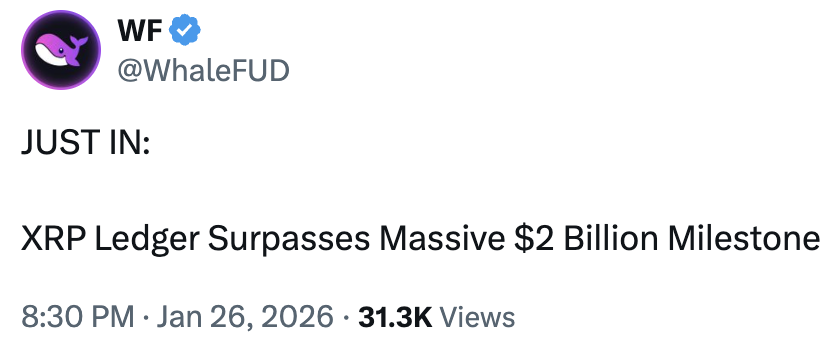
XRPL surpasses $2 billion in tokenized assets. | Credit: Whale FUD X profile
Crossing $2 billion in tokenized assets places XRPL among a relatively small group of blockchains with meaningful RWA adoption. While Ethereum remains the dominant platform for tokenization by absolute value, XRPL’s recent growth rate stands out. According to ecosystem participants, the network doubled its RWA market capitalization from $1 billion to $2 billion in December alone.
This matters because tokenization represents sticky capital. Unlike speculative flows that move quickly in and out of tokens, RWAs tend to remain on-chain once established, especially when tied to regulated financial products. That dynamic suggests XRPL’s growth is not just cyclical, but structural.
More broadly, the milestone reflects a shift in narrative. XRPL is increasingly being framed not as a venue for speculative trading, but as settlement infrastructure for real financial activity—a distinction that carries long-term implications for adoption and valuation.
The Key Drivers Behind XRPL’s Tokenization Surge
XRPL’s rapid growth in tokenized assets is not accidental. It is the result of a focused strategy centered on regulated, institution-friendly products rather than experimental DeFi primitives.
Several key drivers stand out:
RLUSD, Ripple’s U.S. dollar-backed stablecoin, designed to meet institutional and regulatory standards.
Tokenized U.S. Treasuries and funds, providing on-chain access to low-risk, yield-bearing assets.
Clear prioritization of RWAs, rather than chasing short-term DeFi or meme-driven trends.
Stablecoins are particularly important. They serve as the base layer of on-chain finance, enabling settlement, liquidity, and pricing for other assets. RLUSD’s growing presence on XRPL has helped bootstrap activity and credibility, especially among institutional participants.
At the same time, tokenized Treasuries and funds reflect a broader trend across finance. As interest rates remain elevated, demand for yield-bearing instruments has surged. Bringing those products on-chain allows issuers and investors to benefit from faster settlement and global accessibility, without sacrificing familiarity or regulatory alignment.
XRPL’s ecosystem has leaned into this demand rather than resisting it, positioning itself as a practical venue for capital markets experimentation.
Why Institutions Are Paying Attention to XRPL
Institutional adoption is rarely driven by hype. Instead, it depends on reliability, cost predictability, and regulatory comfort, areas where XRPL has distinct advantages.
The network offers low and predictable transaction fees, fast settlement, and a consensus mechanism that has been operating for over a decade. Unlike newer chains that frequently undergo major architectural changes, XRPL emphasizes stability, a feature that resonates with financial institutions managing real capital.
Ripple partners with Ondo Finance. | Credit: ToniTheRippler X profile
Ripple’s long-standing relationships with banks, payment providers, and regulators also play a role. Even amid legal disputes in the U.S., Ripple has continued to engage globally, positioning XRPL as a compliance-aware environment rather than an adversarial one.
For institutions exploring tokenization, these characteristics reduce operational and reputational risk. As a result, XRPL is increasingly viewed as infrastructure rather than an experiment.
Does Tokenization Growth Translate Into XRP Demand?
One of the most debated questions among investors is whether rising on-chain activity actually benefits XRP’s price. The answer is nuanced.
XRP is the native asset of XRPL, used to pay transaction fees and potentially facilitate liquidity between assets. As on-chain activity increases, baseline demand for XRP grows incrementally. More importantly, if XRPL becomes a hub for tokenized capital markets, XRP could play a larger role as a neutral liquidity and bridging asset.
Potential demand channels include:
Increased transaction fee usage as tokenized asset volumes rise.
Liquidity provisioning between tokenized assets and stablecoins.
However, institutional adoption tends to move slowly and does not always translate into immediate speculative price action. Tokenization strengthens XRP’s fundamental utility, but price appreciation often lags real-world usage.
This dynamic contrasts with earlier crypto cycles, where price frequently preceded adoption rather than followed it.
How XRPL Compares to Other Tokenization Platforms
XRPL is not alone in pursuing real-world asset tokenization. Ethereum remains the dominant platform, hosting a wide array of tokenized funds, Treasuries, and stablecoins.
Private and permissioned blockchains are also competing for institutional use cases.
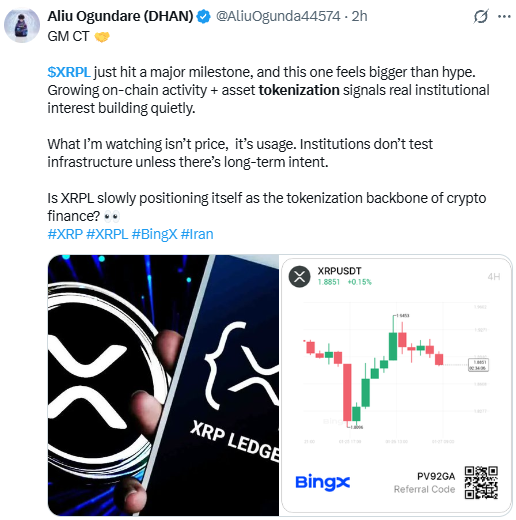
Growing on-chain activity and asset tokenization are behind strong XRPL rise. | Credit: Aliu Ogundare X profile
XRPL’s differentiation lies in efficiency and focus. While Ethereum offers flexibility and composability, it often comes with higher costs and complexity. XRPL, by contrast, is optimized for payments and settlement use cases that align closely with capital markets infrastructure.
Rather than competing directly with Ethereum across all fronts, XRPL appears positioned to complement it, specializing in high-throughput, regulated financial flows.
Continued growth beyond the $2 billion tokenization milestone.
Broader crypto market liquidity and macroeconomic conditions.
Clear expansion of XRP’s functional role within RWA settlement.
Notably, XRP’s previous all-time high occurred during a retail-driven speculative cycle. A future ATH, if it materializes, is more likely to be supported by institutional usage and infrastructure adoption, a slower, but potentially more durable foundation.
XRP Technical Analysis
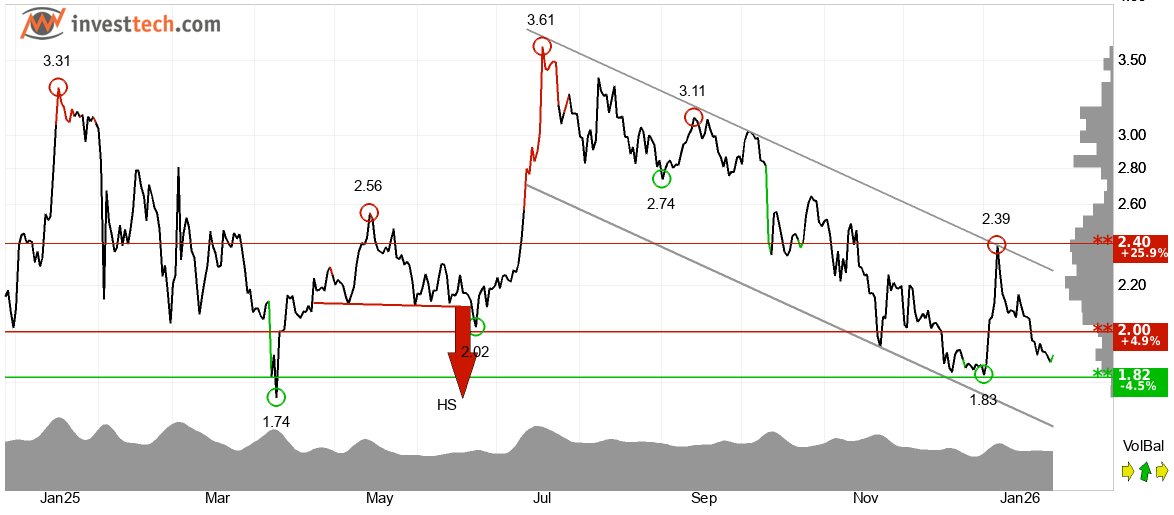
XRP remains in a falling trend channel on the medium- to long-term timeframe, indicating continued downside pressure and weakening investor demand.
Despite the broader downtrend, volume balance is positive, offering some short-term support. Momentum indicators remain weak, however. The Relative Strength Index (RSI) is trending lower across most timeframes and is approaching oversold territory, reflecting persistent selling pressure.
XRP technical analysis. | Credit: InvestTech
XRP is trading below most key moving averages, reinforcing the bearish technical structure. Short- and medium-term averages continue to slope downward, while long-term averages remain well above current price levels, highlighting the lack of sustained upside momentum.
Several oscillators, including the Stochastic Oscillator and Williams %R, show oversold readings on shorter timeframes. While this does not confirm a trend reversal, it increases the likelihood of short-term relief bounces, particularly if broader market conditions stabilize.
Overall, XRP’s technical outlook remains cautiously bearish. A sustained recovery would require a decisive break above the $2.00 resistance level and improving momentum. Until then, price action is likely to remain under pressure or range-bound near support.
What XRPL’s $2B Milestone Means for XRP’s Long-Term Outlook
Perhaps the most important implication of XRPL’s $2 billion milestone is narrative. XRPL is transitioning from being defined by speculation and legal headlines to being associated with real financial infrastructure.
For XRP holders, this shift may require patience. Infrastructure stories rarely deliver overnight gains. But when they succeed, they tend to endure.
XRPL crossing $2 billion in tokenized assets marks a pivotal moment for the network and for XRP’s long-term investment thesis. Stablecoins, tokenized Treasuries, and on-chain funds are transforming XRPL into a serious venue for real-world finance.
Whether XRP reaches a new all-time high remains uncertain. What is increasingly clear, however, is that XRPL is no longer competing for attention: it is competing for relevance. And in the evolving landscape of on-chain capital markets, relevance is what ultimately drives value.
What are tokenized assets on the XRP Ledger (XRPL)?
Tokenized assets on XRPL are real-world financial instruments, such as stablecoins, U.S. Treasuries, or investment funds, that are represented and settled on the blockchain. These assets mirror off-chain value while benefiting from on-chain settlement, transparency, and programmability.
Why is the $2B tokenization milestone important for XRPL?
Crossing $2 billion in tokenized assets signals that XRPL is being used for real financial activity rather than speculation alone. It also indicates growing institutional interest and positions XRPL as a viable platform for on-chain capital markets infrastructure.
How does tokenization on XRPL differ from Ethereum?
Ethereum remains the largest platform for tokenized assets, but XRPL focuses on efficiency, low fees, and fast settlement. XRPL’s design emphasizes reliability and simplicity, making it well-suited for payments and capital markets settlement rather than highly composable DeFi applications.
Does more tokenized assets mean XRP price will go up?
Not necessarily in the short term. Tokenization increases XRPL usage and strengthens XRP’s utility, but price appreciation often lags adoption. Long-term value depends on how deeply XRP becomes integrated into settlement and liquidity flows within the ecosystem.
Disclaimer:
The information provided in this article is for informational purposes only. It is not intended to be, nor should it be construed as, financial advice. We do not make any warranties regarding the completeness, reliability, or accuracy of this information. All investments involve risk, and past performance does not guarantee future results. We recommend consulting a financial advisor before making any investment decisions.
Giuseppe Ciccomascolo began his career as an investigative journalist in Italy, where he contributed to both local and national newspapers, focusing on various financial sectors.
Upon relocating to London, he worked as an analyst for Fitch's CapitalStructure and later as a Senior Reporter for Alliance News. In 2017, Giuseppe transitioned to covering cryptocurrency-related news, producing documentaries and articles on Bitcoin and other emerging digital currencies. He also played a pivotal role in establishing the academy for a cryptocurrency exchange website. Crypto remained his primary area of interest throughout his tenure as a writer for ThirdFloor.


 Easy
Easy