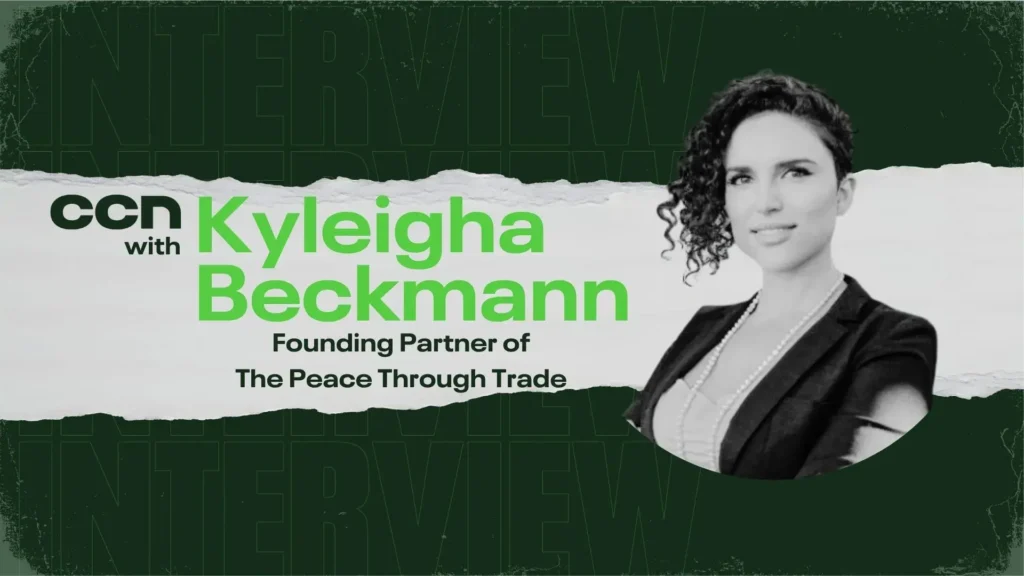
At the Blockchain Futurist Conference, Kyleigha Beckmann, Founding Partner of The Peace Through Trade (PTT Coin) Layer-1 Proof-of-Work (PoW) blockchain, spoke with CCN Senior Editor Guneet Kaur about transforming a personal loss into a mission for ethical innovation.
In an industry often driven by hype and speculation, Beckmann’s vision is based on a blockchain designed to promote cooperation, sustainability, and trust. Peace Through Trade aims to prove that technology can serve humanity.
Here are the details from their conversation.
A $100K Loss: The Setback That Inspired PTT’s Secure Layer-1 Innovation
When asked what inspired the creation of Peace Through Trade, Beckmann recalled a difficult turning point.
“We were initially building a Layer-2 token, actually,” she said.
The project’s direction changed after a phishing attack.
“We bought a token on the wild wild west web, you know, Web3 world, and we were fished. We lost all of our coin… upwards of $100,000,” Beckmann said. “There was no recourse, no insurance, no customer support, no one to talk to.”
That loss made the team rethink the fundamentals of blockchain security. Beckmann said they “couldn’t morally move forward with a Layer-2 token that didn’t have certain parameters in place like security insurance.”
To build something “bulletproof for anybody,” the team decided to design its own Layer-1 blockchain from scratch, focusing on user protection and regulation.
“We had to work within the regulatory framework and build owr own ecosystem,” she said. “Layer-2s depend upon Layer-1s, and that’s why there are lots of issues in terms of scalability and security.”
Building a Stronger Layer-1 PoW Foundation
Peace Through Trade (PTT) aims to improve efficiency and energy use across PoW blockchain networks. Beckmann said the blockchain’s design comes from extensive research and collaboration with academia.
“We were incubated by university groups where all the heads have come together and, over 4.5 years, researched all the different blockchains,” she explained.
“We’ve cherry-picked the best pieces from each and created our own version of a Layer-1.”
Making PoW Mining Accessible to Everyone: Desktop Wallet Mining
Peace Through Trade also reimagines PoW mining accessibility. Beckmann said anyone can mine directly from their desktop wallet.
“Everybody on the Peace Through Trade blockchain can be a miner through their desktop computer,” she said. “You just click a button.”
Unlike other PoW systems that require specialized ASIC miners, PTT’s wallet-based mining approach opens participation to more users.
PTT Coin also serves as the gas token for transactions within the ecosystem, Beckmann said.
Using AI To Improve Balance and Security
When asked what makes PTT different from existing chains, Beckmann emphasized the role of AI.
“We’re fully AI integrated. We have our own unique AI,” she said.
“The AI manages balancing for rewards and security. It’s also completely isolated—not connected to a cloud—so it’s compliant for finance and government.”
Transaction costs remain low to ensure accessibility.
“The gas fees are extremely economical,” Beckmann said. “It’s 0.01 per transaction, and you can see all of the stats and how we’re comparable to other chains on our website.”
Measuring Progress Through Accessibility and Global Compliance
Beckmann said the impact of Peace Through Trade can already be seen through its accessibility and environmentally conscious design.
“We’re currently 100% solar powered,” she said. “The project aims to make blockchain participation affordable and responsible.
Beckmann said that accessibility and sustainability are their main metrics, in a blockchain for the people, by the people, but one that also meets compliance standards.
“We’re KYC/AML so that we’re compliant with the banking system,” she said. “We’re ISO 2022 compliant, so we’re fully integratable into the banking system.”
While the chain remains decentralized, the team’s approach blends open access with accountability.
She emphasized that there are decentralized systems out there, but “the needs of people who want more of a mainstream experience aren’t being met yet,” she said.
“We feel like we’re a solution for those people.”
Preparing for Partnerships and Policy
Looking ahead, Beckmann said the team is in talks with several governments, though details remain confidential.
She explained that national adoption could center around transparency in international transactions.
For her, the guiding philosophy behind Peace Through Trade is rooted in cooperation.
“If the cost of war is superseded by trade, then people are not gonna have war, they’re gonna do trade and be more abundant,” she said, referencing political thinker Edmund Burke.
“That’s the mythos behind what we’re doing. We’re really trying to support the world in facilitating trade and cultivating peace as a result.”
The information provided in this article is for informational purposes only. It is not intended to be, nor should it be construed as, financial advice. We do not make any warranties regarding the completeness, reliability, or accuracy of this information. All investments involve risk, and past performance does not guarantee future results. We recommend consulting a financial advisor before making any investment decisions.

Dr. Lorena Nessi is an award-winning journalist and media technology expert with 15 years of experience in digital culture and communication. Based in Oxfordshire, UK, she combines academic insight with hands-on media practice.
She holds a PhD in Communication, Sociology, and Digital Cultures, and an MA in Globalization, Identity, and Technology.
Lorena has taught at Fairleigh Dickinson University, Nottingham Trent University, and the University of Oxford. She is a former producer for the BBC in London, with additional experience creating television content in Mexico and Japan.
Her research focuses on digital cultures, social media, technology, capitalism, and the societal impact of blockchain innovation.
She has written extensively on digital media and emerging technologies, with her work featured in both academic and media platforms. Her Web3 expertise explores how blockchain technologies shape culture, economics, and decentralized systems.
Outside of work, Lorena enjoys reading science fiction, playing strategic board games, traveling, and chasing adventures that get her heart racing. A perfect day ends with a relaxing spa and a good family meal.

Dr. Guneet Kaur is a senior editor at CCN.com and a Science Fellow at Exponential Science. She is a fintech and blockchain expert with extensive experience in digital finance education, blockchain ecosystems, and cryptocurrency markets. She has worked with global media such as Cointelegraph, as well as education and blockchain platforms, to design and lead strategic content and learning initiatives. As an educator and assessor for top-tier executive programs, she bridges real-world fintech trends with academic insight.
Dr. Kaur is also a published researcher and peer reviewer across fintech and data science journals, including Financial Innovation Journal and International Journal of Big Data Intelligence and Applications. Her work spans data-driven analysis, Web3 innovation, and technical content development. With a strong foundation in both industry and academia, she translates complex financial technologies into practical applications, empowering learners, professionals, and institutions across the rapidly evolving digital finance landscape.


 Easy
Easy