Not a Bot? Prove It: Here’s How HUMN ONCHAIN SUMR Rewards Real Humans in Web3.
Share
Key Takeaways
HUMN ONCHAIN SUMR rewards real users, not bots, with HUMN Points for verifying their identity through privacy-preserving methods.
Human Passport uses zero-knowledge proofs to prove your humanity without exposing personal data, offering security and privacy by design.
The $HUMN token powers the ecosystem, enabling governance, staking, and access to identity-based services in a decentralized, user-owned system.
Unlike biometric or social-graph systems, human.tech’s model avoids invasive scans and network dependencies.
What does it mean to be human in a world increasingly dominated by artificial intelligence, deepfakes, and digital impersonation?
In 2025, this isn’t just a philosophical question, it’s a technological one. And human.tech is stepping up with a bold answer.
With the launch of HUMN ONCHAIN SUMR: Season 1, human.tech is inviting real people, not bots, not scripts, not synthetic avatars, to claim their place in the next generation of the internet. This isn’t just another Web3 campaign. It’s a new way to think about digital identity, privacy, and what it means to be verified on-chain.
If you’ve never heard of “proof of humanity” or wondered why identity matters in decentralized systems, this is your starting point. Let’s break it all down and discover why bringing humanity on-chain might be the key to unlocking a safer, more inclusive internet.
The Problem: Who Are You Online, Really?
Imagine this: You’re part of an online community where votes decide real-world decisions. Maybe you’re participating in a decentralized election, receiving airdrops from blockchain projects, or even accessing humanitarian aid through digital channels.
Now imagine that half the participants aren’t real people.
In today’s online world, bots can fake behavior, AI can generate convincing personas, and your digital identity is often just a username and a password, easily stolen or spoofed. This opens the door to fraud, manipulation, and exclusion. Worse, it erodes trust in the entire system.
That’s where proof-of-humanity comes in.
Rather than focusing on what you are (an address, an account), this idea focuses on who you are: Are you a real, living human being?
human.tech and Human Passport Explained
At the heart of this shift is human.tech, a decentralized identity and privacy infrastructure co-founded by Shady El Damaty, Ph.D., former cognitive neuroscientist and pioneer of DeSci. He is building a framework for natural digital rights, secured by decentralized infrastructure and verified humanity.
Its core product, Human Passport, allows users to prove they’re human, without sacrificing privacy.
Using privacy-preserving zero-knowledge proofs, users verify their identity via real-world actions (connecting a device, verifying email, KYC, biometric options, or even offline attestations), without revealing personal data to any central entity.
“You shouldn’t have to trade your biometric identity to prove you’re a person. Our system is designed so that people can prove they’re human using everyday actions, onchain, offchain, even offline, without giving up sensitive data,” says El Damaty.
That design matters. In contrast to centralized solutions like World Network, which uses biometric iris scans and stores data in global databases, human.tech doesn’t store or centralize anything. Credentials live with users. Verification happens via zero-knowledge proofs. No face scans, no surveillance.
With over 2 million users and $430 million in protected capital, human.tech is already proving that a secure, human-centered identity layer can scale.
What Is HUMN ONCHAIN SUMR?
The HUMN ONCHAIN SUMR campaign is human.tech’s way of celebrating and rewarding the humans who are helping build this identity ecosystem. Season 1 introduces a point system designed to measure engagement, participation, and verification.
By verifying your humanity, collecting Stamps (proofs tied to real actions), and increasing your Humanity Score, you can earn HUMN Points. These points may later be tied to future benefits, including:
$HUMN token drops.
Ecosystem rewards.
Governance rights.
And if you were verified before the campaign’s initial snapshot? You’re in luck: You receive bonus multipliers, giving you a head start in Season 1.
Why HUMN ONCHAIN SUMR Matters: More Than Just Points
So, what’s the big deal? Why should you care about a blockchain campaign awarding points to verified people?
Here’s the bigger picture:
Digital trust: In the age of generative AI, it’s harder than ever to tell who’s real. proof-of-humanity creates digital trust at scale.
Access to opportunity: A verified identity unlocks access to financial services, job platforms, social dApps, and even aid, no passport required.
Decentralized governance: If Web3 wants to be democratic, we must be sure that voters are real. Otherwise, governance can be hijacked by bots or whales.
Privacy by design: Unlike traditional ID systems that collect and store sensitive data, human.tech uses zero-knowledge technology so you can prove your identity without revealing it.
In addition, HUMN ONCHAIN SUMR avoids centralized biometrics like World Network’s iris‑scanning Orbs and sidesteps social‑graph limits of systems like BrightID. Instead, human.tech offers zero‑knowledge proofs of real-world actions to verify humanity without capturing or storing biometric data.
There’s no hardware Orb, no central authority holding sensitive scans. Unlike Worldcoin, it maintains privacy by design, and unlike social‑graph models, it doesn’t require network connections or mundane trust chains. As a result, HUMN ONCHAIN SUMR offers a lightweight, privacy-preserving path to verified human identity—on-chain, without intrusion.
What Is the $HUMN Token
At the heart of this ecosystem is $HUMN, the upcoming native token that will power the Human Network. But $HUMN isn’t just another cryptocurrency.
Here’s what makes it unique:
Utility in identity: Users will use $HUMN to verify identity, stake to secure the network, and access services through Human Passport, Human Wallet, and other infrastructure.
Governance rights: $HUMN holders will be able to vote on protocol decisions, like fee structures, upgrades, and grant programs, putting real power into the hands of real users.
Rewards for participation: Whether you’re a node operator helping process verifications or just a user collecting Stamps, you can earn $HUMN by contributing to the ecosystem.
Human-first design: In a landscape crowded with tech-centric tokens, $HUMN focuses on people. It’s about rewarding verified humans, enabling fair participation, and preventing Sybil attacks (where one person pretends to be many).
How Can You Get Involved with HUMN ONCHAIN SUMR
Whether you’re curious about digital identity or eager to earn points and join the next wave of decentralized innovation, getting started is easy:
Mint your Human Passport at app.passport.xyz
Collect Stamps and grow your Humanity Score
You don’t need to be a developer or blockchain expert to participate. You just need to be human.
Navigating the Passport App: Verifying Humanity Starts Here
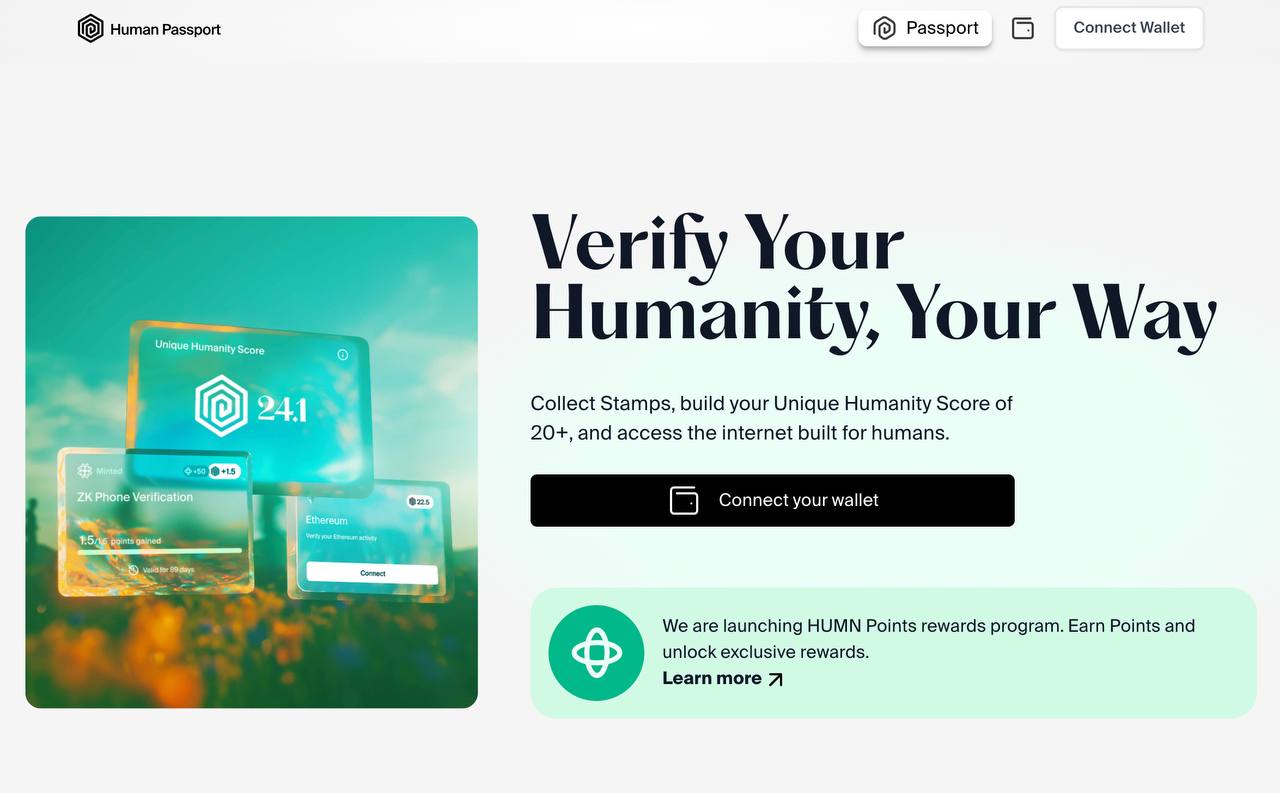
The Passport app serves as the entry point to human.tech’s identity infrastructure and the HUMN ONCHAIN SUMR program. Upon logging in, users are presented with clear instructions, an overview of the HUMN Points system, and access to the full suite of identity verification tools.
The Passport app interface. | Source: human.tech
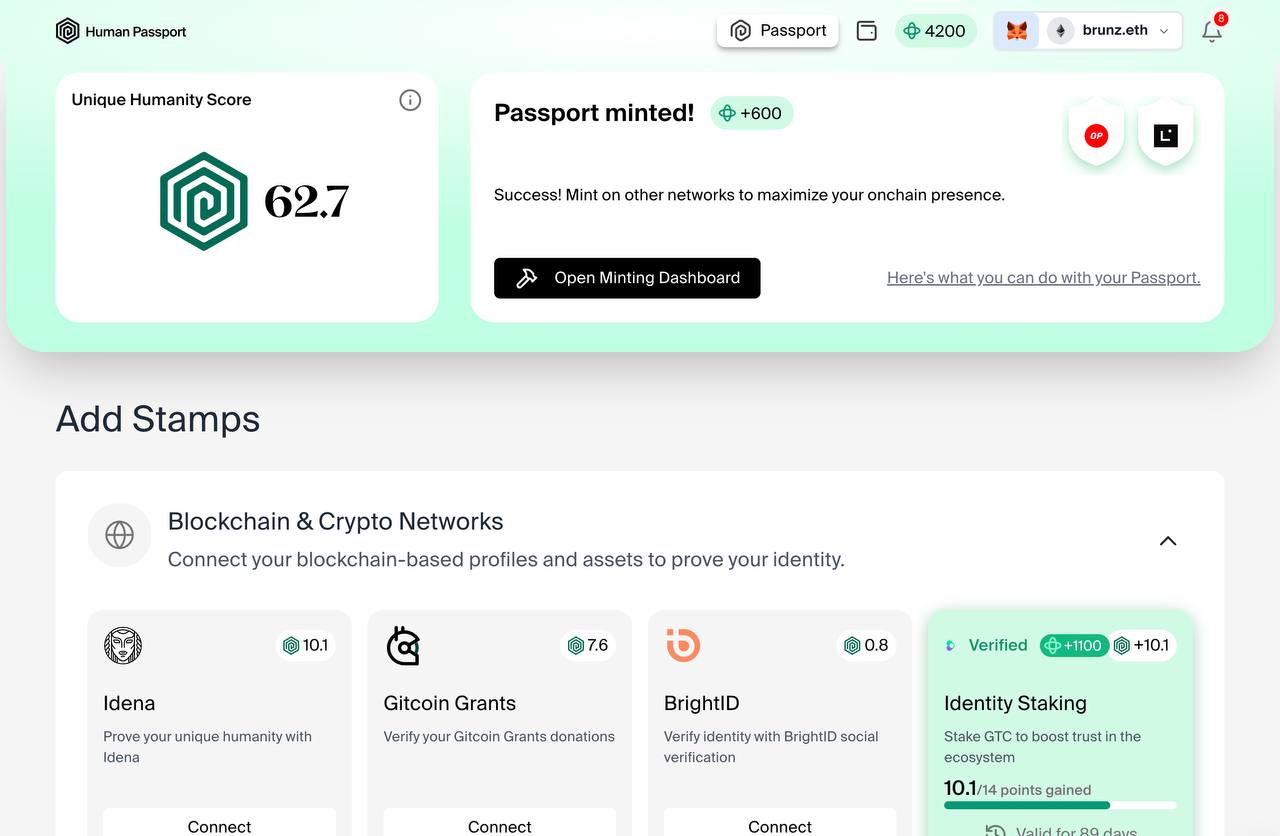
The home screen prominently displays each user’s Unique Humanity Score alongside their HUMN Points, offering a real-time view of progress and eligibility within the ecosystem. Many web3 Stamps are automatically verified, giving users a head start toward building their humanity profile without additional steps.
Humanity Score Dashboard | Source: human.tech
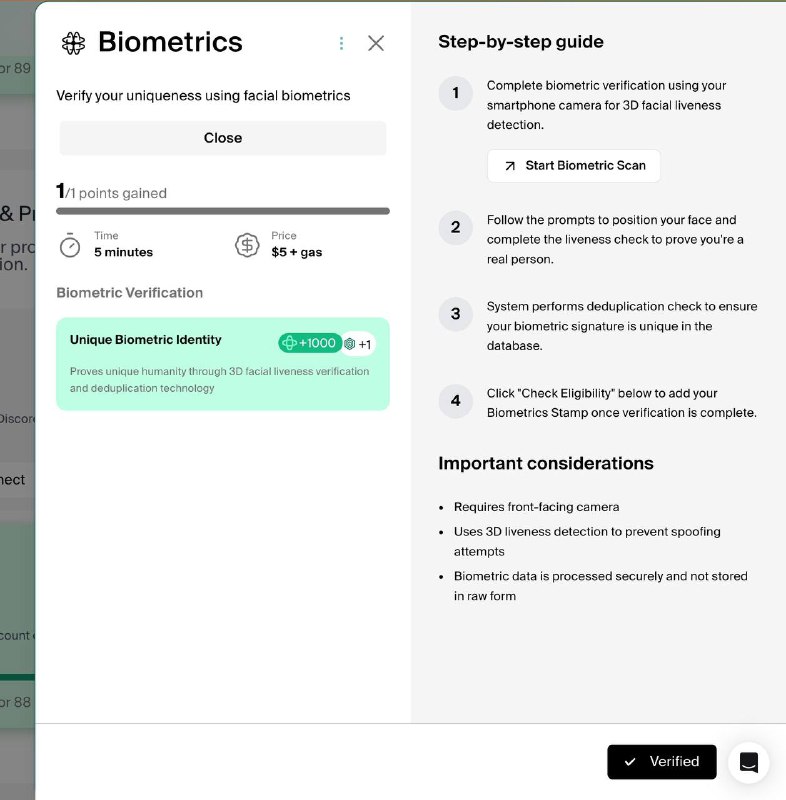
To increase their scores, users can verify a wide range of Stamps, each representing a different signal of unique personhood. Within each Stamp, users can view specific verification instructions, point rewards, time estimates, and any associated costs. This transparent system enables users to choose their verification paths based on accessibility, effort, and impact.
Verify the stamps to build up points. | Source: human.tech
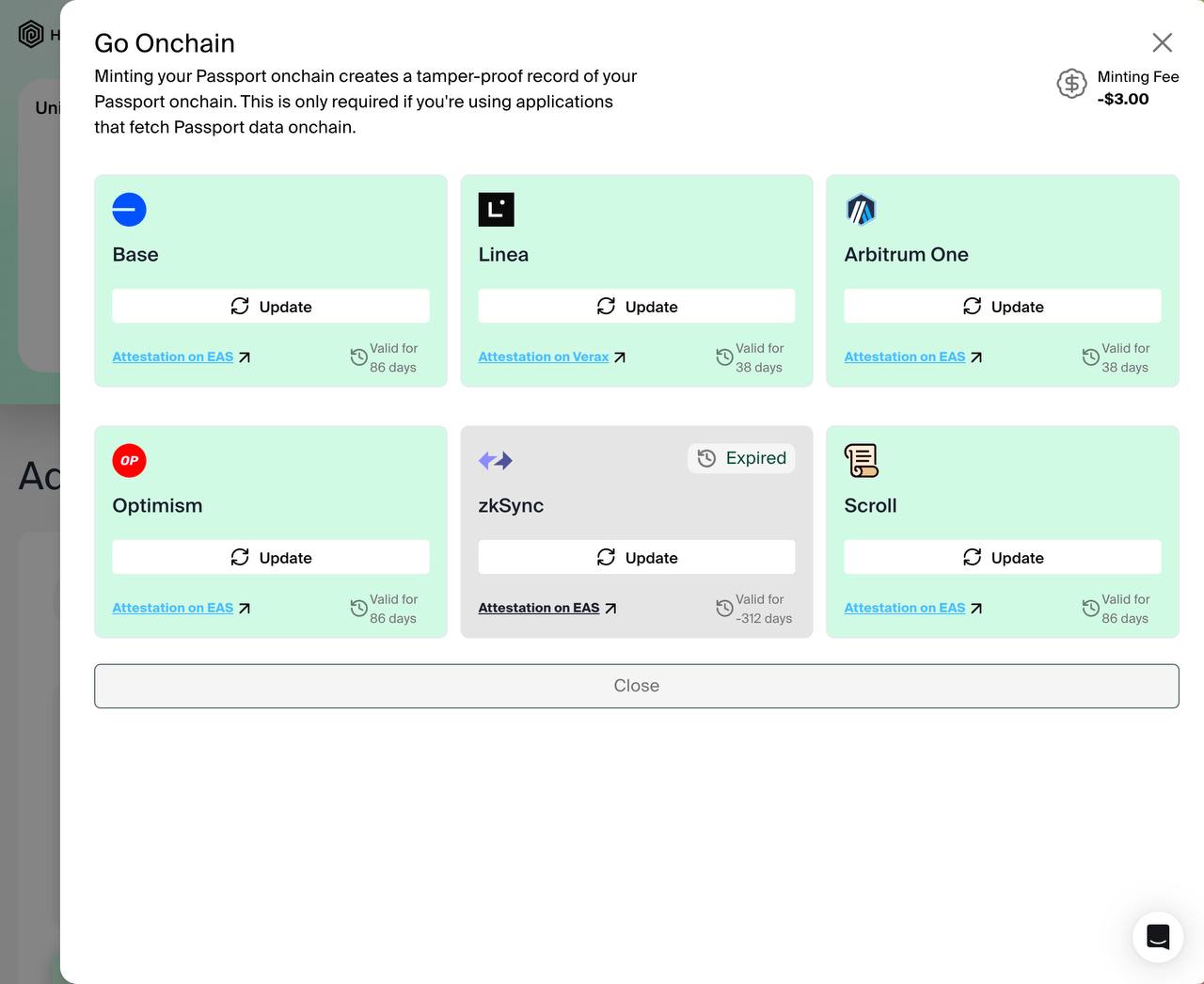
For those looking to take their identity fully on-chain, the app also provides the option to mint a Passport to various EVM-compatible networks. Doing so not only enhances a user’s decentralized identity footprint but also earns additional HUMN Points in the process.
Mint passport on-chain. | Source: human.tech
Together, these features make the Passport app the operational hub for building a trusted, verifiable digital identity on-chain and off.
Avoiding the Whales and Sybils: A Fair Start
CCN spoke to El Damaty about how human.tech plans to keep HUMN ONCHAIN SUMR fair for real users, not just early whales or opportunistic players.
“Passport’s unique strength is to do exactly that – sift through the wallets and identify real humans in a cohort and exclude the sybils and bots,” says El Damaty. “We have lots of information that helps make this possible, and it is why we are requiring all users to have a Unique Humanity Score of 20 or higher to participate in Season 1.”
Verifying humanity happens across a number of dimensions, such as biometrics, KYC, social/web of trust and in-person verifications. Human Passport supports all of these to ensure users can prove their unique humanity, while also preventing any single whale from dominating the system.
“We are capping the total rewards any wallet can get and making that cap accessible to everyone,” adds El Damaty.
Beyond Gitcoin: A privacy-preserving, globally inclusive identity layer
“Gitcoin Passport laid the foundation, but Human Passport is evolving it into a full-stack, global proof-of-humanity layer,” says El Damaty.
This includes several privacy-enhancing technologies for identity verification built on zero-knowledge proofs. After Gitcoin Passport was acquired by human.tech in late 2024, the focus expanded far beyond Web3. Human Passport is now built for global inclusion, humanitarian use, and AI resilience.
It’s not just about avoiding Sybil attacks. It’s about giving people a human-first identity layer that works both online or offline.
In addition, HUMN ONCHAIN SUMR avoids centralized biometrics like World Network’s iris‑scanning Orbs and sidesteps social‑graph limits of systems like BrightID. Instead, human.tech offers zero‑knowledge proofs of real-world actions to verify humanity without capturing or storing biometric data.
There’s no hardware Orb, no central authority holding sensitive scans. Unlike World Network, it maintains privacy by design, and unlike social‑graph models, it doesn’t require network connections or mundane trust chains. As a result, HUMN ONCHAIN SUMR offers a lightweight, privacy-preserving path to verified human identity—on-chain, without intrusion.
Extending Humanity to the Offline World
Many Web3 projects talk about “proof of humanity,” but few consider offline populations, such as refugees or individuals without smartphones or government-issued IDs. These are often the very people most in need of access to aid, identity, and digital inclusion.
El Damaty explained how human.tech addresses these edge cases through its RelayID initiative.
“RelayID was built specifically for edge cases; places where access to phones, IDs, or internet is limited,” says El Damaty. “In these environments, trust often flows through human networks, not centralized systems.”
That’s why RelayID supports community-based attestations, enabling local leaders, aid workers, or trusted peers to vouch for someone’s identity, without requiring the individual to interact with a screen.
This approach dramatically expands who can be included in aid distribution. No biometric scans. No data brokering. Just verifiable proof that someone is a real person in need.
“We’re already seeing early deployments in Africa, where the absence of formal documentation is one of the biggest barriers to accessing resources,” says El Damaty. “The response has been overwhelmingly positive, because it flips the script: rather than forcing people to prove themselves to institutions, the system works on their terms.”
What You Should Watch Out For
While HUMN ONCHAIN SUMR offers an innovative, privacy-focused approach, it’s important to keep a few caveats in mind:
Evolving tech and adoption risks: As with new blockchain identity systems, adoption across services may be limited, and standards are still emerging. The long‑term utility of HUMN Points and $HUMN tokens depends on ecosystem growth.
Governance and control: Centralized coordination of identity tools can inadvertently concentrate influence. Users should watch how governance rights evolve, ensuring decentralization remains intact .
Privacy trade‑offs: Although human.tech uses zero‑knowledge proofs, no system is fully immune to data linkability or re‑identification risks, especially given the immutable nature of blockchains.
In short, this is a promising step forward, but participation should be informed, balanced, and cautious.
Conclusion
In many ways, the internet was never designed with people in mind. It was built for machines, protocols, and efficiency, not for trust, dignity, or identity. But that’s changing.
The rise of decentralized, privacy-first identity platforms like human.tech marks a shift toward an internet that knows how to recognize and respect its users. The HUMN ONCHAIN SUMR campaign is your invitation to be part of that shift, to help shape a future where your digital self reflects your real self, not just a wallet address or username.
In a time when AI blurs the line between fact and fiction, being provably human is your greatest superpower. And now, there’s a network ready to recognize that.
What do I need to participate in HUMN ONCHAIN SUMR?
All you need is to mint a Human Passport at app.passport.xyz, complete simple verification steps (like email or phone), and start collecting Stamps to earn points.
Is this the same as World Network or other proof-of-humanity tools?
No. Unlike World Network, there are no biometric scans or Orbs involved. human.tech uses zero-knowledge proofs from everyday actions, it’s privacy-focused and non-intrusive.
What can I do with HUMN Points or $HUMN tokens?
Points may influence eligibility for future rewards like $HUMN token drops, governance rights, and ecosystem perks. The $HUMN token itself will serve utility, staking, and voting functions in the Human Network.
Is my personal data safe with human.tech?
Yes. human.tech never stores raw personal data. All verifications are done using cryptographic methods (zero-knowledge proofs), ensuring your privacy and control over your identity remain intact.
Disclaimer:
The information provided in this article is for informational purposes only. It is not intended to be, nor should it be construed as, financial advice. We do not make any warranties regarding the completeness, reliability, or accuracy of this information. All investments involve risk, and past performance does not guarantee future results. We recommend consulting a financial advisor before making any investment decisions.
Onkar Singh has three years of experience as a digital finance content creator. Throughout his career, he has collaborated with various DeFi projects and crypto media outlets. In his leisure time, he enjoys fitness activities at the gym and watching movies across different genres. Balancing his professional and personal interests, Onkar continues to contribute to the digital finance landscape while pursuing his hobbies.


 Easy
Easy