Home / Education / Crypto / Privacy / Willy Woo Says Bitcoin’s Energy Use Creates ‘Unbreakable’ Money Than Gold or Fiat — Is It Safe From Quantum Risk?
Bitcoin’s energy use may be its strength, not a flaw. Here’s why experts say it makes BTC safer than gold or fiat and what risks remain. | Credit: CCN.com
Share
Key Takeaways
Bitcoin’s energy use is central to its security, not a flaw, as proof-of-work ties its integrity to real-world energy, making attacks extremely costly and difficult.
Gold relies on physical scarcity, fiat on political systems, while Bitcoin uses energy to enforce scarcity and consensus.
Estimates show the Bitcoin network consumes significantly less energy than both the global banking sector and gold mining industry.
Bitcoin’s strength comes from combining energy-based security today with the ability to upgrade against future threats like quantum computing.
Bitcoin’s energy consumption has long been one of the most controversial aspects of the network. Critics argue it is wasteful, environmentally harmful, and economically inefficient. Supporters counter that the energy is not a flaw, but a feature.
Now, prominent on-chain analyst Willy Woo has reignited the debate with a provocative claim: Bitcoin’s reliance on energy is precisely what makes it the strongest form of money ever created, stronger than gold, and far more resilient than fiat.
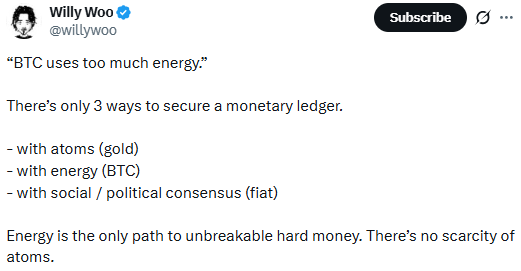
According to Woo, there are only three ways to secure a monetary system: with atoms (gold), with energy (Bitcoin), and with social or political consensus (fiat currencies).
“Energy is the only path to unbreakable hard money,” Woo argued, adding that breaking Bitcoin would require capturing 50% of the world’s available energy, a near-impossible task.
But how accurate is this claim? And even if Bitcoin is secured by energy today, could emerging technologies like quantum computing threaten that security in the future?
Bitcoin’s energy consumption comes from its proof-of-work (PoW) mechanism, where miners compete to solve cryptographic puzzles and validate transactions. This process requires massive computational power, and therefore energy.
Willy Woo says there are only three ways to secure a monetary system. | Credit: Willy Woo X profile
The logic is simple:
To attack Bitcoin, you must outcompete honest miners.
To outcompete miners, you need more computational power.
To gain that power, you must spend enormous amounts of energy.
This creates a system where security is tied directly to real-world resource expenditure.
Woo’s argument builds on this principle. Gold is secured by physical scarcity, atoms that are difficult to extract. Fiat currencies are secured by governments and institutions. Bitcoin, however, is secured by energy itself, which must be continuously expended to maintain the network.
Bitcoin vs Gold vs Fiat: Three Models of Monetary Security
Woo’s framework simplifies monetary systems into three categories, each with its own strengths and weaknesses.
Gold (Atoms)
Gold’s value comes from its physical scarcity and the difficulty of mining it. However, Woo argues that atoms are not truly scarce in a cosmic sense. With enough technological advancement, such as asteroid mining, gold’s supply could theoretically increase.
Fiat (Social Consensus)
Fiat currencies are backed by governments and trust in institutions. Their security depends on political stability and economic management. While flexible, this system is vulnerable to inflation, policy missteps, and loss of confidence.
Bitcoin (Energy)
Bitcoin’s scarcity is enforced by mathematics and energy expenditure. New coins can only be created through mining, which requires real-world energy input. Unlike fiat, supply is fixed. Unlike gold, issuance is predictable and algorithmic.
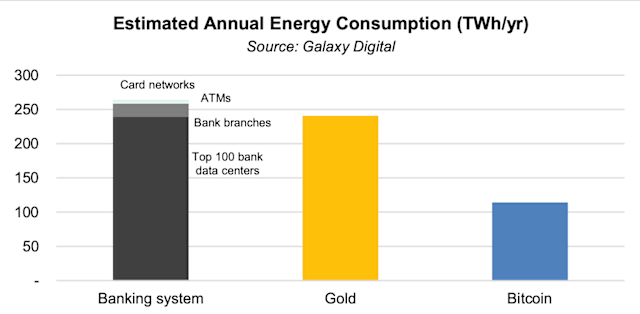
Estimated annual energy consumption. | Credit: Galaxy Digital
The key difference is that Bitcoin ties its security to something universally competitive: energy.
As Woo notes, energy is always in demand across the global economy. Any attempt to attack Bitcoin would require diverting massive energy resources away from other uses.
Is Bitcoin Really Energy Inefficient? Comparing BTC to Gold and Banking
Bitcoin’s energy consumption has often been criticized in isolation, but comparisons with traditional systems tell a more nuanced story.
Already back in 2021, a report by Galaxy Digital found that Bitcoin’s annual energy usage, around 113.89 TWh at the time, was significantly lower than other financial systems:
Global banking system: 238.92 TWh per year
Gold industry: 240.61 TWh per year
These estimates suggest that Bitcoin consumes less than half the energy used by banking or gold production. And things haven’t changed a lot since then.
The difference is visibility. Bitcoin’s energy usage is transparent and measurable in real time, making it an easy target for criticism. In contrast, the energy footprint of banks, spanning data centers, branches, ATMs, and card networks, is more diffuse and harder to quantify.
Still, the debate remains divided. Critics argue that Bitcoin’s energy use is unjustified, especially if the network is seen as primarily speculative. Supporters counter that Bitcoin represents a new form of global monetary infrastructure, and that securing such a system inherently requires energy.
To attack the network, an adversary would need to control more than 50% of its total hashpower, commonly known as a 51% attack. In practice, this means acquiring or redirecting an enormous amount of energy.
But energy is not static. It is:
Widely distributed across the globe.
Continuously competed for by industries.
Increasingly tied to economic productivity.
As Woo points out, even if more energy becomes available over time, through technological progress or expanded generation capacity, it does not become easier to attack Bitcoin. Instead, that energy is absorbed into the broader economy.
This idea aligns with concepts like the Kardashev Scale, which measures a civilization’s ability to harness energy. As societies unlock more energy, demand for that energy also increases.
In this framework, Bitcoin’s security scales with global energy competition. To compromise the network, an attacker would need to outcompete not just miners, but entire industries.
Can Quantum Computers Break Bitcoin?
While Bitcoin’s energy-based security is robust, it is not immune to technological disruption. One of the most discussed risks is quantum computing.
Quantum computers use fundamentally different principles than classical computers, allowing them to solve certain problems much faster. This has raised concerns about whether they could break Bitcoin’s cryptography.
Most experts agree that Bitcoin’s SHA-256 hashing algorithm is unlikely to be broken by quantum computers in the near future.
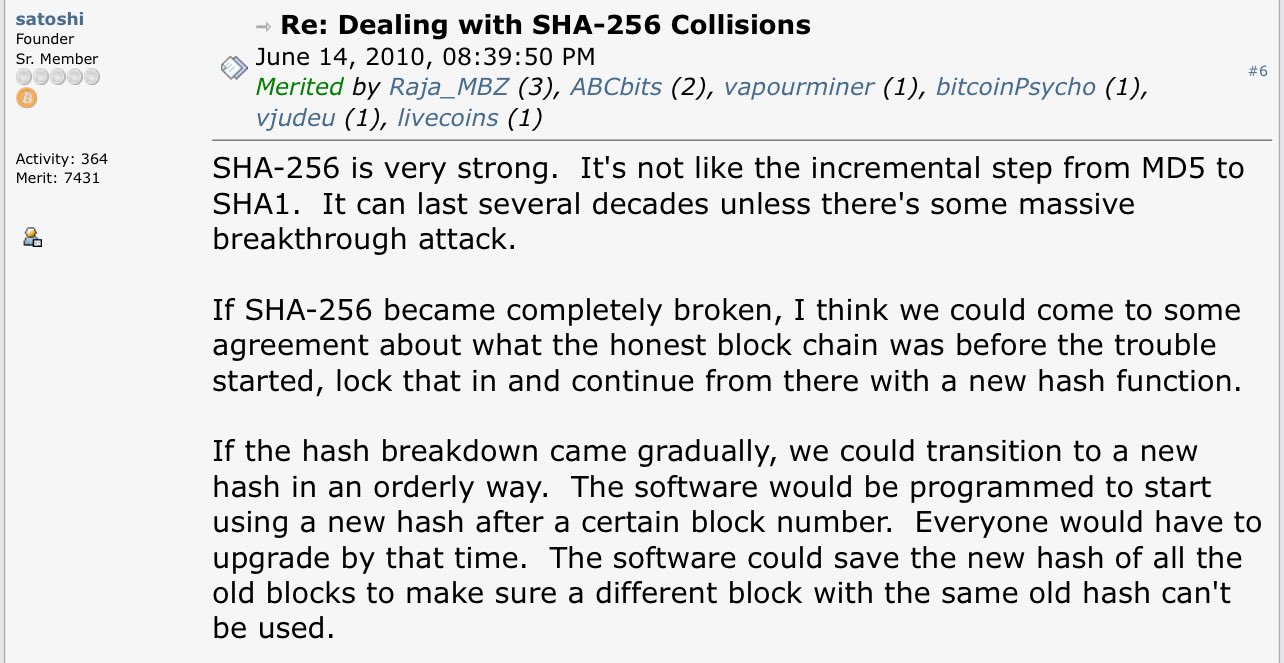
Satoshi Nakamoto explained how to deal with SHA-256 collisions. | Credit: Bitcoin whitepaper
Quantum algorithms like Grover’s algorithm can speed up brute-force attacks, but only reduce security from 256 bits to 128 bits. Even at that level, the computational requirements remain astronomically high.
Current estimates suggest that breaking SHA-256 would require quantum hardware far beyond what is expected before 2030, or even decades later.
ECDSA: The Real Weak Point
The bigger concern lies in Bitcoin’s elliptic curve digital signatures (ECDSA).
Quantum algorithms like Shor’s algorithm could, in theory, break ECDSA by solving the discrete logarithm problem. This would allow an attacker to derive private keys from public keys.
However, the hardware requirements are enormous:
Thousands of logical qubits
Millions of physical qubits with error correction
Today’s quantum computers are nowhere near this scale. Most forecasts place the timeline for such capabilities in the 2035–2045 range, though some estimates suggest a small probability of risk by 2030.
Bitcoin’s Built-In Defense: Adaptability
One of Bitcoin’s most overlooked strengths is its ability to adapt.
Satoshi Nakamoto anticipated the possibility of cryptographic breakthroughs as early as 2010. He suggested that if SHA-256 or other algorithms were compromised, the network could transition to new cryptographic standards.
This could happen in two ways:
A gradual upgrade, where nodes adopt new algorithms over time.
An emergency fork, where the network switches to a new system after a major vulnerability.
These measures help reduce exposure to potential vulnerabilities while the ecosystem prepares for long-term changes.
Energy Secures Bitcoin But Evolution Keeps It Alive
Willy Woo’s argument highlights a fundamental truth about Bitcoin: its energy consumption is not a flaw, but the foundation of its security.
By tying its ledger to real-world energy expenditure, Bitcoin creates a system that is extremely difficult to attack. Unlike gold or fiat, its security is not based on physical scarcity or institutional trust, but on a globally competitive resource.
At the same time, no system is completely immune to technological change. Quantum computing presents a real, though distant, challenge, particularly for Bitcoin’s signature schemes.
The good news is that Bitcoin was designed with change in mind. Its open-source nature and decentralized governance allow it to evolve as new threats emerge.
In the end, Bitcoin’s strength may lie in the combination of both principles:
Energy makes it hard to break today.
Adaptability ensures it can survive tomorrow.
That dual foundation, physical security and technological flexibility, may be what ultimately makes Bitcoin the closest thing the world has ever seen to “unbreakable” money.
Bitcoin uses energy because of its proof-of-work (PoW) system, where miners compete to validate transactions and secure the network. This energy expenditure acts as a real-world cost, making it extremely difficult and expensive to attack the blockchain.
Is Bitcoin’s energy consumption higher than traditional systems?
Not necessarily. While Bitcoin’s energy usage is highly visible, studies suggest it consumes less energy than the global banking system and gold industry. The difference is that Bitcoin’s consumption is transparent and easier to measure.
What did Willy Woo mean by “energy creates unbreakable money”?
Willy Woo argues that Bitcoin is secured by energy, which is a universally scarce and competitive resource. To attack Bitcoin, an entity would need to control a majority of global mining power, which would require enormous amounts of energy, making it practically “unbreakable.”
Is gold really less secure than Bitcoin?
Gold is physically scarce and durable, but its supply could theoretically expand with future technologies like asteroid mining. Bitcoin, by contrast, has a fixed supply and uses energy-based security, which some argue makes it more predictable and harder to manipulate.
Disclaimer:
The information provided in this article is for informational purposes only. It is not intended to be, nor should it be construed as, financial advice. We do not make any warranties regarding the completeness, reliability, or accuracy of this information. All investments involve risk, and past performance does not guarantee future results. We recommend consulting a financial advisor before making any investment decisions.
Giuseppe Ciccomascolo began his career as an investigative journalist in Italy, where he contributed to both local and national newspapers, focusing on various financial sectors.
Upon relocating to London, he worked as an analyst for Fitch's CapitalStructure and later as a Senior Reporter for Alliance News. In 2017, Giuseppe transitioned to covering cryptocurrency-related news, producing documentaries and articles on Bitcoin and other emerging digital currencies. He also played a pivotal role in establishing the academy for a cryptocurrency exchange website. Crypto remained his primary area of interest throughout his tenure as a writer for ThirdFloor.


 Easy
Easy