Home / Education / Crypto / Investing / Bitcoin Could Reach $1 Million by 2027 and $5 Million by 2031, Peer-Reviewed Study Finds — But How Likely Is It?
Bitcoin Could Reach $1 Million by 2027 and $5 Million by 2031, Peer-Reviewed Study Finds — But How Likely Is It?
Share
Key Takeaways
Research published in the Journal of Risk and Financial Management suggests Bitcoin could reach $1 million by early 2027.
The model is built around Bitcoin’s fixed 21 million supply and increasing institutional accumulation. As ETFs, corporate treasuries, and sovereign buyers remove coins from circulation, reduced liquidity could amplify price movements.
Higher withdrawal rates of 2,000 BTC per day could push Bitcoin toward $2 million by late 2027 and $5 million by 2031, with Monte Carlo simulations indicating a 75% chance of prices exceeding $4.8 million by 2036.
Projections rely heavily on continued ETF inflows, corporate treasury adoption, and sovereign reserves.
Bitcoin reaching seven-figure territory within the next few years has long been a popular narrative in crypto markets. Now, a peer-reviewed academic paper published in the Journal of Risk and Financial Management has added formal modeling to that thesis, forecasting Bitcoin could reach $1 million by early 2027, potentially $2 million later that year, and $5 million by 2031 under high-demand scenarios.
Research, titled “A Supply and Demand Framework for Bitcoin Price Forecasting,” was authored by Murray A. Rudd and Dennis Porter and focuses on Bitcoin’s fixed supply interacting with rising institutional demand. Study argues that Bitcoin’s unique monetary structure, capped supply combined with growing accumulation, creates conditions for exponential price growth when liquidity declines.
"Bitcoin could reach $1 million by 2027 and $5 million by 2031."
According to a peer-reviewed pricing model published in the Journal of Risk and Financial Management. pic.twitter.com/qBxxjJfGuY
Unlike traditional assets, Bitcoin supply does not expand in response to price increases. This structural constraint forms the foundation of the model’s bullish projections.
Model Based on Liquidity Drain and Institutional Demand
Framework developed in study uses supply-demand equilibrium modeling calibrated to Bitcoin’s halving cycles, long-term holder behavior, and institutional adoption trends. Researchers focused on withdrawals from liquid supply, meaning Bitcoin moved into long-term custody such as ETFs, corporate treasuries, sovereign reserves, or cold storage.
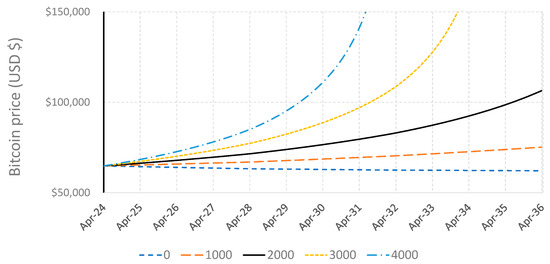
The model suggests that withdrawals exceeding 1,000 BTC per day could meaningfully reduce circulating liquidity and trigger price acceleration. Under more aggressive scenarios, withdrawals between 2,000 and 3,000 BTC daily could result in extreme supply constraints.
Projected price with varying levels of withdrawal from Bitcoin’s liquid supply. | Source: JRFM
Researchers concluded that when demand growth combines with reduced liquid supply, Bitcoin price begins shifting from adoption-driven growth to scarcity-driven expansion. In highest demand scenarios, the model forecasts $1 million Bitcoin by early 2027, followed by $2 million by late 2027, and $5 million by early 2031.
The study also calculated compound annual growth rates reaching 40.2% under aggressive adoption scenarios, significantly below Bitcoin’s historical growth but still extraordinary compared to traditional asset classes.
Historical context strengthens this argument. Bitcoin delivered approximately 99.5% CAGR over 13 years, demonstrating that high growth trajectories are not unprecedented in Bitcoin’s lifecycle.
Institutional adoption forms the core assumption behind the model’s projections. Study highlights that even modest allocation by large institutions could significantly impact Bitcoin markets because available liquid supply remains limited.
Research notes that long-term holders already control a large portion of circulating supply, reducing available liquidity. Institutional demand layered on top of this dynamic creates potential for accelerated price movements.
Institutional adoption trends supporting this thesis include:
Spot Bitcoin ETFs launched in 2024 absorbed substantial supply, removing coins from liquid circulation. Corporate treasury adoption, led by companies such as Strategy, further reduced available supply. Sovereign accumulation discussions also gained traction following El Salvador’s Bitcoin reserve strategy.
Study emphasizes that modest allocation by pension funds, sovereign wealth funds, and asset managers could absorb meaningful portions of Bitcoin’s available supply, amplifying price movements.
Researchers also modeled demand shift multipliers to simulate adoption waves. Higher multipliers combined with supply withdrawals produced nonlinear price increases, particularly after liquidity thresholds tightened.
Gold Comparison and Market Size Implications
The study compared Bitcoin’s potential growth to gold’s market capitalization, currently estimated around $16 trillion. Model suggests Bitcoin reaching gold-equivalent valuation would require 10x demand growth combined with approximately 1,000 BTC daily withdrawals.
Under more aggressive scenarios, researchers estimated Bitcoin’s total asset value could reach $91.4 trillion with strong demand multipliers and liquidity reductions.
Such valuation would position Bitcoin as one of largest global financial assets, rivaling major asset classes including global equities, real estate, and sovereign bonds.
Comparable forecasts from industry players support similar narratives. ARK Invest previously projected $3.8 million Bitcoin by 2030, assuming institutional investors allocate roughly 5% of portfolios to Bitcoin. Study notes that achieving similar price levels would require significantly higher demand or reduced liquid supply.
Monte Carlo Simulations Suggest Multi-Million Bitcoin
The study also incorporated probabilistic modeling using Monte Carlo simulations. Results suggested 75% probability of Bitcoin exceeding $4.81 million by 2036 under strong adoption scenarios.
The Monte Carlo approach adds credibility by incorporating uncertainty into projections, rather than relying on a single deterministic forecast. However, outcome remains highly dependent on assumptions around demand growth and liquidity removal.
🚨HUGE:
Binance Founder CZ believes Bitcoin will hit $1,000,000:
Several structural assumptions underpin bullish projections:
Institutional demand accelerates through ETFs, sovereign reserves, and corporate adoption. Long-term holders continue accumulating and reduce circulating supply.
Lost coins remain inaccessible, tightening available liquidity. Halving cycles reduce new supply issuance.
The global macro environment supports store-of-value assets.
Combined, these factors create supply-shock conditions rarely seen in traditional financial markets.
Key Risks and Limitations Identified in Study
The study also highlighted limitations that could weaken projections, including:
Demand elasticity assumptions remain uncertain, making price forecasts sensitive to model parameters.
Estimating lost coins introduces uncertainty, as dormant wallets may re-enter circulation if prices rise.
Researchers also acknowledged that layer-2 solutions such as Lightning Network could alter Bitcoin’s valuation dynamics, complicating supply-demand modeling.
Credit-driven institutional demand shocks may also introduce volatility rather than steady growth.
Long-term holders selling into price rallies could also increase supply, weakening scarcity-driven price expansion.
Macro Context: Bitcoin Transitioning Toward Store of Value
Study places Bitcoin within broader macroeconomic trends. Inflation concerns, sovereign debt expansion, and monetary policy uncertainty have increased interest in scarce assets. Gold historically benefited from similar macro conditions, and Bitcoin increasingly competes within that category.
Institutional investors also increasingly view Bitcoin as a portfolio diversification tool, particularly amid declining bond returns and equity volatility.
Growing infrastructure around Bitcoin, including custody solutions, derivatives markets, and regulatory clarity, further supports institutional participation.
Realistic Probability of Multi-Million Bitcoin
Short-term probability of $1 million Bitcoin remains uncertain. Achieving such valuation requires sustained institutional demand and continued supply reduction. Medium-term probability improves if sovereign adoption emerges and ETF flows continue.
Long-term projections above $2 million depend on Bitcoin evolving into a global reserve asset, competing with gold and sovereign bonds.
Extreme scenarios such as $5 million Bitcoin require widespread institutional and sovereign adoption combined with persistent liquidity constraints.
Long-Term Price Outlook for Bitcoin
The peer-reviewed model does not guarantee multi-million Bitcoin, but provides a structured framework showing how such outcomes could emerge. Bitcoin’s fixed supply combined with growing institutional demand creates unique market dynamics rarely observed in financial history.
Whether Bitcoin reaches $1 million by 2027 remains uncertain. However, research highlights fundamental reality: Bitcoin’s supply cannot expand, while potential demand continues to grow.
That imbalance, if sustained, could ultimately drive price levels previously considered unrealistic.
The study focuses on supply reduction and institutional demand. When large investors accumulate Bitcoin and remove it from circulation, available liquidity shrinks, potentially pushing prices higher.
How realistic is $1 million Bitcoin by 2027?
Scenario is possible but depends on sustained institutional accumulation. Continued ETF inflows, corporate treasury buying, and sovereign adoption would increase likelihood.
Why does withdrawing 1,000 BTC per day matter?
Removing 1,000 BTC daily significantly reduces liquid supply over time. With Bitcoin’s fixed issuance and halving cycles, reduced liquidity can create supply shocks.
Could Bitcoin realistically reach $5 million?
Multi-million Bitcoin would require global reserve asset adoption, similar to gold’s role today. Such outcome remains aggressive but becomes more plausible over longer timeframes.
Disclaimer:
The information provided in this article is for informational purposes only. It is not intended to be, nor should it be construed as, financial advice. We do not make any warranties regarding the completeness, reliability, or accuracy of this information. All investments involve risk, and past performance does not guarantee future results. We recommend consulting a financial advisor before making any investment decisions.
Onkar Singh has three years of experience as a digital finance content creator. Throughout his career, he has collaborated with various DeFi projects and crypto media outlets. In his leisure time, he enjoys fitness activities at the gym and watching movies across different genres. Balancing his professional and personal interests, Onkar continues to contribute to the digital finance landscape while pursuing his hobbies.


 Easy
Easy