20,000,000th $BTC Will Be Mined This Week — How It Impacts Bitcoin’s Price and Scarcity
Share
Key Takeaways
Bitcoin is nearing a major supply milestone.
The final coins will take more than a century to mine.
Scarcity will influence prices — but risks remain.
Bitcoin is approaching a historic milestone signalling it is reaching the end of its tightly controlled supply — the mining of its 20 millionth coin.
At the current block production rate, Bitcoin miners will reach the threshold within days. This means they have already created more than 95% of the total Bitcoin that will ever exist.
The milestone has renewed debate among investors and analysts about Bitcoin’s long-term supply dynamics, its price trajectory and how the network will function as the pace of new issuance slows.
Try Our Recommended Crypto Exchanges
Sponsored
Disclosure
We sometimes use affiliate links in our content, when clicking on those we might receive a commission at no extra cost to you. By using this website you agree to our terms and conditions and privacy policy.
Bitcoin’s underlying protocol caps supply at 21 million coins.
The network issues new tokens roughly every 10 minutes as miners validate transactions and add blocks to the blockchain.
However, the rate of new issuance slows over time.
The network protocol roughly halves the reward miners receive for each block every four years in a process known as a “halving,” a mechanism designed to gradually reduce the flow of new coins entering circulation.
When Will All Bitcoin Be Mined?
Because of that schedule, producing the final one million Bitcoins will take far longer than the first 20 million.
One more week until the 20,000,000th bitcoin is mined.
The network has generated nearly all of its supply in the roughly 17 years since its launch in 2009, but miners are expected to mine the last coins around 2140.
Risks for the Network
As the supply of new Bitcoin slows, attention is increasingly turning to how the network will sustain the miners that secure it.
Miners currently earn revenue from both newly issued Bitcoin and transaction fees paid by users.
Some fear that if network activity remains limited, fee revenue alone may not be enough to sustain mining operations, potentially eroding incentives to secure the blockchain.
Others argue that rising adoption, higher Bitcoin prices and the development of a competitive fee market will heavily offset the shrinking supply of new coins.
Potential Impact on Bitcoin Price
The approaching supply milestone also highlights Bitcoin’s scarcity — a feature many investors view as central to its value proposition.
Many Bitcoin loyalists argue that if demand continues to grow while new supply slows, the imbalance could support higher prices over the long term.
Bitcoin has historically experienced strong price swings around events that reduce new supply.
Past halvings have coincided with sharp increases in Bitcoin’s price and periods of heightened volatility.
After the 2012 halving, Bitcoin’s price rose roughly 80-fold, while the 2016 halving preceded a roughly 300% gain.
In the 16 months following the 2020 halving, the crypto climbed more than 600%, according to data cited by derivatives marketplace CME Group.
FT columnist Jemima Kelly tells CNBC Bitcoin's true value is $0 because endless altcoins kill its scarcity argument. 🤡 pic.twitter.com/b5hIV3TwYX
However, some critics question whether Bitcoin’s scarcity alone can sustain its value.
Financial Times columnist Jemima Kelly has argued that Bitcoin’s value is effectively “zero,” saying the cryptocurrency is not uniquely scarce because thousands of other digital tokens exist.
Supporters argue that Bitcoin’s fixed supply cap of 21 million coins differentiates it from other cryptocurrencies whose issuance rules developers can change.
Tradable Supply Is Much Smaller
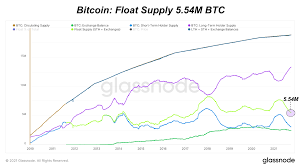
Miners have already mined nearly 20 million Bitcoin, but experts say the amount actually available for trading is far smaller.
Blockchain analytics firm Glassnode reports that a large share of Bitcoin’s supply sits in long-term wallets that rarely move coins.
Estimates cited by CCN’s Education team indicate roughly 13 million bitcoin are considered “illiquid,” meaning they are held by long-term investors, institutions, cold storage wallets or owners who rarely sell.
Bitcoin float supply. | Credit: Glassnode
By contrast, exchanges currently hold about 3 million Bitcoin — the portion of the supply most readily available for buying and selling.
Because only a limited amount of Bitcoin circulates on exchanges, large inflows of demand — such as institutional investment or ETF purchases — can have an outsized impact on prices.
Lost Coins Also Tighten Supply and Bitcoin Price
Not all of the roughly 20 million mined Bitcoins remain accessible.
Researchers estimate that people have permanently lost millions of coins due to forgotten passwords, discarded hard drives, or inaccessible wallets.
Blockchain analytics firms estimate that roughly 1.8 million Bitcoin — about 8.5% of the total supply — may be effectively lost, according to data cited by Fortune in 2024.
Many of these coins date back to Bitcoin’s early years, when the cryptocurrency had little financial value and users had limited infrastructure to store digital assets securely.
Bitcoin did not surpass $1 until 2011, meaning many early users likely lost the private keys needed to access their wallets.
Experts believe many dormant wallets will remain inaccessible indefinitely, though some may be recoverable in theory.
Kurt Robson is a London-based reporter at CCN, specialising in the fast-moving worlds of crypto and emerging technology. He began his career covering local news in Cornwall after graduating from Falmouth University with First Class Honours in Journalism. There, he cut his teeth on everything from council meetings to missing swans.
He quickly rose through the ranks to become a frontline journalist at several of the UK’s leading national newspapers. Over the years, he has interviewed musicians and celebrities, reported from courtrooms and crime scenes, and secured multiple front-page exclusives.
Following the upheaval of the COVID-19 pandemic, Kurt shifted his focus to technology journalism—just ahead of the AI boom. With a natural curiosity and a trained eye for emerging trends, he has found a new rhythm in reporting on innovation.
At CCN, Kurt's work focuses on the cutting edge of crypto, blockchain, AI, and the evolving digital world. Drawing on his background in people-first reporting and his deep interest in disruptive tech, Kurt delivers stories that are insightful, entertaining, and human-centric.