NVIDIA CEO Jensen Huang says Bitcoin mining turns wasted energy into currency. Are miners energy buyers, grid partners, or misunderstood power users? | Credit: CCN.com
Share
Key Takeaways
Bitcoin mining converts excess, stranded energy into portable economic value, reframing miners as energy buyers rather than indiscriminate energy consumers.
NVIDIA CEO Jensen Huang’s remarks highlight Bitcoin’s unique role as a system that transports energy value globally by converting electricity into a digital currency.
The AI infrastructure boom is reshaping Bitcoin mining, prompting miners to compete with hyperscalers for power, cooling, and data center space.
Leading miners are evolving into infrastructure and energy companies, offering flexible load management, hosting services, and grid-balancing capabilities.
When NVIDIA CEO Jensen Huang describes Bitcoin mining as “taking excess energy and storing it into a new form called currency,” he isn’t speaking like a crypto evangelist. He’s talking like an engineer.
₿REAKING: NVIDIA CEO Jensen Huang says, “Bitcoin mining is taking excess energy and storing it into a new form. It's called currency. And you take that currency wherever you like. So you took energy from one place and now you've transported it everywhere.” pic.twitter.com/oDjCS7XRnW
The comment landed at a moment when two capital-intensive worlds, AI infrastructure and Bitcoin mining, are increasingly colliding. NVIDIA used the same stage to unveil its next-generation Vera Rubin AI platform, a system designed to deliver five times the AI computing power of its predecessors.
At the same time, Bitcoin miners are rebranding themselves not as coin producers, but as energy buyers and infrastructure operators, competing for the same power, land, and cooling capacity that AI firms now desperately need.
This convergence raises a deeper question: Is Bitcoin mining best understood as energy consumption, or as energy demand that stabilizes grids and monetizes excess supply?
Bitcoin Mining Converts Excess Energy Into Digital Value
Huang’s framing captures a core idea that Bitcoin miners have long argued but rarely articulated so clearly: electricity is difficult to store and expensive to transport. Bitcoin changes that.
Electricity produced in remote or oversupplied locations, hydropower during rainy seasons, flare gas from oil fields, and wind and solar energy during off-peak hours often go unused. Bitcoin mining allows that energy to be:
Consumed on-site.
Converted into digital currency.
Moved globally at near-zero marginal cost.
In economic terms, Bitcoin mining acts as a buyer of last resort for stranded energy. Unlike factories or cities, miners can relocate quickly, scale consumption up or down, and tolerate intermittent power. That flexibility is precisely what makes them helpful to grids struggling with renewable volatility.
Are Bitcoin Miners Energy Consumers or Buyers?
Traditionally, Bitcoin mining has been portrayed as an energy consumer. Increasingly, it behaves more like an energy buyer.
Miners do not generate power demand indiscriminately. They seek:
The lowest marginal cost of electricity.
Curtailable or interruptible power contracts.
Locations with excess generation capacity.
In many regions, miners sign agreements that permit grid operators to shut them off during periods of peak demand. In exchange, miners receive cheaper power the rest of the time. This makes them economically similar to industrial buyers who stabilize demand rather than strain supply.
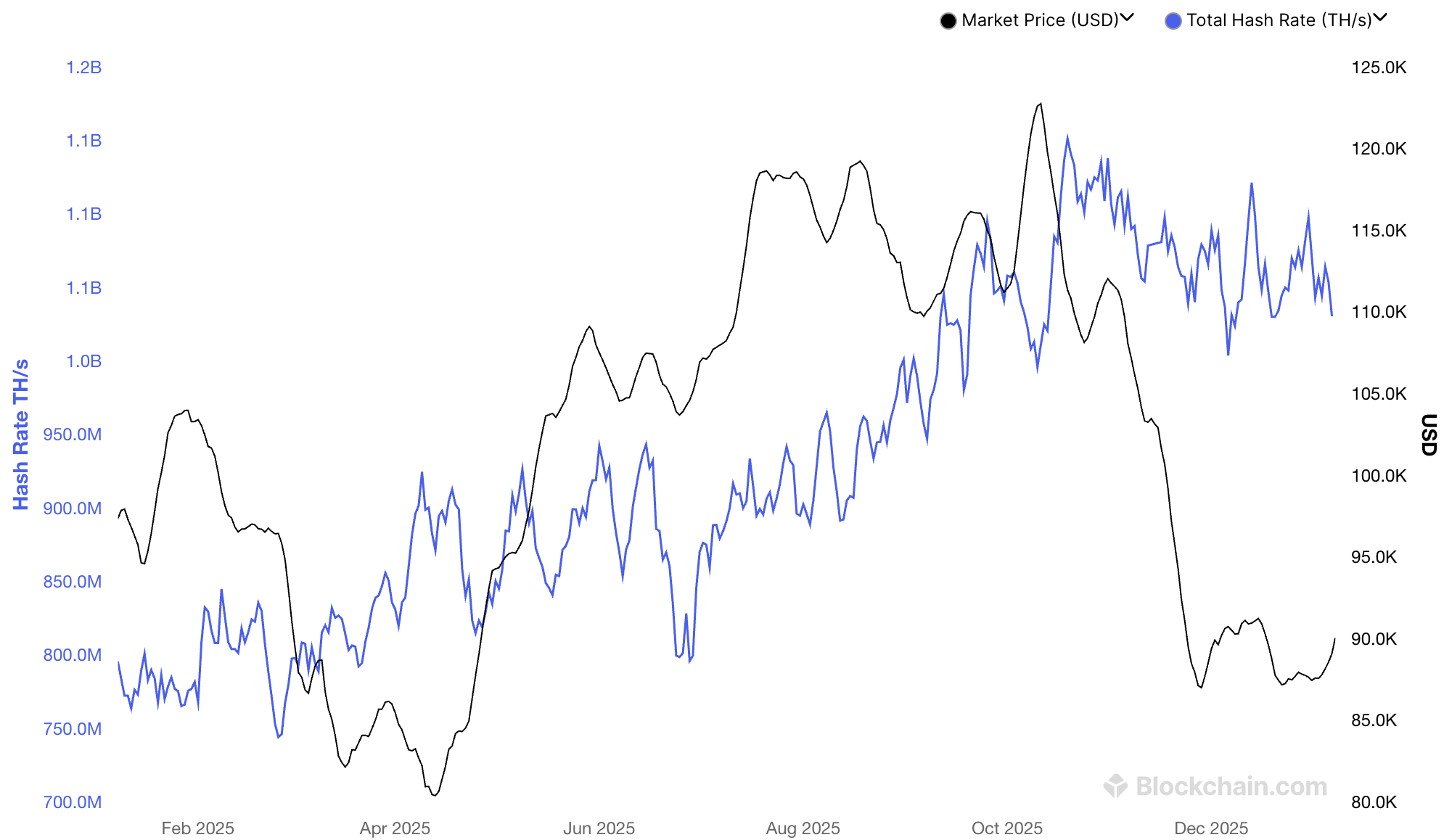
Bitcoin total hashrate. | Credit: Blockchain.com
In Texas, for example, miners routinely power down during heatwaves, selling electricity back to the grid. In oil-producing regions, miners consume flare gas that would otherwise be burned off into the atmosphere.
Seen this way, mining is less about using excessive energy and more about harnessing energy that would otherwise go to waste.
The AI Boom Is Reshaping Bitcoin Mining Economics
The rise of artificial intelligence has complicated this narrative.
At CES in Las Vegas, NVIDIA announced that its Vera Rubin platform is now in full production, with systems designed to increase AI output efficiency significantly. Rubin servers will include:
72 GPUs and 36 CPUs per server.
The ability to scale into “pods” with over 1,000 chips.
Roughly 10x efficiency gains in AI token generation, despite only a modest increase in transistor count.
This surge in AI demand is reshaping global infrastructure markets. Data-center space, cooling systems, and power contracts are becoming premium assets. Hyperscalers, cloud providers, and AI startups are bidding aggressively for the best sites.
Bitcoin miners, especially those with cheap power and existing facilities, suddenly find themselves sitting on valuable real estate.
Why Bitcoin Miners Are Becoming Data Center and Infrastructure Companies
In response, many publicly listed miners have shifted their messaging. They now describe themselves as:
Hosting AI workloads can offer steadier cash flows than mining during Bitcoin down cycles. Unlike mining revenue, which fluctuates with price and difficulty, AI hosting contracts are often long-term and dollar-denominated.
However, this pivot also raises barriers. AI customers demand:
High reliability
Advanced cooling
Dense networking
Premium locations
Smaller miners without capital or scale risk being squeezed out of the market. The industry is bifurcating into infrastructure-heavy firms that resemble utilities and hosting providers, and pure-play miners that rely solely on Bitcoin margins.
Latest Bitcoin Mining Data: Hashrate, Energy Use, and Efficiency Trends
Recent publicly available mining data reinforces this shift.
As of early 2026:
The global Bitcoin hashrate continues to reach new highs, reflecting ongoing capital investment despite increased competition.
Mining difficulty has increased, compressing margins for inefficient operators.
Energy efficiency (joules per terahash) has improved, driven by newer ASICs and better cooling.
Public miners increasingly disclose non-mining revenue, including hosting, grid services, and AI-related contracts.
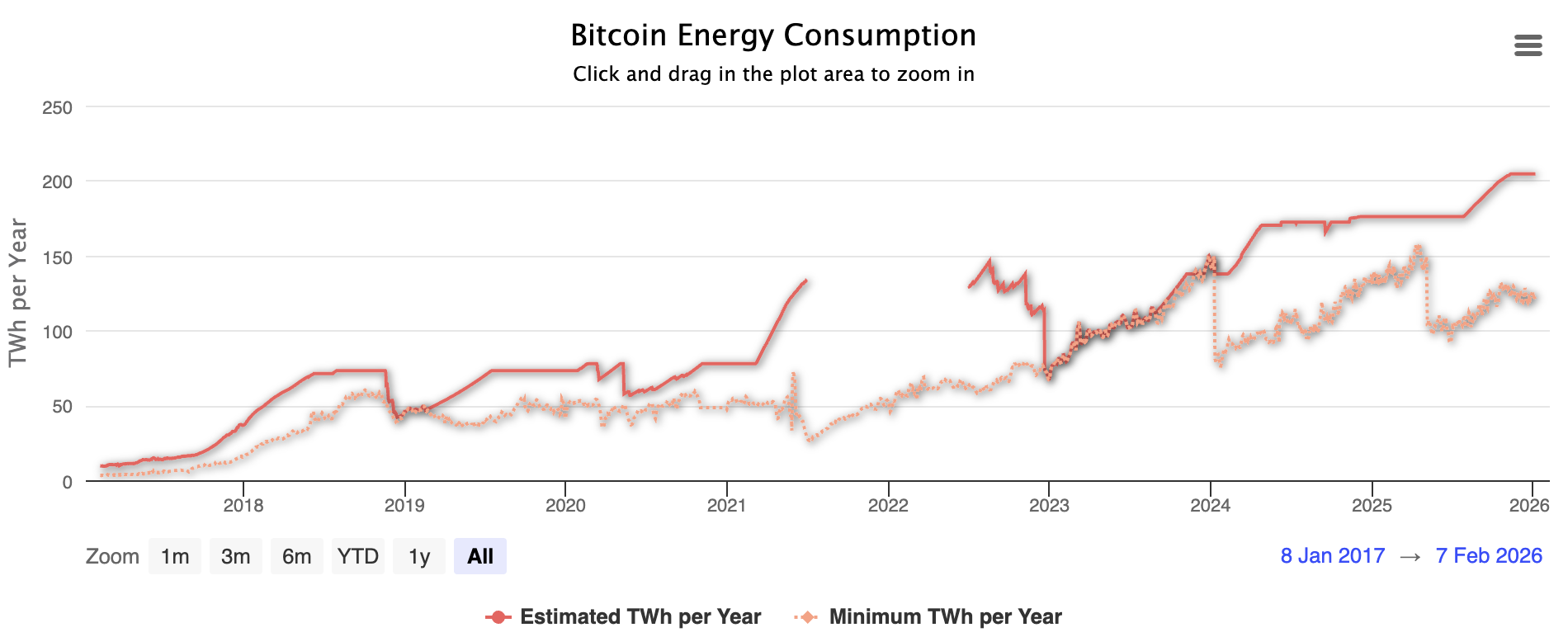
Bitcoin energy consumption. | Credit: Digiconomist
At the same time, regional concentration remains dynamic. Hashrate continues to migrate toward jurisdictions offering:
This data supports the view that mining is becoming capital- and infrastructure-intensive, favoring firms that operate like energy buyers and grid partners rather than speculative actors.
Bitcoin Mining vs AI Infrastructure: Competition or Complement?
The relationship between AI and Bitcoin mining is not purely competitive.
Both industries want:
Cheap electricity
Scalable infrastructure
Efficient cooling
But they differ in behavior. AI workloads demand constant uptime and predictable performance. Bitcoin mining is uniquely flexible, able to shut down instantly without catastrophic consequences.
That flexibility gives miners an edge in energy markets where volatility is high. In grids dominated by renewables, miners can absorb excess generation when supply is high and step aside when households and industry need power most.
In that sense, mining can complement AI rather than compete with it, if miners lean into their role as flexible energy buyers.
Does Bitcoin Mining Help or Hurt Power Grids?
Critics still point to Bitcoin’s absolute energy consumption. That concern is valid in isolation. But energy economics is about margins, not totals.
What matters is:
Where the energy comes from.
Whether it would have been used otherwise.
How flexible the demand is.
Bitcoin mining increasingly checks favorable boxes on all three. When powered by stranded gas, excess hydro, or curtailed renewables, mining can reduce emissions rather than increase them.
When miners participate in demand response programs, they can improve grid resilience.
This does not make mining universally “green.” It does make it more nuanced than simplistic consumption metrics suggest.
Jensen Huang’s View: Bitcoin as an Energy Transport Mechanism
Huang’s comment reframes Bitcoin mining in a way that resonates beyond the cryptocurrency world.
Bitcoin mining turns electricity into a transportable, censorship-resistant economic asset. That asset can be moved instantly across borders, stored indefinitely, and exchanged globally.
From an engineering perspective, that is remarkable. From an energy-market viewpoint, it is disruptive.
What Bitcoin Mining’s Energy Role Means for 2026 and Beyond
As AI accelerates and energy constraints tighten, the winners in Bitcoin mining will likely be those who:
Secure long-term, flexible power contracts.
Invest in infrastructure quality.
Integrate with grid operators.
Treat mining as a form of energy monetization, not speculation.
In that world, miners are not merely energy consumers; they are also energy producers. They are buyers, balancers, and converters of power into digital capital.
Bitcoin may still be debated as a form of money. But as Jensen Huang inadvertently highlighted, its role as an energy transport mechanism is becoming harder to ignore.
And in an era defined by power scarcity and compute intensity, that role may matter more than ever.
What did NVIDIA CEO Jensen Huang mean by “Bitcoin mining turns energy into currency”?
Huang explained that Bitcoin mining converts excess or stranded electricity into a portable digital asset. Energy produced in one location can be transformed into Bitcoin and transferred globally, effectively “transporting” energy value without physical infrastructure.
Is Bitcoin mining an energy consumer or an energy buyer?
Increasingly, Bitcoin miners behave like energy buyers rather than passive consumers. They seek cheap, excess, or interruptible power and often participate in demand-response programs, shutting down during peak demand to support grid stability.
How does Bitcoin mining help monetize excess energy?
Mining allows unused energy, such as flare gas, surplus hydroelectric power, or excess renewable generation, to be converted into Bitcoin instead of being wasted or curtailed, creating economic value from otherwise lost electricity.
What is NVIDIA’s Vera Rubin platform and why does it matter?
NVIDIA’s Vera Rubin platform is a next-generation AI system offering up to five times the computing power of prior systems. Its launch accelerates demand for power and data-center infrastructure, intensifying competition between AI firms and crypto miners.
Disclaimer:
The information provided in this article is for informational purposes only. It is not intended to be, nor should it be construed as, financial advice. We do not make any warranties regarding the completeness, reliability, or accuracy of this information. All investments involve risk, and past performance does not guarantee future results. We recommend consulting a financial advisor before making any investment decisions.
Giuseppe Ciccomascolo began his career as an investigative journalist in Italy, where he contributed to both local and national newspapers, focusing on various financial sectors.
Upon relocating to London, he worked as an analyst for Fitch's CapitalStructure and later as a Senior Reporter for Alliance News. In 2017, Giuseppe transitioned to covering cryptocurrency-related news, producing documentaries and articles on Bitcoin and other emerging digital currencies. He also played a pivotal role in establishing the academy for a cryptocurrency exchange website. Crypto remained his primary area of interest throughout his tenure as a writer for ThirdFloor.


 Easy
Easy