Quantum Safe IP And Blockchain Tools That Protect And Monetize Digital Creativity
Share
Intellectual property law moves more slowly than many other fields shaped by technology. Among the reasons are copyright offices facing backlogs, creators struggling to prove ownership and digital works spreading faster than systems designed to protect them.
Artizyou and BIP Quantum want to change that trajectory.
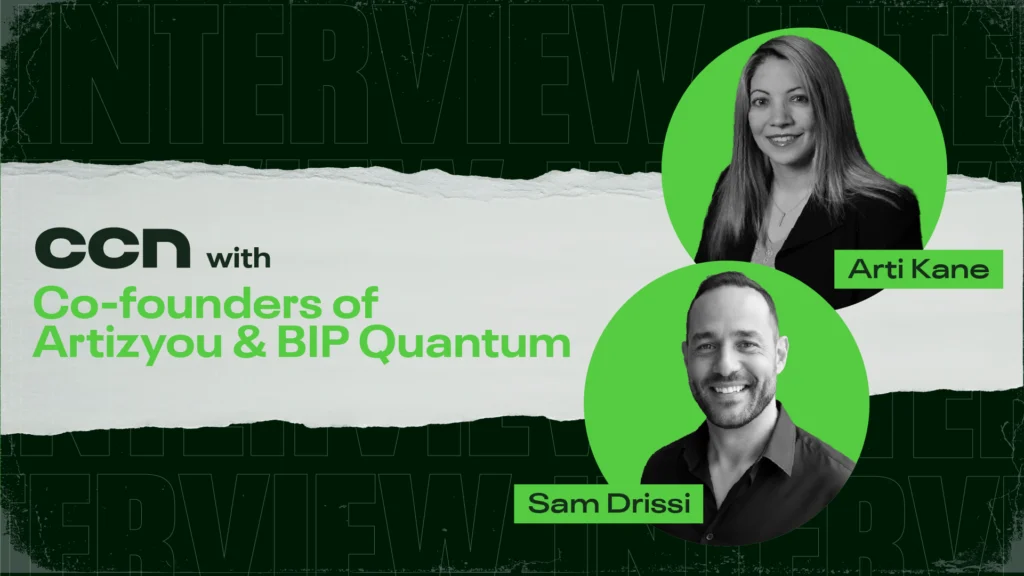
Co-founders Sam Drissi and Arti Kane focus on blockchain timestamping, AI-driven verification, and quantum-safe infrastructure that secures digital assets today and in the next era of computing. Their vision centers on programmable IP that creators can protect, license, and monetize worldwide.
This article explains how blockchain, AI, and quantum-resistant cryptography create a new foundation for global IP protection and digital creativity.
Watch the full interview here:
Why IP Law Turns to Blockchain Tools for Creator Protection
Intellectual property law changes slowly. Drissi describes law as “one of the oldest and most resistant ecosystems” compared with fast progress in medicine or engineering.
He explains that real adoption required years of research, development, and education so creators could understand how IP works without legal complexity.
He adds that early users wanted one simple outcome. “I want to timestamp that, prove I created this work first.” Traditional methods relied on sealed letters or notary processes.
“You cannot go to the court with a postmail letter,” he notes. Blockchain timestamps became a universal alternative for any digital format.
Who Uses Artizyou for Blockchain IP Protection and Why Timestamps Matter
Creators use Artizyou to secure original works before publishing them. Kane outlines the legal foundation.
“Copyright is original works of creative expression fixed in a medium and patents are new useful and non-obvious inventions.”
She explains that copyrights cover music, film, software code, artworks, and writing, while patents protect processes, machines, compositions, and designs.
Drissi details adoption patterns. “Our users today are a group of I would say, digital artists, illustrators, writers, developers and finally we have a couple of musicians and producers.”
Developers joined early because code theft requires clear proof of authorship and version history. Writers and artists face widespread plagiarism online, which has led the team to develop AI tools capable of detecting altered or copied content.
How BIP Quantum Turns IP Protection Into Monetization
Artizyou focuses on copyright. BIP Quantum focuses on patents and the broader economic layer of IP. Drissi explains the bridge between the two platforms.
“BP Quantum goes even further by turning protection IP into an economic asset.” He describes programmable licenses with customizable royalties, commercial terms, geographic limits, and clear rules for how others can use a work.
A single photo illustrates the model. A photographer could license one image to a Canadian brand while selling another license to a media outlet in Asia or the United Kingdom. Smart licensing processes automate rights and payments.
Fractional ownership expands the model. Drissi says creators can “raise money giving away let’s say 10 or 20% of your IP” without entering traditional venture capital cycles. Kane adds that users gain “a non-exclusive license or an exclusive license” and the owner collects royalties based on those agreements.
When Abstract Ideas Qualify for IP Protection
Ideas gain protection when they are documented in a clear and concise form. Drissi explains that creators must fix an idea “in a draft or a design” to generate a timestamp and certification.
Kane notes that conventional filings remain slow and expensive, with copyrights taking months and patents taking years. She says a patent can cost “at least sometimes $100,000” to obtain.
The teams view blockchain certification as a practical alternative that reduces timelines and expands global access.
The Quantum Threat and the Risk of ‘Store Now, Decrypt Later’
Drissi calls it “a real risk.” He notes that attackers can store encrypted files today and wait for future quantum computers to break traditional cryptography. “Future quantum computers could probably unlock wallets or signatures,” he says.
To address this, BIP Quantum uses quantum-resistant vaults based on hash-based signatures. Drissi describes the concept.
“A traditional password is something a quantum computer can guess instantly. A quantum safe signature is like a mathematical fingerprint.”
He emphasizes that no system can promise a “100% guarantee,” but quantum-safe methods provide a stronger foundation than current standards.
Designing Decentralized Tools for Non-Technical Creators
Creators do not need technical knowledge to use Artizyou or BIP Quantum. Kane provides legal guidance through consultations and demos. Drissi says the team invests in education through physical events, ebooks, learning groups, and direct access to patent lawyers.
The design goal is simplicity. “If you can upload a file you can protect your IP,” Drissi says. Artizyou uses an integrated custodial wallet that removes setup tasks.
Templates automate copyright terms and licensing options. For BIP Quantum, all cryptographic processes remain hidden behind a clean interface.
How Fractional IP Funding Meets the Limits of Conventional Protection
Fractional IP offers new ways for creators to develop projects. Drissi explains how an author funding a book could share a percentage of IP rights with supporters. If the book succeeds, community members recover their contribution through returns tied to those rights. Creator tokens can also grant early access, one-to-one interactions, or exclusive content.
The World Intellectual Property Organization (WIPO) sets global frameworks but cannot address backlog issues at national offices. Kane highlights that patents often become outdated before approval.
Drissi explains that the team aims to create an alternative structure built on transparency, AI validation, indexation, and automated licensing.
Their long-term vision includes a hybrid blockchain with public transparency for verification and a private quantum-safe layer for sensitive information.
What Quantum Safe Protection Means for Creators and the Future of Global IP
Quantum safety reduces the risk of future decryption. “Your IP cannot be stolen today or in a future where quantum computers exist,” Drissi explains. Hash-based signatures support this goal by creating irreversible mathematical proofs of ownership.
He positions quantum resistance as essential for the next era of digital value, where human and AI-generated works coexist.
Artizyou plans to become a free, open-source IP passport in collaboration with the Linux Foundation.
Drissi imagines a world where global innovators can protect and license creations instantly. “In the future intellectual property licensing and profitability will be accessible to everyone,” he says.
He envisions automated copyright and patent systems with AI support, simple digital marketplaces for buying and selling IP, and fractional ownership structures that remove barriers between creators and funding.
Kane aligns with the vision and Drissi closes with an invitation.
“Please join us and let’s build the future together, one IP at a time.”
Artizyou and BIP Quantum introduce a new framework for protecting, licensing, and monetizing intellectual property. Blockchain timestamps solve authorship disputes.
AI strengthens verification. Quantum-safe cryptography prepares creators for future risks.
Their model centers on accessibility so global innovators can rely on clear, transparent, and programmable IP systems.
Disclaimer:
The information provided in this article is for informational purposes only. It is not intended to be, nor should it be construed as, financial advice. We do not make any warranties regarding the completeness, reliability, or accuracy of this information. All investments involve risk, and past performance does not guarantee future results. We recommend consulting a financial advisor before making any investment decisions.
Dr. Lorena Nessi is an award-winning journalist and media technology expert with 15 years of experience in digital culture and communication. Based in Oxfordshire, UK, she combines academic insight with hands-on media practice.
She holds a PhD in Communication, Sociology, and Digital Cultures, and an MA in Globalization, Identity, and Technology.
Lorena has taught at Fairleigh Dickinson University, Nottingham Trent University, and the University of Oxford. She is a former producer for the BBC in London, with additional experience creating television content in Mexico and Japan.
Her research focuses on digital cultures, social media, technology, capitalism, and the societal impact of blockchain innovation.
She has written extensively on digital media and emerging technologies, with her work featured in both academic and media platforms. Her Web3 expertise explores how blockchain technologies shape culture, economics, and decentralized systems.
Outside of work, Lorena enjoys reading science fiction, playing strategic board games, traveling, and chasing adventures that get her heart racing. A perfect day ends with a relaxing spa and a good family meal.


 Easy
Easy