Will Bitcoin ETFs fuel a Christmas bull run? Discover how ETF flows, low holiday liquidity, and market sentiment could drive a year-end BTC surge or a deeper drop. | Credit: Veronica Cestari/CCN.com
Share
Key Takeaways
As the year unfolds and the market declines, investors are wondering how Bitcoin will fare during the Christmas period.
Historically, the cryptocurrency market has been relatively muted during the festive period, with notable movements recorded in 2017 and 2020.
If institutions rebalance their portfolios before Dec. 31 or increase their Bitcoin exposure, ETFs must purchase BTC in large quantities, which can quickly drive up the price.
If investors withdraw money from ETFs or react to negative macroeconomic news, ETFs may sell BTC rapidly, causing sharper dips.
As the year comes to a close, a familiar question resurfaces: Will Bitcoin rally into Christmas?
However, a lot depends on liquidity, sentiment, and whether ETF flows continue to come in. This article explains in plain terms how ETFs can fuel a year-end “Santa rally,” what history shows about Bitcoin at Christmas, and the risks you should know.
A spot Bitcoin ETF allows large investors to buy a shares-based fund that directly tracks Bitcoin’s price, rather than purchase coins on an exchange or holding private keys.
In 2024, regulators approved spot Bitcoin ETFs, and significant institutional money poured in, boosting demand and strengthening the connection between traditional finance and the cryptocurrency market. That approval and flow of ETF capital helped push Bitcoin much higher in 2024.
Why does that change the Christmas picture? Two simple reasons. First, ETFs make it easier for large, slow-moving pools of money, such as pensions, mutual funds, and wealth managers, to invest in bitcoin. Second, ETF flows can be large and concentrated: if many funds and investors decide to buy before year-end, they can create a strong, short-term demand shock that pushes prices up quickly.
Put bluntly: where once crypto moves were driven mainly by traders and retail, a new layer of institutional buyers can make year-end rallies bigger, or, if they panic and sell, deeper.
Bitcoin Christmas Performance: 10-Year Seasonal Trends and Data
Bitcoin has a mixed history around Christmas. Some years saw significant gains, others steep drops. Below is a simple table showing Bitcoin’s closing price on Dec. 25 for the last ten years, along with the year-over-year percentage change. The raw pattern helps explain why traders watch “Xmas time” closely.
Year
BTC close on Dec 25 (USD)
YoY % change vs previous Dec 25
2015
$455.65
—
2016
$896.18
+96.8%
2017
$14,026.60
+1,465%
2018
$3,815.49
−72.8%
2019
$7,275.16
+90.7%
2020
$24,664.72
+239.1%
2021
$50,429.86
+104.4%
2022
$16,847.51
−66.6%
2023
$43,613.14
+158.9%
2024
$99,299.19
+127.6%
The table shows significant fluctuations, with enormous gains in some years and substantial drops in others. That volatility is why ETFs matter; they can amplify both upward and downward moves.
How Bitcoin ETFs Could Trigger a Christmas Bull Run
Here’s how ETFs could help create an end-of-year rally:
Large passive flows: ETFs can accommodate significant purchases from institutions. If many investors decide to allocate to bitcoin before tax-year or portfolio-rebalance deadlines, ETFs buy coins to match demand. Direct buying tends to push the price higher.
Liquidity squeeze on low supply days: Holidays often have thinner trading volumes. A buy order of the same size has a greater impact on the price when fewer people are trading. ETF demand in thin holiday markets can therefore cause sharper price spikes.
Momentum and headlines: Big inflows and rising prices feed on each other. Positive headlines about ETF adoption attract more buyers, creating a feedback loop. Past rallies have shown that momentum can accelerate into year-end. Analysts and traders watched this dynamic during the 2024 ETF inflows.
However, remember that the reverse is also true. If ETFs experience outflows or if macroeconomic news (such as a hawkish Fed move) spooks investors, ETFs can sell their holdings quickly. In thin markets, this can trigger deep drops.
Major Risks That Could Prevent a Bitcoin Santa Rally
ETFs raise the odds of a rally, but they don’t guarantee one. Key risks include:
Macro shocks: Rapid policy shifts (interest-rate surprises), geopolitical news, or credit shocks can make investors dump risk assets, including Bitcoin, even if ETF flows are positive.
Liquidity mismatch: Some ETFs permit daily redemptions, but their underlying markets may be thin. If many investors attempt to sell at once, prices can fall rapidly.
ETF concentration: A small number of funds and market makers dominate the flow of assets. If they change strategies, that can quickly reverse price moves.
Regulatory headlines: Negative rules or enforcement actions can spook ETF buyers and trigger redemptions.
These risks mean that any potential Christmas rally driven by ETFs could be sharp but short-lived, or it could fizzle if counter-forces dominate.
What to Expect Before Jingle Bells
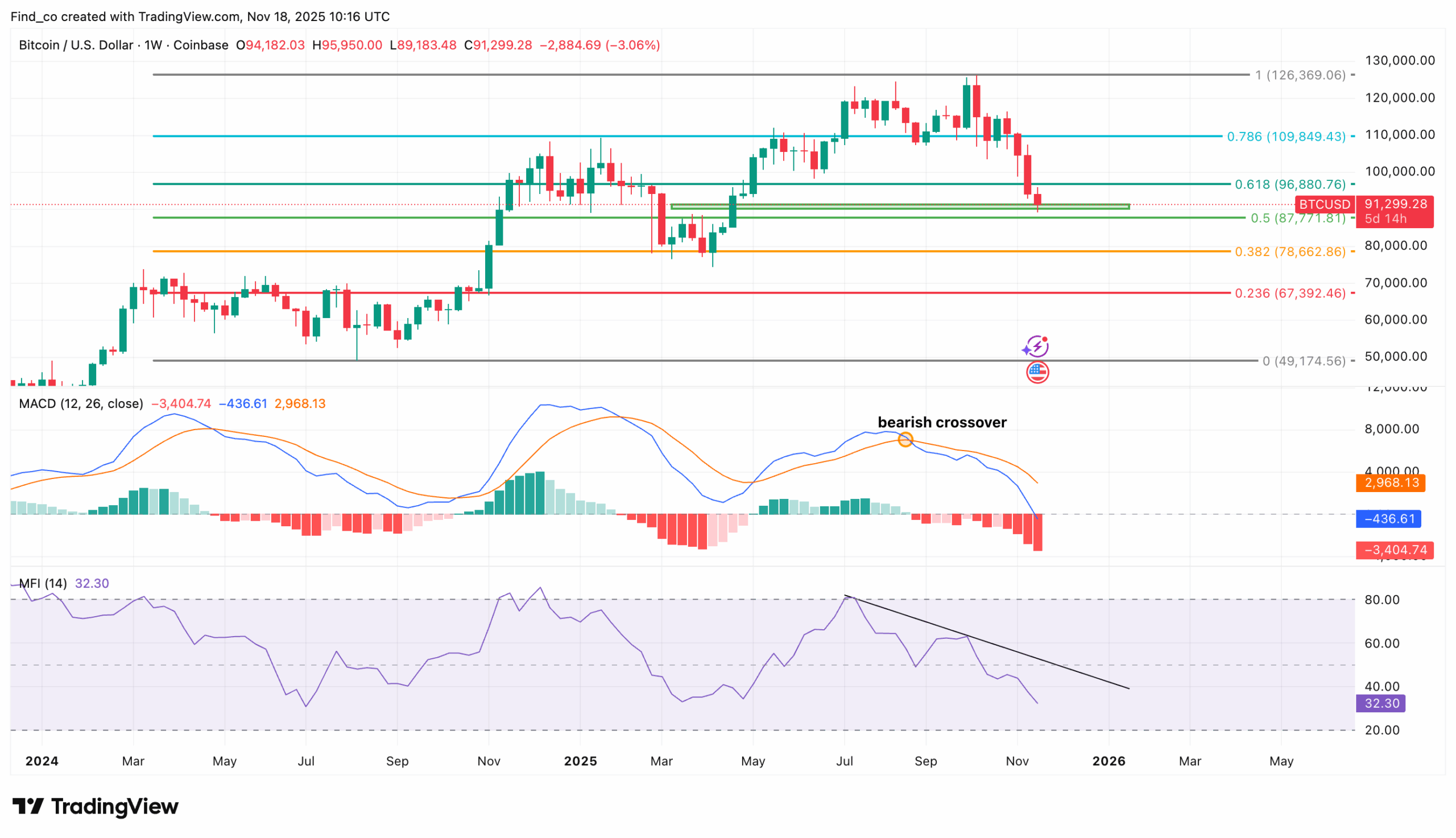
On the weekly chart, Bitcoin’s price has printed four consecutive red candles, signaling persistent selling pressure.
According to CCN’s analyst Victor Olanrewaju, BTC continues to hover above a critical support zone around $90,004. This level has acted as an essential buffer, and its defense will likely determine Bitcoin’s next major direction.
However, the Moving Average Convergence Divergence (MACD) has formed a bearish crossover, suggesting that downward momentum is strengthening.
BTC/USD weekly chart | Credit: TradingView
“Adding to this risk, the Money Flow Index (MFI) has continued to decline, reflecting a fading of capital inflows,” Olanrewaju said.
“If this bearish trend persists, Bitcoin could decline to around $87,771 before the end of December.”
Still, the outlook is not entirely one-sided. A notable increase in buying pressure could reverse this trend.
If bulls regain control and BTC breaks convincingly above the $96,880 resistance, the market structure would shift back toward bullish conditions. A move above this level could open the door for a rally toward $109,849, positioning Bitcoin for a potential recovery into early 2026.
How Investors Should Navigate a Potential Holiday Rally
If you’re watching a holiday rally, keep it simple. ETFs increase the likelihood of larger year-end moves because they bring substantial, easy money into the bitcoin market. That raises both the short-term upside and downside.
Here’s some practical tips:
Don’t over-leverage. Volatility can wipe out positions fast.
Watch ETF flows and trading volume. Rising inflows and falling supply are bullish signals.
Consider the time horizon. If you’re a long-term investor, small holiday swings are noise. If trading, manage stop losses and position size.
Understand macro context. Fed comments, inflation prints, and global risk appetite matter as much as ETF news.
Will Bitcoin ETFs Spark a Christmas Bull Run?
Spot Bitcoin ETFs turned a niche market into something closer to mainstream finance. That institutional bridge raises the odds of a strong year-end rally, especially in quieter holiday trading, but it also makes Bitcoin more sensitive to large, concentrated flows.
History shows Christmas can be a decisive moment for crypto, but it’s a double-edged sword: ETFs can fuel a Santa rally, or they can speed the sled downward when sentiment shifts.
Watch ETF flows, market liquidity, and macro news, and treat any holiday cheer with a dose of risk management.
A “Santa Rally” refers to a price increase that happens around Christmas and the end of the year. Stocks have historically exhibited this pattern, and crypto traders often look for a similar effect in Bitcoin.
Why are Bitcoin ETFs important for a Christmas rally?
Because ETFs enable large institutions, such as pension funds and wealth managers, to easily purchase Bitcoin. If these investors buy more ETF shares near year-end, ETFs must buy actual Bitcoin, which increases demand and can push the price up quickly.
What exactly is a spot Bitcoin ETF?
A spot Bitcoin ETF is a financial product that tracks the real price of Bitcoin. Instead of buying Bitcoin on an exchange, investors buy ETF shares, and the fund holds Bitcoin on their behalf.
Does history suggest Bitcoin will rally this Christmas?
History alone cannot predict the future, but it does show that Christmas often brings significant price moves, up or down. With ETFs now in place, the moves may be even bigger.
Disclaimer:
The information provided in this article is for informational purposes only. It is not intended to be, nor should it be construed as, financial advice. We do not make any warranties regarding the completeness, reliability, or accuracy of this information. All investments involve risk, and past performance does not guarantee future results. We recommend consulting a financial advisor before making any investment decisions.
Giuseppe Ciccomascolo began his career as an investigative journalist in Italy, where he contributed to both local and national newspapers, focusing on various financial sectors.
Upon relocating to London, he worked as an analyst for Fitch's CapitalStructure and later as a Senior Reporter for Alliance News. In 2017, Giuseppe transitioned to covering cryptocurrency-related news, producing documentaries and articles on Bitcoin and other emerging digital currencies. He also played a pivotal role in establishing the academy for a cryptocurrency exchange website. Crypto remained his primary area of interest throughout his tenure as a writer for ThirdFloor.


 Easy
Easy