Such large confidence raises the question of whether the ETF boom is fostering overconfidence. | Source: Pexels
Share
Key Takeaways
Two-thirds of ETF investors only entered the market after 2020, and 70% say they’d go “all in” on ETFs.
Questions have been raised about the potential overconfidence in a relatively new crowd.
Millennials now make up the largest generation of ETF investors.
ETFs are booming, and so is investor confidence.
According to Charles Schwab’s 2025 ETFs and Beyond Study, most ETF investors joined the market after 2020, and 70% of them say they’d go “all in.”
As enthusiasm for low-cost funds and crypto-themed ETFs grows, the study suggests that excitement may be outpacing experience among the newest wave of traders.
Try Our Recommended Crypto Exchanges
Sponsored
Disclosure
We sometimes use affiliate links in our content, when clicking on those we might receive a commission at no extra cost to you. By using this website you agree to our terms and conditions and privacy policy.
The Schwab study, conducted by independent firm Logica Research between July 25 and Aug. 14, 2025, surveyed 2,000 investors, evenly split between ETF and non-ETF users.
It found that 66% of current ETF investors first bought an ETF in 2020 or later, highlighting the market’s rapid growth since the pandemic-era investing boom.
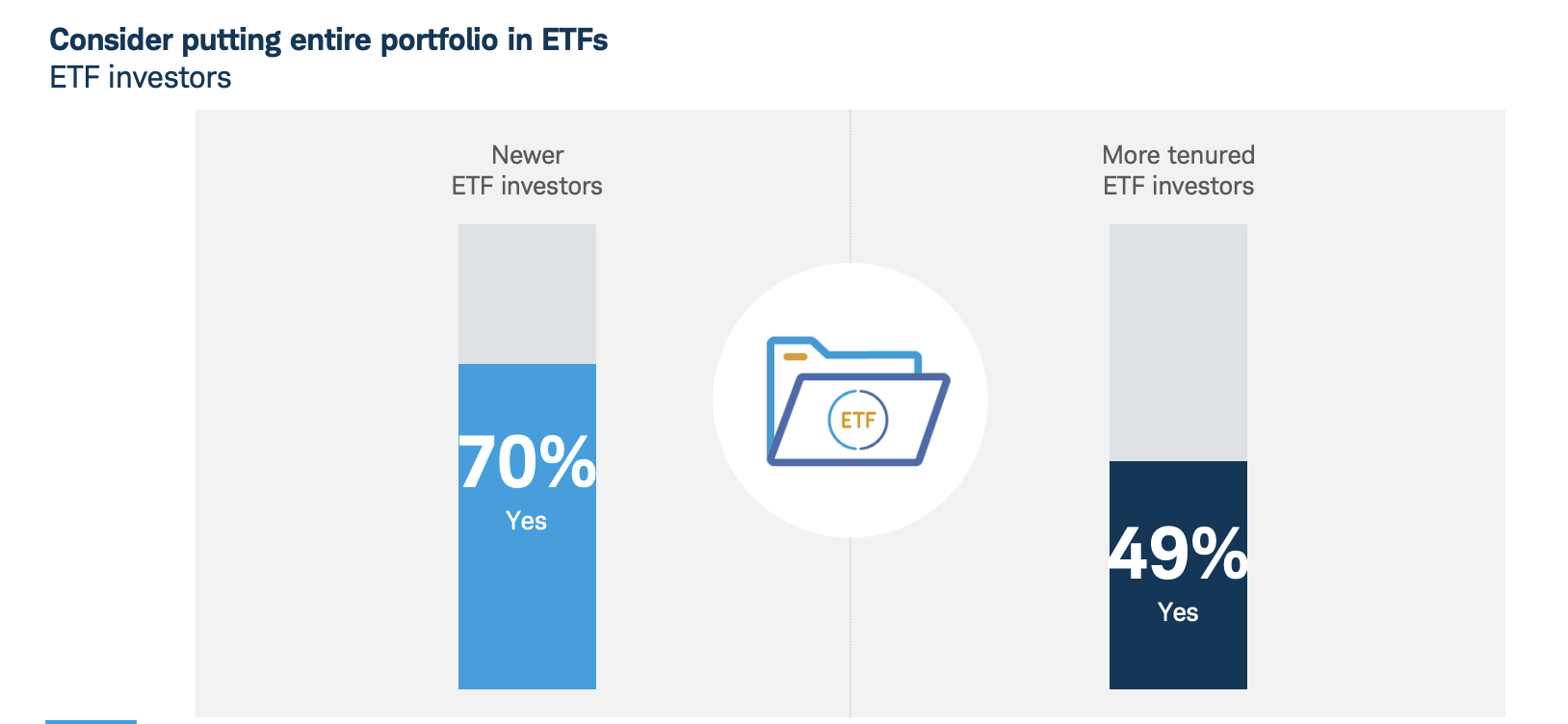
New investors are ready to risk it all. | Source: Charles Schwab ETFs and Beyond Study
Despite their short track record, 70% of these newer investors said they would consider putting their entire portfolio into ETFs, compared with 49% of more experienced participants.
Overall, 93% of ETF holders agreed that ETFs are “a necessary part of my portfolio,” and 82% said they are their preferred investment vehicle.
Optimism At Record Levels
Investor optimism in the ETF space remains unusually high.
The study reports that 99% of ETF investors are confident they will meet their desired investment outcomes, while 91% believe their portfolios could recover from a “deep recession or black-swan event.”
Such near-unanimous confidence, rare even in bull markets, raises the question of whether the ETF boom is fostering overconfidence.
The report also found that 75% of ETF investors are “extremely likely” to purchase another ETF within the next two years, and 61% increased their ETF allocations in 2025.
The average investor now holds 27% of their portfolio in ETFs, a figure expected to climb to 34% within five years.
Crypto ETFs Lead the Charge
The study highlights how crypto exposure has become a defining feature of the new ETF generation.
Among all ETF holders, 35% plan to buy spot crypto ETFs in the next 12 months.
For millennial ETF investors, that rises to 44%, nearly quadruple the 11% recorded among Boomers.
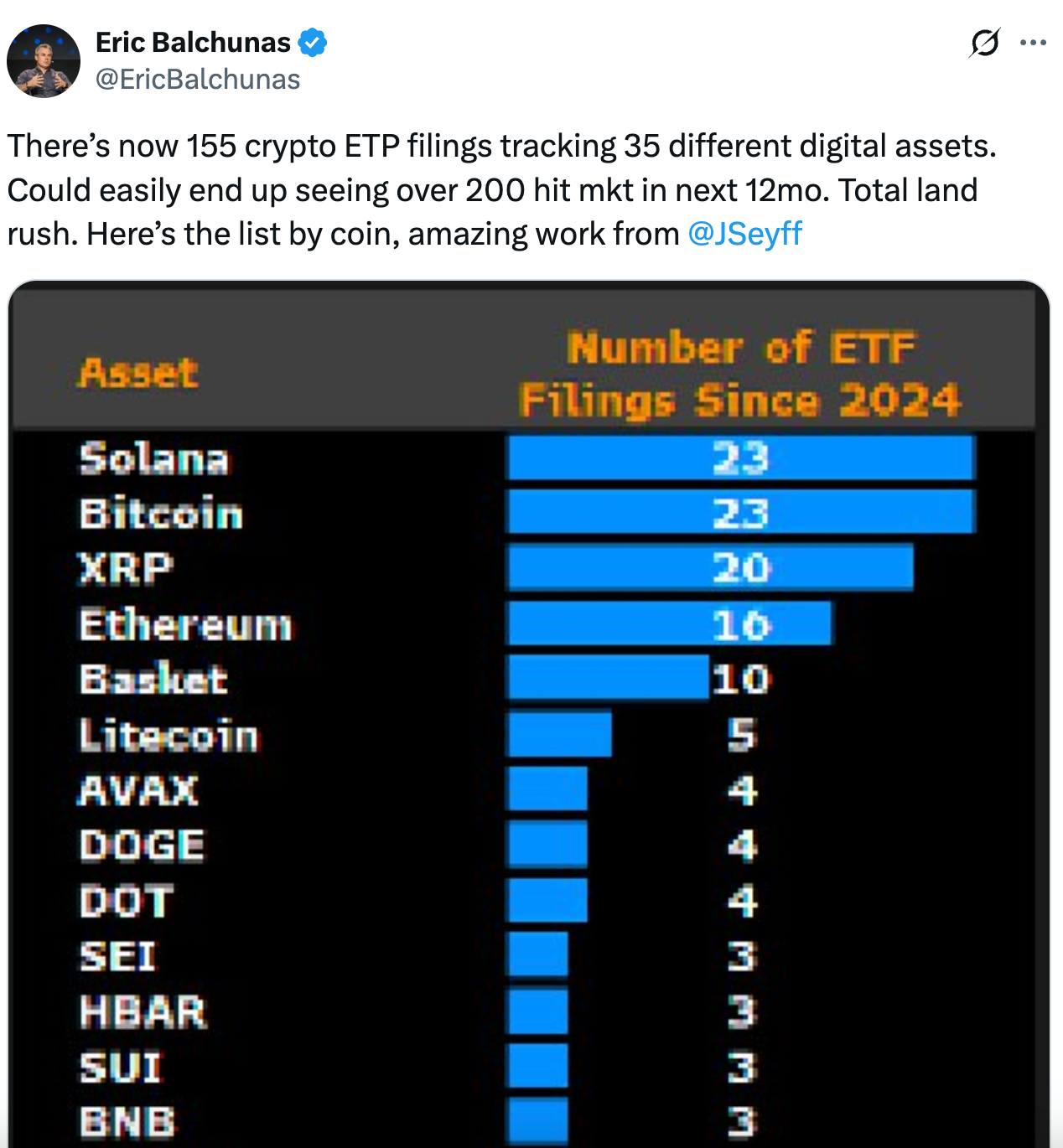
ETP filings | Source: X @EricBalchunas
Millennials also express a stronger interest in single-stock ETFs (43%), long/short ETFs (40%), and thematic ETFs (34%), reinforcing their willingness to take on risk and pursue niche strategies.
Schwab’s data shows that 49% of ETF investors strongly agree that ETFs allow them to “try out investing in targeted or niche asset classes or strategies separate from [their] long-term portfolio.”
Generational Drivers
Millennials account for 43% of ETF investors in the survey, the largest generational group, compared with 35% Gen X and 16% Boomers.
They also hold the highest ETF allocations, making up 30% of their portfolios, which is projected to reach 36% within five years.
In contrast, Gen X investors currently hold 26%, while Boomers hold 21% in ETFs.
Moreover, 32% of Millennials said they expect to “significantly increase” their ETF holdings over the next year, compared with 20% of Gen X and only 6% of Boomers.
Why Are Investors So Confident?
A large factor of ETFs that boosts confidence in traders is cost, with 59% of respondents claiming total cost is “extremely important” when selecting an ETF, while 94% agreed that ETFs help them keep costs down.
Talking to Investopedia in July, financial planner Eric Croak said, “I tell people to think of ETFs like playlists.”
“You do not buy every song separately; you stream a curated set built around a mood or theme. ETFs work the same way,” Croak added.
“You get a group of stocks or bonds working toward a goal, like income or growth, and you do not have to manage each holding on your own.”
Accessibility also plays a key role in boosting confidence; over 45% of respondents said ETFs give them exposure to asset classes “they normally wouldn’t be able to invest in.”
Kurt Robson is a London-based reporter at CCN, specialising in the fast-moving worlds of crypto and emerging technology. He began his career covering local news in Cornwall after graduating from Falmouth University with First Class Honours in Journalism. There, he cut his teeth on everything from council meetings to missing swans.
He quickly rose through the ranks to become a frontline journalist at several of the UK’s leading national newspapers. Over the years, he has interviewed musicians and celebrities, reported from courtrooms and crime scenes, and secured multiple front-page exclusives.
Following the upheaval of the COVID-19 pandemic, Kurt shifted his focus to technology journalism—just ahead of the AI boom. With a natural curiosity and a trained eye for emerging trends, he has found a new rhythm in reporting on innovation.
At CCN, Kurt's work focuses on the cutting edge of crypto, blockchain, AI, and the evolving digital world. Drawing on his background in people-first reporting and his deep interest in disruptive tech, Kurt delivers stories that are insightful, entertaining, and human-centric.














 Litecoin’s (LTC) ETF Buzz Fades as Price Risks Breakdown Toward $70