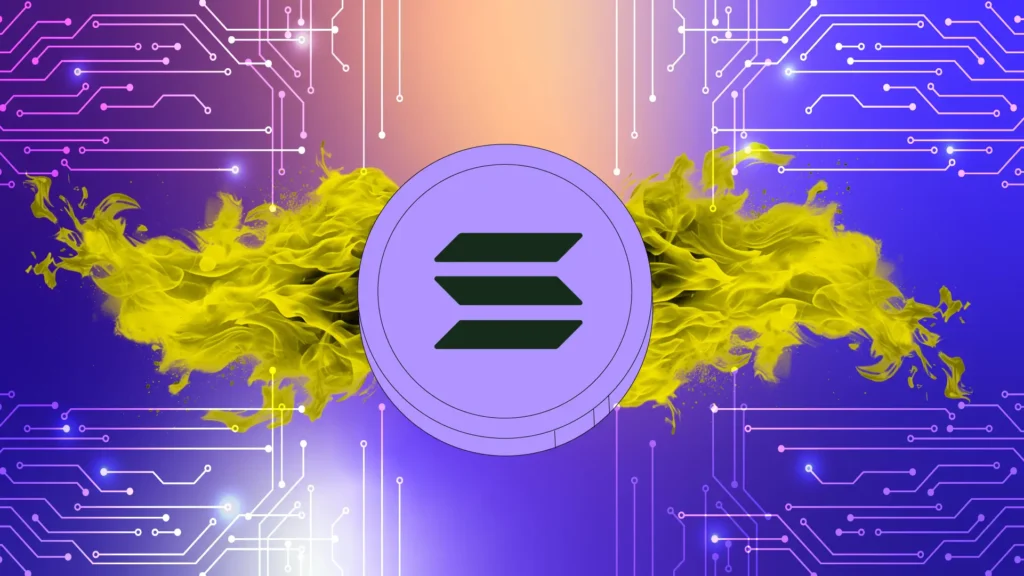
Firedancer, a new validator client built by Jump Crypto, could redefine Solana’s speed, scalability, and reliability. | Credit: Derek Fenech/CCN.com
Share
Key Takeaways
Solana’s architecture was built for speed, offering ultra-fast transactions and low latency.
Built by Jump Crypto entirely from scratch in C++, Firedancer re-implements Solana’s rules, consensus, and execution engine.
Designed for multithreading and parallel processing, Firedancer better uses multi-core CPUs to eliminate bottlenecks.
Validators can choose between clients, and upgrades can roll out more safely and gradually.
When Solana first launched in March 2020, it captivated blockchain observers by promising high throughput and low latency. Its architecture was designed for speed, featuring proof-of-history (PoH), Tower BFT, and tight hardware-based optimizations.
But over time, Solana’s growth also exposed its constraints: software bottlenecks, occasional network outages, and the risk of systemic failures tied to limited validator-client diversity.
Enter Firedancer: a next-generation validator client built from scratch by Jump Crypto, intended to coexist alongside Solana’s existing clients. For Solana’s current users like developers, validators, institutions, and everyday participants, Firedancer could mark a turning point.
It doesn’t just represent incremental improvement, but a potential fundamental shift in performance, security, and resilience.
This article will explain what Solana’s current validator clients look like, what Firedancer is, how it works, and its promise. It will also explain why it matters for existing Solana users, the risks, trade-offs, and the path ahead.
Try Our Recommended Crypto Exchanges
Sponsored
Disclosure
We sometimes use affiliate links in our content, when clicking on those we might receive a commission at no extra cost to you. By using this website you agree to our terms and conditions and privacy policy.
Solana’s Current Validator Clients: Strengths and Limitations
To run a validator (i.e., help secure the network), you need client software, a program that processes transactions, proposes blocks, communicates with peers, and enforces protocol rules.
Multiple independent implementations coexist on many blockchains (like Ethereum), so a bug or weakness in one client doesn’t threaten the whole network.
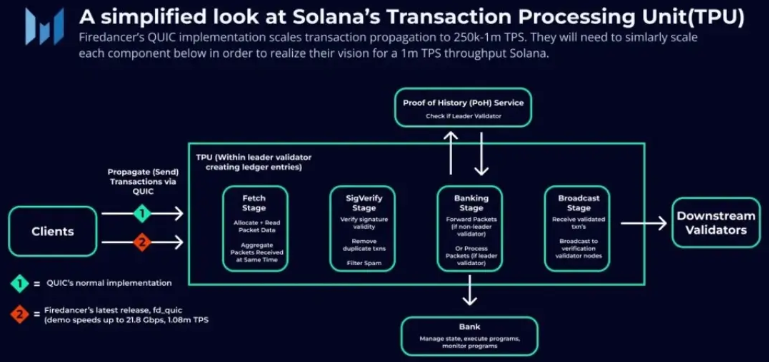
A simplified look at Solana’s Transaction Processing Unit (TPU). | Credit: Messari
Solana Labs client: The main reference implementation is written in Rust.
Jito and Jito-Solana: A fork (or variant) used by validators specializing in MEV or optimizations.
“Sig” client (Zig language): A newer, more minimal client targeting specific performance niches.
Because most validators run variants of the same codebase, the network is more vulnerable to client bugs, exploits, or breakdowns affecting many nodes simultaneously. In the past, Solana has experienced network slowdowns or partial outages under load or during unusual conditions.
The risk: a single software bug or misbehavior could ripple across many validators.
Moreover, the existing clients have limits. While Solana’s architecture is optimized for high throughput in many respects, real-world constraints, like memory, single-thread processing, network overheads, and block scheduling, mean that performance hits ceilings under heavy usage in practice. Validators struggle to keep up, latency rises, or blocks drop.
Thus, there’s a compelling need for client diversity, higher throughput, and more robust software architectures. That’s precisely the space Firedancer seeks to enter.
What Firedancer Is and How It Works
Firedancer is a new validator client (a complete implementation of Solana’s consensus and execution rules) built by Jump Crypto. It is designed to maximize performance, resilience, and diversity. It is largely independent, rewritten from scratch, with a different architecture and programming language.
What Firedancer is. | Credit: Jump Crypto
Key Features and Innovations
C++ or low-level optimizations: Firedancer is implemented in C++ or low-level systems code instead of Rust or Zig. This allows tighter control over memory, threads, and resource usage, squeezing latency and maximizing throughput.
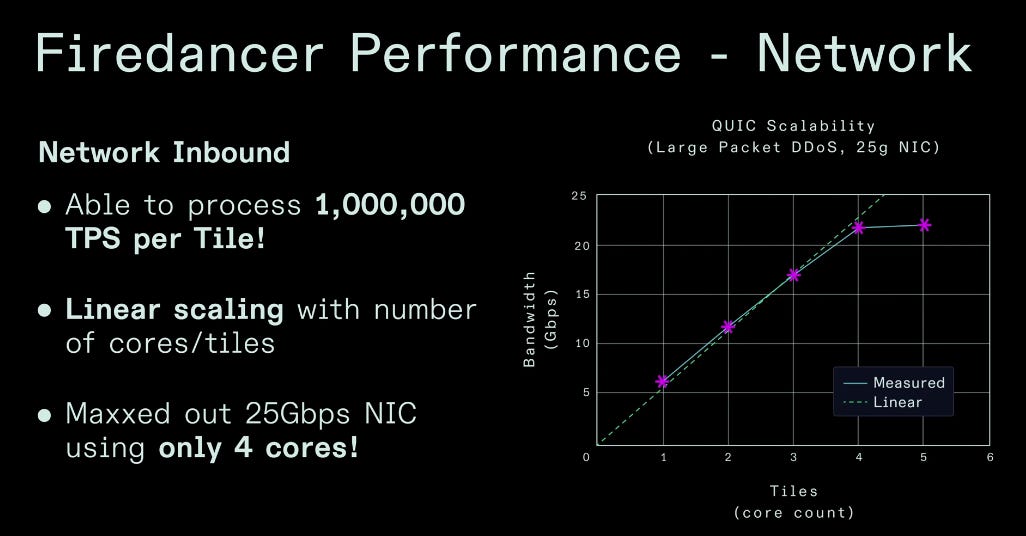
Parallelism and multithreading: Firedancer is built to leverage better multi-core CPUs, parallelizing work that current clients do more sequentially. Overlapping tasks (e.g., verification, networking, block building) can reduce bottlenecks caused by single-thread work queues.
Independent client architecture (client diversity): Because Firedancer is a separate codebase, validators running other clients are less likely to suffer if a bug or vulnerability affects one client. This isolates risk and strengthens the network’s resilience.
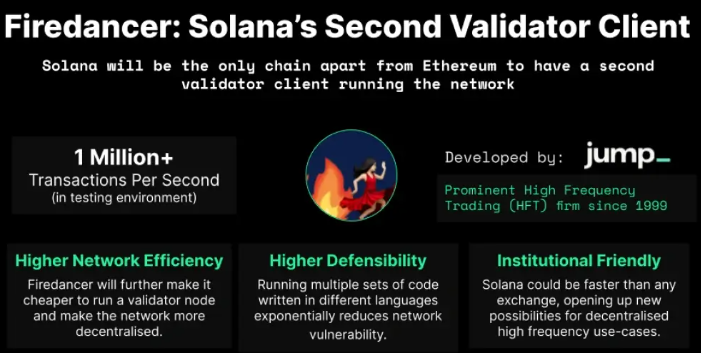
High throughput goals: In demonstrations and discussions, Firedancer has been associated with ambitious targets: over 1 million transactions per second (TPS) in ideal conditions. Whether this can hold in real mainnet conditions remains to be seen.
Integration path via “Frankendancer” testnets: Rather than launching all at once, Firedancer is being introduced gradually, via hybrid testnets (e.g,. “Frankendancer”) that mixes old and new client functionality , so validators can experiment and iron out compatibility issues.
Network upgrade coordination: To adopt Firedancer safely, the network consensus rules must be compatible across clients. Validators must coordinate upgrades, ensure consensus consistency, and maintain backward compatibility where needed.
How Firedancer Fits Into Solana’s Stack
When a transaction arrives:
A validator running Firedancer receives it and subjects it to local validation (signature checks, account debits, etc.).
Many such transactions are batched, ordered, and packaged into blocks by the validator’s consensus logic.
Firedancer handles peer communication, block propagation, and gossip protocols, ideally more efficiently than before.
Consensus proceeds (PoH + BFT rules), and validated blocks are appended to the chain.
In short, Firedancer replaces or augments the validator’s core processing, networking, and consensus modules. Its advantage is that it does so more efficiently, in parallel, and with fewer overheads.
Why Firedancer Upgrade Matters for Solana’s Current Clients & Users
Existing users often confront congestion, rising latency, and failed transactions during peak loads. If Firedancer delivers even a fraction of its target improvements, Solana could accommodate more activity without bottlenecks.
More DeFi transactions, NFTs, gaming, micropayments, and “listen-to-earn” flows become practical.
Transaction costs remain low even under heavy load.
The network can support more users and sophisticated applications without collapsing.
For developers and protocols, this means building more ambitious systems, such as high-frequency trading, real-time streaming, and metaverse layers, without fearing that Solana will choke.
Improved Fault Tolerance and Resilience
Because Firedancer adds client diversity, the network becomes more robust:
Bugs, exploits, or performance issues impacting one client are less likely to take down the entire network.
Validators can switch clients if one implementation misbehaves or fails.
Upgrades can happen more safely; one client can roll changes sooner, while others wait.
The chain becomes more fault-tolerant, with fewer single points of software failure.
Incentives for Validators and Stakers
Validators may gain competitive advantages if running Firedancer leads to better uptime, lower latency, or fewer dropped blocks. Stakeholders delegating to those validators could benefit indirectly via improved reliability.
Institutional users like custodians, exchanges, and staking services will appreciate the reduced risk of network downtime, improving confidence in building financial-grade services on Solana.
Safety through redundancy and isolation of faults.
If Solana can more reliably promise those, it becomes more viable for real-world infrastructure (payments, trading, settlement) beyond pure crypto-native use.
The Transition and Coexistence
But existing clients and users won’t be discarded. During the period of adoption:
Clients must remain compatible as validators running different clients must reach consensus in unison.
Performance and interoperability must be smooth enough to avoid fragmentation or divergence.
Some validators may remain on existing clients for stability or familiarity until Firedancer proves itself.
Therefore, the upgrade is additive, not substitutional, at least initially.
Risks, Trade-offs and the Path Ahead
While Firedancer holds promise, it’s not a silver bullet. Solana’s current users should be aware of the challenges and uncertainties ahead.
Technical Risks and Compatibility
Consensus consistency: Ensuring that different clients interpret protocol rules identically is tricky. Even minor discrepancies can lead to forks or consensus failures.
Bugs and regressions: A brand-new client could introduce new vulnerabilities.
Validator hardware demands: Firedancer may demand more memory, I/O, or compute resources, raising the barrier for smaller validators.
Network-level bottlenecks: Even if the client can handle high throughput, other elements, such as network latency, peer bandwidth, and disk I/O, may become the limiting factors.
Transition Complexity
Rolling out a new client across a live, production mainnet is complicated.
Validators must coordinate upgrades, configure settings, test, and maintain smooth continuity.
Gradual integration (via hybrid testnets, phased adoption) will be necessary to avoid disruptions.
Centralization and Cost Barriers
High resource requirements push smaller validators out or concentrate client adoption among well-funded nodes, potentially reducing decentralization.
Validators unwilling or unable to upgrade may lag, creating disparity in performance across the network.
Community and Trust
The community must trust that Firedancer behaves correctly and securely; any misstep early could erode confidence.
Open audits, bug bounties, and transparency will be critical.
The eventual shift to multi-client governance and client competition must be managed to avoid political or social centralization around a single client.
What Comes Next — Key Milestones to Watch
To track Firedancer’s progress and its impact on existing clients and the Solana ecosystem, keep an eye on:
Milestone
Why it matters for existing clients / users
Frankendancer testnet deployment
Allows validators to run hybrid old+new client setups and detect mismatches
Bug bounty or security audits
Confidence in the client’s safety before mainnet use
Phased mainnet rollout
Smooth, controlled adoption without network disruption
Validator adoption rate
How many validators switch or support Firedancer vs staying with legacy clients
For Solana’s existing users, such as validators, DeFi projects, stakers, and institutions, the arrival of Firedancer is more than just a new piece of software.
It’s a potential paradigm shift:
It can push performance beyond current limits, enabling more ambitious applications.
It strengthens the network by diversifying clients and improving resilience.
It offers an upgraded foundation for financial-grade applications and institutional adoption.
It challenges the current client-based vulnerabilities and motivates healthy competition in infrastructure development.
But the path forward is delicate. Success requires careful coordination, robust testing, validator confidence, and a commitment to open security. For those who have already bet on Solana, Firedancer gives hope that the network will scale further and can scale more safely and intelligently.
When Firedancer fully rolls out, it won’t just be Solana getting faster. It may finally unlock the version of Solana many have long envisioned: robust enough for mass adoption, reliable for institutions, and resilient enough for the long haul.
Firedancer is a new validator client for the Solana blockchain, developed by Jump Crypto. It’s a complete re-implementation of Solana’s validator software, built from scratch in C++ to deliver faster transaction processing, better scalability, and greater network resilience.
Why does Solana need another validator client?
Currently, most Solana validators rely on the Solana Labs client, meaning a single bug or crash could impact a large portion of the network. Firedancer introduces client diversity, reducing the risk of network-wide failures while improving performance.
What is Jump Crypto?
Jump Crypto is a division of Jump Trading, a global quantitative trading firm known for high-frequency systems engineering. They are contributing Firedancer to their investment in building high-performance Web3 infrastructure. Their expertise in ultra-low latency systems makes them well-suited for this role.
How will Firedancer improve Solana’s decentralization?
Client diversity is a key pillar of decentralization. Solana reduces systemic risk by having multiple independent validator clients, similar to Ethereum’s multi-client model (Geth, Prysm, Lighthouse, etc.). Firedancer ensures that no single software implementation can bring down the entire network.
Giuseppe Ciccomascolo began his career as an investigative journalist in Italy, where he contributed to both local and national newspapers, focusing on various financial sectors.
Upon relocating to London, he worked as an analyst for Fitch's CapitalStructure and later as a Senior Reporter for Alliance News. In 2017, Giuseppe transitioned to covering cryptocurrency-related news, producing documentaries and articles on Bitcoin and other emerging digital currencies. He also played a pivotal role in establishing the academy for a cryptocurrency exchange website. Crypto remained his primary area of interest throughout his tenure as a writer for ThirdFloor.


 Easy
Easy